Pala Dynasty: Bengal’s “Elected” King and the Politics of Who Gets a Voice
The authority was dangerous, the realm fractured, and the men competing for power had pushed Bengal toward collapse. This was not 2026, but around 750 CE, when a man with no great inheritance was chosen to restore order. His name was Gopala, and his accession became the foundation of a dynasty that would transform the region into a major center of power, learning, art, and Buddhist culture.
Also Read: Bengal Sketches [1],[2],[3],[4],[5],[6],[7],[8],[9],[10],[11],[12],[13],[14],[15]
By the mid-eighth century, Bengal had endured decades of political fragmentation after Shashanka’s kingdom declined. Later Pala records called this disorder Matsyanyaya, the “law of the fishes,” in which the powerful prey upon the weak. Though not a precise chronology, the phrase preserves a memory of prolonged instability. It was in this troubled landscape that Gopala rose to power.
The Monghyr copper plate from mid-ninth century presents Gopala as a powerful and legitimate sovereign who brought order to a politically fragmented Bengal. It praises him as an ideal ruler whose righteous reign made even the legendary kings of ancient India seem credible.
Extraordinarily little is known with certainty about his early life. Later accounts and Pala inscriptions associate his family with Varendra, in northern Bengal. His grandfather Dayitavishnu is described as learned, while his father Vapyata is remembered as a warrior. Nothing suggests that Gopala inherited a great imperial throne. His family’s origins appear comparatively modest, although later traditions attempted to give the dynasty a more exalted pedigree.
Also Read: Bengal Sketches [16],[17],[18],[19],[20],[21],[22],[23],[24],[25],[26],[27],[28],[29],[30]
Gopala’s accession is remarkable. Dharmapala’s Khalimpur copper plate says the prakriti, the kingdoms leading political powers made Gopala “take the hand of Lakshmi,” goddess of sovereignty and fortune, to end Matsyanyaya. This inspired the claim that he was “elected,” though not by popular vote: Bengal’s landowners and elites, threatened by endless rivalry, agreed he could restore order. Leadership through political consensus was rare in early medieval India. Driven as much by exhaustion with conflict and corruption as by admiration for him, his selection began a new political order.

Centuries later, the Tibetan Buddhist historian Taranatha (1575-1634 CE) told a dramatic tale: Bengal’s chosen kings were killed on their first night by a Naga woman or demoness, making the throne a death sentence. Gopala accepted it, slew the creature with a weapon linked to the Buddhist goddess Chunda, and survived. This later legend shows how Buddhists remember him, as the ruler who broke a cycle of chaos. The historical Gopala needs no demoness to be remarkable.
The Monghyr copper plate from mid-ninth century presents Gopala as a powerful and legitimate sovereign who brought order to a politically fragmented Bengal. It praises him as an ideal ruler whose righteous reign made even the legendary kings of ancient India seem credible.
The inscription poetically claims that he conquered the land to the ocean, suggesting extensive military consolidation, though such royal claims should be read with some caution. His campaigns eventually gave way to peace, symbolized by the release of his war elephants into the forests. Most importantly, the charter establishes Gopala as the founder of a legitimate royal lineage, from which his successors inherited and expanded the Pala realm.
Gopala’s chief achievement was consolidating power, though his kingdom’s exact extent is uncertain. Centered on Bengal, especially Varendra and Gauda, Pala authority moved among military and administrative centers rather than a fixed capital, with Gauda and, later, key sites in Bihar serving as important seats of power. Gopala founded a dynasty that dominated eastern India for generations. His son Dharmapala made the Palas a major imperial power, and his grandson Devapala expanded their influence; at its height, their realm covered much of Bengal and Bihar and reached well beyond them.

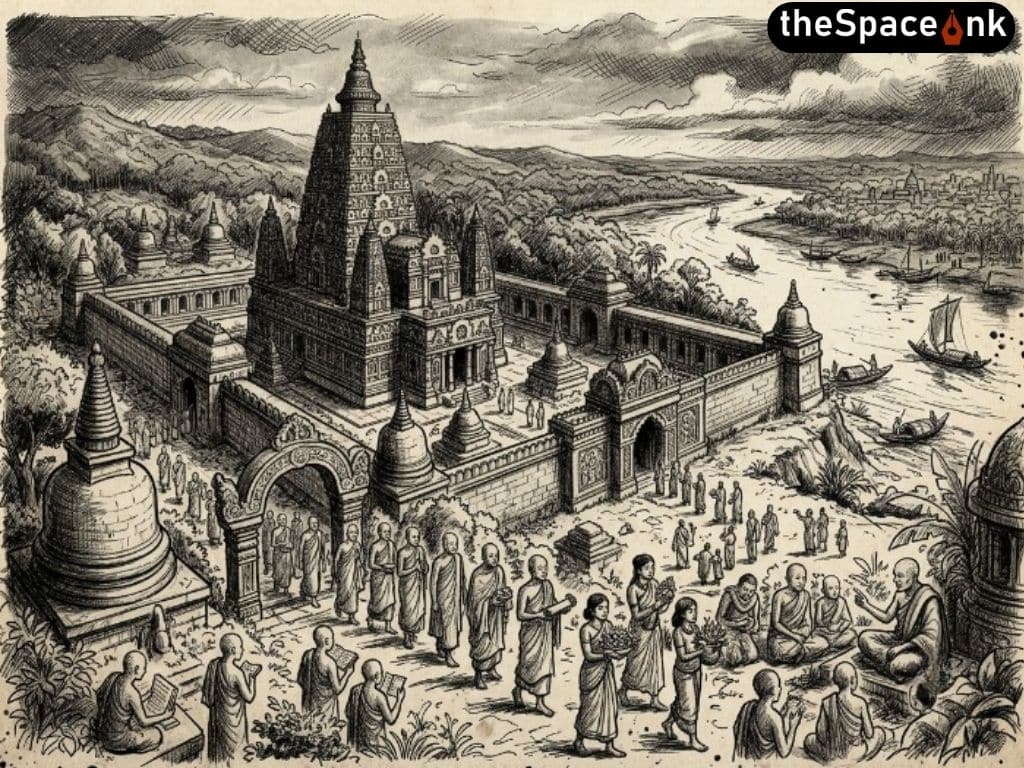
The Palas’ legacy extended beyond territory: they fostered one of medieval South Asia’s great Buddhist cultural worlds. Their patronage sustained Nalanda, established Vikramashila as a leading Buddhist center, and produced Somapura in present-day Bangladesh, a defining monument of Pala architecture and religion. From these institutions, ideas traveled.
Monks journeyed between eastern India, Tibet, Nepal, and other parts of Asia. Manuscripts crossed mountains and borders. Philosophical traditions developed and were transmitted. Sculptors created images in stone and bronze whose distinctive artistic language would influence Buddhist art far beyond Bengal and Bihar.

Yet the period should not be romanticized. The Pala realm was not a peaceful Buddhist kingdom untouched by war. Its rulers fought rival powers, competed for territory, and took full part in the political struggles of early medieval India. Their support for Buddhism coexisted with other religious traditions, while armies, land grants, taxation, political alliances, and the labor of countless people, most of whose names never entered the historical record, sustained the empire.
Gopala laid its foundation. From it rose the Pala Empire that lasted four centuries, whose armies shaped eastern India, whose monasteries illuminated the Buddhist world, and whose art traveled far beyond the borders of their realm.
The empire and its throne are gone, but Bengal’s ancient choice still echoes. Around 750 CE, a few powerful men raised Gopala from chaos; today, millions enter the polling booth to decide who will govern. The meaning of an “election” has transformed, yet the question endures: who gets a voice when Bengal chooses its future in 2026 and beyond?
Images: Wikipedia, Britannica, AI

Dr. Jamil is a passionate oncology commercial leader whose two-decade journey has been driven by a deep commitment to improving the lives of people with cancer. As Head of the Early Commercial Team at Merck Oncology and an Adjunct Professor at Columbia Business School, he shapes innovative pipelines while mentoring and inspiring future healthcare leaders. Beyond work, he is a soulful armchair historian of Bengal, a devoted Manchester City fan, and someone whose heart is forever tied to the culture, stories, and spirit of Kolkata.