
Where Faiths Meet: Sufism and the Soul of Bengal
I grew up in a Sufi family in Calcutta, where faith drifted through daily life like incense: rosewater at milads, dusk gathering at the windows, elders talking over tea, visitors at the door, children wandering into prayer. I learned that the sacred needed neither silence nor ceremony; it lived in ordinary moments and in the way we beheld one another. Sufism came to me not through sermons, but through stories that turned my gaze inward.
Also Read: Bengal Sketches [1],[2],[3],[4],[5],[6],[7],[8],[9],[10],[11],[12],[13],[14],[15],[16]
A Stranger Who Became Part of the House
Sufism reached Bengal before the Turkish conquest, through Muslim merchants, travelers, and religious figures. By the eleventh and twelfth centuries, traditions surrounding Muslim saints had taken root across the region. Bengal’s sacred memory preserves Shah Sultan Rumi, linked to eleventh-century Mymensingh, and Baba Adam Shahid, associated with the Dhaka region.

Saints soon became woven into Bengal’s geography. Shah Jalal became inseparable from Sylhet and is now memorialized at Dhaka airport. His life lies between history, memory, and hagiography: tradition places his arrival in the early fourteenth century, though accounts differ. More important than the dates is what followed: the saints entered a land already rich in culture and faith. The Moroccan traveler Ibn Battuta journeyed to Sylhet in 1346 to meet Shah Jalal, whom he described as an ascetic of remarkable spiritual discipline.
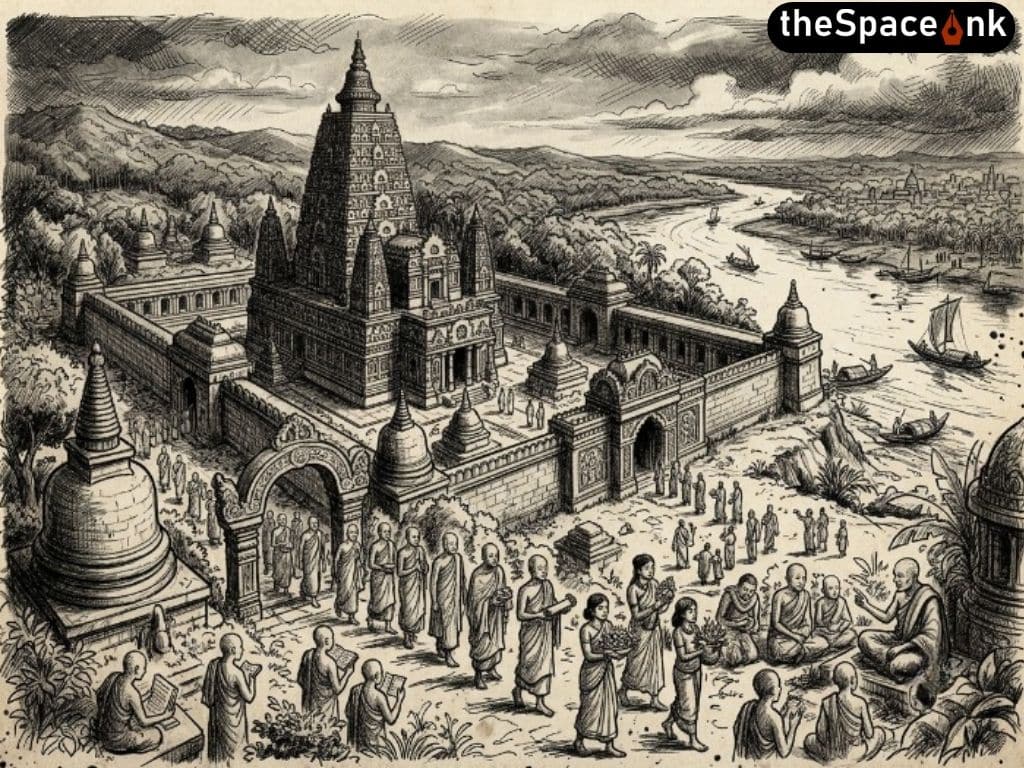
Bengal was already ancient, layered, and spiritually diverse. Buddhism had flourished under the Palas; Hindu, Tantric, and folk traditions ran deep; and Vaishnavism would later spread with great emotional force. Sufism entered this rich world and began a dialogue with it.

One Stone, Many Civilizations
A modest artifact captures this encounter more powerfully than any monument. In Shian, a village in Birbhum near my ancestral home, a stone linked to an early Sufi lodge bears an inscription traditionally dated to the early thirteenth century, among Bengal’s earliest known Muslim inscriptions. On its reverse is an older Sanskrit inscription from the Pala period associated with a Hindu military figure.
Also Read: Bengal Sketches [17],[18],[19],[20],[21],[22],[23],[24],[25],[26],[27],[28],[29],[30],[31],[32]
One stone, several centuries, many faiths: an image distinctly Bengali. The past was not erased but reused, as one age built upon another and gave old objects new meaning. A Buddhist past, a Hindu inscription, a Muslim khanqah. The stone reflects a lasting truth about Bengal: cultures do not always meet at walls; sometimes they gather quietly in courtyards.
Where Tigers Bowed to Saints
Nowhere is this more haunting than in the Sundarbans, where nature itself inspires a distinctive faith. Hindus and Muslims share stories of Bonbibi, protector of the forest; Dokkhin Rai, lord of the wilderness; and Gazi Pir, the twelfth- or thirteenth-century Muslim saint who masters wild animals and tigers.


Gazi Pir entered Bengal’s popular imagination, and the nineteenth-century Gazi Scroll is now held by the British Museum. Tradition also links him to Rani Rashmoni, who built a shrine beneath a peepal tree after he appeared in her dream, and to another shrine at Dakshineswar temple. Whatever their historical accuracy, these stories reveal a shared sacred geography in which a Muslim pir could inhabit a landscape of Hindu deities. Bengal made room for both worlds.

The Age of the Saints
Between the thirteenth and sixteenth centuries, Sufi establishments spread across Bengal. Suhrawardis. Chishtis. Later, Naqshbandis and Qadiris. Each brought its own discipline, spiritual vocabulary, and understanding of the path.
Pandua in Malda became one of the great centers of Bengal’s Sufi culture. Shaikh Jalaluddin Tabrizi, associated with the Suhrawardi tradition, became one of its most celebrated figures. Much of his biography comes through later Persian and hagiographical traditions, and historians must therefore separate memory from verifiable fact. Yet his influence is written into the landscape. His shrine complex at Pandua included religious spaces, a mosque, a kitchen, and the Salami Darwazah.

The very existence of such a complex tells us that Sufism was not merely an individual pursuit of mystical experience. It had institutions. It fed people. It sheltered travelers. It created communities.
The Chishtis followed. Shaikh Akhi Siraj, who died in 1357, was remembered as Aina-i-Hindustan, the “Mirror of India.” His disciple Nur Qutb Alam became another major spiritual figure, and his tomb at Pandua remains a landmark of Bengal’s medieval heritage.
Later came other orders and other interpretations. Some Sufis embraced the ecstatic songs and practices of Bengal’s popular religious culture. Others regarded such practices with suspicion. The Naqshbandis, for example, were more inclined toward disciplined adherence to established Islamic practice.
This tension is important. The history of Sufism in Bengal was never one seamless story of harmony. There were disagreements. There were reformers. There were orthodox critics. There were popular practices that formal religious authorities challenged. But beneath these tensions was an extraordinary cultural encounter.
Eight hundred years have passed since the earliest Sufi mystics began leaving their traces across this extraordinary delta. Their names have faded in places. Their shrines and ashtanas have weathered. Their songs have changed. Some legends have grown larger than history, while history itself has become difficult to separate from legend.
When Mysticism Found a Voice
Music is the clearest expression of this encounter. Sufism found a Bengali voice in Murshidi and Marfati songs, Gazir gan, Fakir music, naat, and the poetry of Sayid Sultan, Shah Barid Khan, and Alaol.
The Bauls carried this inward vision further: the Beloved is not distant but found within the body, breath, and heart, where lover and Beloved meet. Here Bengal’s Sufi inheritance merges with a broader mystical culture, as Islamic, Hindu, Buddhist, and Tantric ideas and practices cross boundaries.
The result was not a single religion. It was something more elusive: a shared spiritual vocabulary.
Saints and the Making of the Delta
Sufism’s story in Bengal was also one of land. Much of the medieval delta was forest, marsh, and wetland, gradually transformed by agricultural expansion. Sufi settlements, khanqahs, and shrines sometimes helped communities form through cultivation, exchange, food, shelter, and spiritual guidance.
Yet Sufis did not “develop” Bengal alone; peasants, indigenous communities, elites, rulers, administrators, and religious institutions all shaped this transformation. Sufi influence rested less on conquest than on service, reputation, and presence.
The Bengal That Remained
Today, Sufi shrines still punctuate the landscape of West Bengal and Bangladesh: in Bagerhat, Bogra, Chittagong, Dhaka, Furfura Sharif, Gaur, Kolkata, Malda, Mangalkot, Midnapur, Pandua, Patharchapuri, Rajshahi, Sylhet, and countless smaller villages and towns.
Some are magnificent. Some are humble. Some are little more than a grave beneath an ancient tree. But each is a doorway into memory.
For me, that memory is personal: shinni in a dargah where the world recedes, Bangla qawwali felt beneath the ribs, or a Baul song that knows me.
Bengal’s Sufi inheritance never stays frozen; like its rivers, it changes language, music, and form while preserving the same longing. Bengal’s Sufi inheritance endures because the region has always been a meeting place of rivers, languages, empires, faiths, and memories. At their best, these encounters allow people to meet without asking one another to surrender who they are.
Eight hundred years have passed since the earliest Sufi mystics began leaving their traces across this extraordinary delta. Their names have faded in places. Their shrines and ashtanas have weathered. Their songs have changed. Some legends have grown larger than history, while history itself has become difficult to separate from legend.
Yet something remains: a fragrance, a song over water, a prayer beneath a tree, a hand across an old boundary. Beneath Bengal’s bells, azan, drums, dhaak, and restless voices runs a quieter music, the song beneath the song. The Sufis taught that the Beloved waits not at journey’s end, but within the journey itself.
Images: Wikipedia, Wikipedia, Wikipedia, Sundarban Tiger Reserve, Gettyimages

Dr. Jamil is a passionate oncology commercial leader whose two-decade journey has been driven by a deep commitment to improving the lives of people with cancer. As Head of the Early Commercial Team at Merck Oncology and an Adjunct Professor at Columbia Business School, he shapes innovative pipelines while mentoring and inspiring future healthcare leaders. Beyond work, he is a soulful armchair historian of Bengal, a devoted Manchester City fan, and someone whose heart is forever tied to the culture, stories, and spirit of Kolkata.