
How One Man Turned a Medieval Mess into Brand Bengal
Long before Bengal had a name, it had a presence. The Aitareya Aranyaka, a late Vedic text from the eighth or seventh century BCE, records the Vangas alongside the Magadhas. To the authors of the late Vedic world, the east was far from the center, but its people had already entered memory. Centuries later, the Mahabharata would list Vanga among the kingdoms of eastern India, grouped with Anga, Pundra, Suhma and Kalinga. It was remembered as one of the many realms drawn into the epic struggle of Kurukshetra. Bengal existed, but only as one piece of a larger mosaic.

The Nesari copper plates of the Rashtrakuta emperor Govinda III (c. 805 CE) contain one of the earliest known references to both Gauda and Vanga. They describe the Pala ruler Dharmapala as Vangala Bhumipat, or “King of Vangala,” marking an early linguistic shift from the older name Vanga.
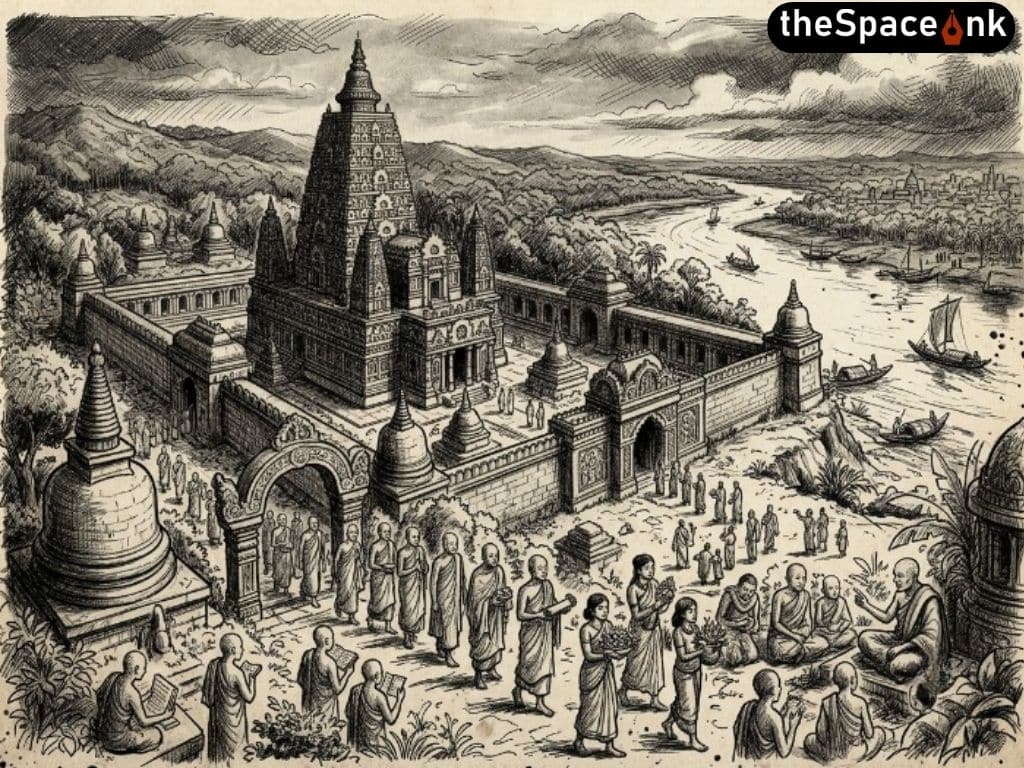
The inscription also notes that Govinda III seized the banner of the goddess Tara from the Pala army, a rare detail that points to the Buddhist character of the Pala state. No other known Rashtrakuta inscriptions use the term Vangala, though it appears later in records such as the Chola Tirumalai inscription (1021–24 CE), where Vangaladesa refers to eastern Bengal under the Chandra rulers.

Despite being called Vangala by external powers, the Pala dynasty referred to its kingdom as Gauda (Gaudadesa), the prestigious classical name for northern and western Bengal. Pala inscriptions, including the Khalimpur copper plate of Dharmapala, emphasize Gauda as the core of the kingdom and refer to administrative regions (bhuktis) such as Pundravardhana, Vardhamana, Danda, Srinagara and Tira.
The Palas used Sanskrit and Pali as languages of administration and scholarship, while the population spoke an eastern Indo-Aryan vernacular, Gaudiya Apabhraṃśa, the ancestor of modern Bengali. While the Palas preferred titles such as Gaudesvara (“Lord of Gauda”) to emphasize their connection to the prestigious northern heartland, outsiders sometimes used Vanga as a broader geographical and political designation.

The succeeding Sena dynasty also lacked a single imperial name for its realm. Instead, inscriptions such as Vijayasena’s Deopara Prashasti (c. 1153 CE) defined the kingdom through the classical regions of Vanga, Gauda, Radha, and Varendra. Like the Palas, the Senas used Sanskrit for the court, administration, and literature, while Gaudiya Apabhraṃśa continued to develop under their rule.
Also Read: Bengal Sketches [1],[2],[3],[4],[5],[6],[7]
Fourteenth-century Bengal had three rival capitals and one chronic problem: each thought it was the only one that mattered. Lakhnauti (originally Lakshmanvati founded by King Lakshman Sena) held the north, Satgaon the south, and Sonargaon the east. They competed relentlessly for power and prestige, like roommates who kept labeling their food and arguing over whose name was on the lease.
Ilyas Shah was more than a Sultan. He was Bengal’s first famous brand architect. He took a medieval mess and turned it into Brand Bengal. Had social media existed in the 1350s, his profile might have read: Founder of the Bengal Sultanate. Unifier of Provinces. Creator of Bangala. Enjoyer of Monsoons.
Between 1342 and 1358, Shamsuddin Ilyas Shah of Central Asian descent did what countless rulers before him had failed to accomplish. Through diplomacy, warfare, and a healthy disregard for anyone standing in his way, he brought the rival provinces under a single authority. By 1352, Bengal was politically united for the first time under an independent sovereign. But conquest was only half the achievement. The truly lasting innovation was conceptual.
Also Read: Bengal Sketches [8],[9],[10],[11],[12],[13],[14]
Ancient texts had spoken of Vanga, Gauda, Radha, Samatata, Varendra, and countless other regional identities. Ilyas Shah reached for something bigger. Instead of ruling merely one part of the land, he proclaimed himself Shah-i-Bangala or King of Bengal in that moment, a collection of regions became a country-sized idea. The kingdom became Bangala. The people became Bangalis. Just like that, the region once nicknamed Bulgakpur or Land of Strife by Delhi Sultans got a much nicer makeover and became Bangala.

A shared political and cultural identity began to emerge where competing local identities had long prevailed. It was one of the most successful rebranding campaigns in South Asian history. Same place, far better vibes. The contemporary chronicler Shams-i Siraj Afif recognized the significance immediately, referring to Ilyas Shah as the Sultan of the Bangalis. The terminology stuck.

After that, the name Bangalah spread like a catchy tune. The Mughals upgraded it to Subah i Bangalah. Portuguese traders pronounced it Bengala. Then the British showed up, adjusted the accent, and settled on Bengal, because of course they did.
So, in the end, Ilyas Shah was more than a Sultan. He was Bengal’s first famous brand architect. He took a medieval mess and turned it into Brand Bengal. Had social media existed in the 1350s, his profile might have read: Founder of the Bengal Sultanate. Unifier of Provinces. Creator of Bangala. Enjoyer of Monsoons.
Images: Wikipedia, Banglapedia,Indian Manuscripts, Craiyon

Dr. Jamil is a passionate oncology commercial leader whose two-decade journey has been driven by a deep commitment to improving the lives of people with cancer. As Head of the Early Commercial Team at Merck Oncology and an Adjunct Professor at Columbia Business School, he shapes innovative pipelines while mentoring and inspiring future healthcare leaders. Beyond work, he is a soulful armchair historian of Bengal, a devoted Manchester City fan, and someone whose heart is forever tied to the culture, stories, and spirit of Kolkata.