

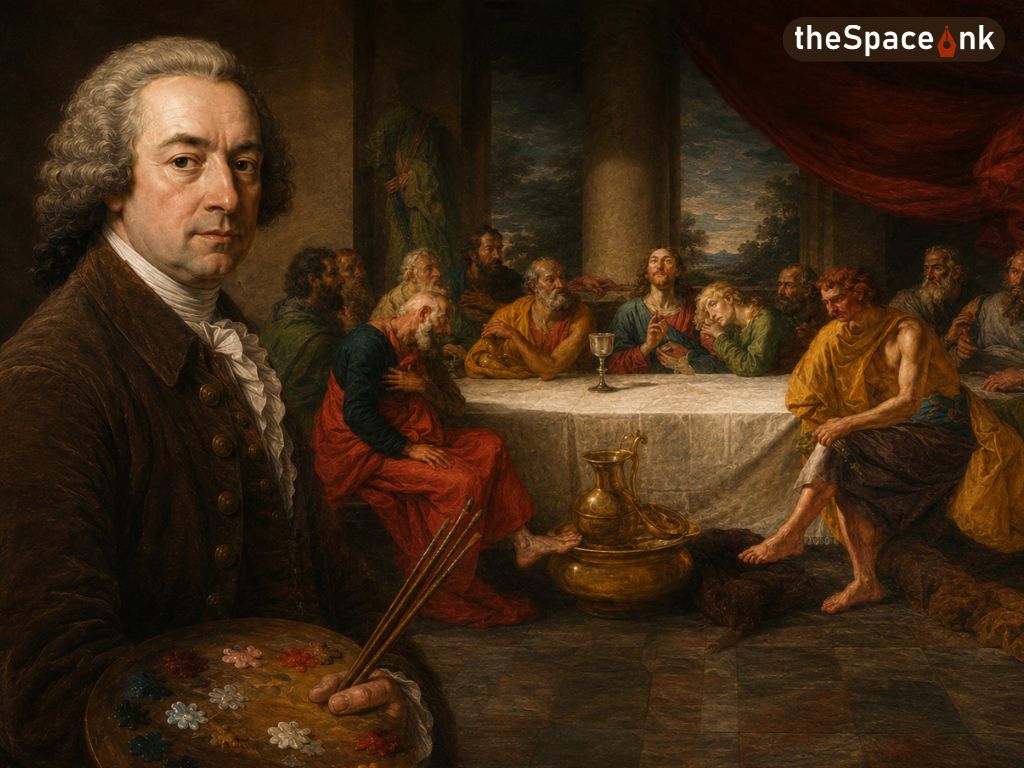
Johann Zoffany: The Last Supper in Kolkata
On a recent return to my beloved Kolkata, I set out at dawn with three childhood friends to lose ourselves in the city’s older quarters. The streets were just beginning to stir as shutters lifted like reluctant eyelids, tea stalls breathed out their first fragrant steam, and stray dogs rearranged themselves with aristocratic boredom. Each lane loosened another memory, another rumor, another buried shard of history. The walk was already a delight, but its true revelation waited inside the hushed sanctuary of St. John’s Church, where I found a painting that wore the solemn face of a religious masterpiece and concealed the private pulse of a scandal sheet.

The story begins with Johann Zoffany, who arrived in Calcutta in September 1783 aboard the East India Company ship Lord Macartney. He was fifty, financially strained, and hoping India would be more forgiving than London about such inconveniences as a troubled marriage, heavy debt, and a gift for offending the wrong people. Fortunately for him, fame travelled well. Zoffany was already a founding member of the Royal Academy, a celebrated portraitist of King George III, and one of the finest painters of social theatre in Georgian Britain.

Zoffany’s genius had always been this ability to turn portraiture into human theatre. In Britain, he had won royal favor by painting George III and Queen Charlotte not as remote ceremonial figures, but as people gathered in relaxed domestic settings. His Royal Academy reads like an eighteenth-century group photograph, full of artists debating, drawing, and appraising one another. His theatrical portraits of David Garrick did something similar for the stage, capturing not just likeness but performance, charisma, and public image.

But Zoffany also had a talent for misjudging patrons. His vast The Tribuna of the Uffizi, commissioned by George III, disappointed the king because it became as much a portrait of collectors, connoisseurs, tourists, and art dealers as of the royal collection itself. The cooling of royal favor helped push him eastward. India promised money, freedom, and a social world capacious enough to reward brilliance and overlook inconvenience, provided the paintings were good and the bills were paid.

Wealthy with Company money and colonial self-importance, Calcutta was ready for him. It greeted Zoffany as colonial elites often greet celebrity: with commissions. British India offered artists a profitable bargain: flatter its officials, merchants, soldiers, and nabobs, and be paid well to preserve their importance in oil. Zoffany moved quickly. Governor-General Warren Hastings’s patronage opened the doors of the colonial establishment, and within months he became one of British India’s busiest painters. His portraits did more than capture faces; they staged an entire world of European manners, Indian landscapes, domestic rituals, servants, furniture, textiles, letters, hookahs, and humid light.

One of his most enchanting Indian works presents an ordinary afternoon beneath the shade of a jackfruit tree. British families linger over tea while Indian attendants refill hookahs, pour cups, and deliver letters. The scene might appear gentle, even leisurely, yet it records a whole colonial order in miniature: who sits, who serves, who speaks, who waits. Zoffany’s eye was alert to these arrangements. He could make domestic life look effortless while quietly preserving the codes of power beneath it.
Also Read: Bengal Sketches [1],[2],[3],[4],[5],[6],[7],[8],[9],[10],[11]
He later travelled upriver to Lucknow and the court of the Nawab of Awadh, where pageantry grew grander. Hunting scenes, elephant fights, cockfights, and courtly gatherings became his subjects, with Zoffany moving among them as painter, witness, and opinionated guest with brushes. Reports claim he earned extraordinary sums, sometimes up to 10,000 rupees per portrait.
His celebrated Colonel Mordaunt’s Cock Fight, set at the court of the Nawab, crowds aristocrats, soldiers, courtiers, merchants, and onlookers around an extravagant contest. Europeans and Indians stand shoulder to shoulder, each face rendered with striking individuality. Today, these canvases remain invaluable records of late eighteenth-century India, preserving dress, etiquette, leisure, hierarchy, and the uneasy intimacy of colonial society.

By 1786, however, he had returned to Calcutta and found a new stage: the recently completed St. John’s Church. Wishing, at least officially, to leave a humble gift, he offered the church a monumental 10-by-12-foot painting of The Last Supper, free of charge. It sounded generous, even devotional. The church accepted. What it had approved, history would soon reveal, was a baroque-era personality test with religious lighting.
Also Read: Bengal Sketches [12],[13],[14],[15],[16],[17],[18],[19],[20],[21]
On April 9, 1787, just in time for Easter, Calcutta’s elite gathered for the unveiling. One imagines the polite anticipation: sacred subject, famous artist, respectable church, perhaps some mild admiration before lunch. Then the curtain dropped. Zoffany had not simply painted Christ and the apostles. He had painted Calcutta society into one of Christianity’s holiest scenes, placing recognizable local faces around the table with the audacity of someone who understood both art history and gossip.

Jesus was modeled on Father Parthenio, a well-known Greek Orthodox priest. That choice was striking enough, but the apostles carried the real charge. Saint John was modeled after W. C. Blaquiere, a city magistrate remembered for surveillance, severity, and the general air of a man who could make innocence feel procedurally complicated. Then came Judas. For this role, Zoffany chose a local merchant named Tulloh, with whom he had recently had what lawyers might call a disagreement and everyone else might call a financial feud with feelings.
In 1789, Zoffany left India for England, taking his fortune and reputation with him. Behind him in St. John’s remained a work that functioned equally well as masterpiece, satire, devotional image, and long-form revenge note. Over the next two centuries, the painting endured the usual tropical curriculum: heat, humidity, leaks, termites, neglect, and architectural optimism.
Tulloh appears clutching a bag of silver and staring outward, as if prepared to betray the viewer next. Subtle it was not. It certainly was effective. Calcutta, unsurprisingly, did not remain calm. Gossip spread faster than monsoon damp. Tulloh, deeply unhappy at finding himself cast as the most notorious traitor in Christian history, allegedly pursued a defamation suit. Zoffany seems to have met the uproar with the composure of an artist who had already calculated the distance to the nearest ship.

What makes the painting so fascinating is not merely the joke, or even the insult, but the compression of worlds within it. A European sacred subject is transplanted into colonial Calcutta; Biblical figures acquire local bodies; private grudges are laundered through religious symbolism; and a church painting becomes a social mirror. Zoffany understood that portraiture could flatter, but he also knew it could expose. Around that table sit empire, vanity, devotion, resentment, ambition, and the dangerous pleasure of being recognized.
In 2010, restoration efforts led by the Indian National Trust for Art and Cultural Heritage, with support from the Goethe-Institut, brought it back from the brink. The intervention was less resurrection than highly skilled emergency care for an extremely dramatic patient.
In 1789, Zoffany left India for England, taking his fortune and reputation with him. Behind him in St. John’s remained a work that functioned equally well as masterpiece, satire, devotional image, and long-form revenge note. Over the next two centuries, the painting endured the usual tropical curriculum: heat, humidity, leaks, termites, neglect, and architectural optimism. By the twentieth century, it had become less Last Supper than last few fibers hanging on.
In 2010, restoration efforts led by the Indian National Trust for Art and Cultural Heritage, with support from the Goethe-Institut, brought it back from the brink. The intervention was less resurrection than highly skilled emergency care for an extremely dramatic patient. Today the painting still hangs in St. John’s Church, serene and dignified, declining to admit that it once triggered a colony-wide social meltdown.
Most visitors, me included, could pass beneath it unaware they were looking at a 240-year-old dinner party of offended guests, legal fury, and an artist already plotting his exit. That is Kolkata’s genius: it hides its stories in corners, dust, church doors, and paintings that seem calm until someone tells you where to look. Leaving St. John’s, I felt not only the scandal in the paint but the intimacy of meeting my city anew – old, beautiful, decaying, nostalgic, and still mischievously alive. I began the morning expecting a familiar walk; I left reminded that Kolkata can still ambush me with history, wit, and a perfectly placed betrayal.
Images: Wikipedia, Wikimedia Commons, Wikimedia Commons, Wikimedia Commons, Wikimedia Commons, Wikimedia Commons, AI

Dr. Jamil is a passionate oncology commercial leader whose two-decade journey has been driven by a deep commitment to improving the lives of people with cancer. As Head of the Early Commercial Team at Merck Oncology and an Adjunct Professor at Columbia Business School, he shapes innovative pipelines while mentoring and inspiring future healthcare leaders. Beyond work, he is a soulful armchair historian of Bengal, a devoted Manchester City fan, and someone whose heart is forever tied to the culture, stories, and spirit of Kolkata.



One Response
What a beautiful writeup.
Thank you for sharing a piece of history that I never knew about.