Faith Under Fire: The Battle for Dharma
Imagine waking to a world where every authority seemed united against the inheritance you revered: the colonial state, foreign critics, and even Western-educated reformers within your own community. For the orthodox Hindu elite of early nineteenth-century Bengal, this was not an abstraction but an urgent historical crisis. Before traditional society could absorb the shock of British imperial rule, its religious and social foundations were pressed from three directions at once: by Christian missionaries, by colonial officials claiming the mantle of moral reform, and by Western-educated Indian reformers who sought to remake Hinduism from within.
Also Read: Bengal Sketches [1],[2],[3],[4],[5],[6],[7],[8],[9],[10],[11],[12],[13]
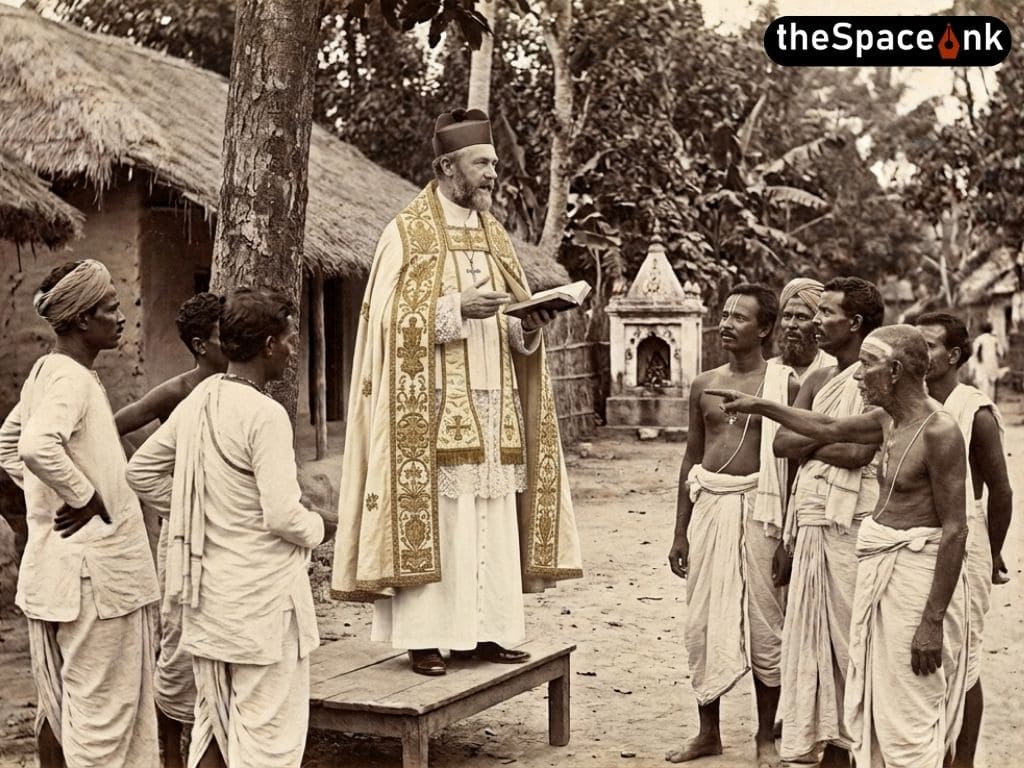
Christian missionaries in Bengal framed Hindu society as morally and spiritually fallen, attacking idol worship, caste hierarchy, child marriage, temple rituals, pilgrimage, astrology, and Brahmin authority. Through tracts, sermons, and public debates, they presented indigenous customs not as legitimate faith practices, but as errors in urgent need of Christian enlightenment.

At the same time, the British colonial administration began presenting itself not just as a commercial power, but as a moral modernizer. Driven by both humanitarian concern and imperial paternalism, officials pursued major social reforms, some addressing practices that Indians themselves increasingly questioned. The most dramatic came in December 1829, when Governor General Lord William Bentinck outlawed sati, the practice of widow immolation, after years of campaigning by Indian reformers such as Raja Ram Mohan Roy.
Yet sati’s abolition was only the beginning. British-led reforms soon extended to widow remarriage, female education, age of consent, women’s property rights, and long-standing social traditions. Whether motivated by altruism or colonial self-justification, these interventions left conservative leaders increasingly exposed to foreign rule.

The most unsettling pressure came from Hinduism itself. As reformist groups such as the Brahmo Samaj and later the Arya Samaj gained influence, they argued that many long-standing practices were not sacred foundations but later departures from ancient Vedic teachings. They questioned image worship, hereditary caste, priestly monopoly, and called for a return to Hinduism’s perceived original purity. Now the sharpest critiques came not only from missionaries or colonial officials, but from fellow Hindus seeking to reform the religion from within.

Encircled on all sides, the orthodox Hindu elite realized that their traditional world was facing an existential challenge. For centuries, Hindu society had functioned not as a centralized, monolithic institution, but as a vast and flexible ecosystem. It consisted of regional deities, neighborhood temples, caste councils, pilgrimage networks, and monastic mathas, each operating with considerable autonomy within its own sphere. Colonial modernity, however, fundamentally changed the rules of engagement.
Faced with organized missionary societies, imperial legislation, and articulate reform movements, conservative leaders realized that scattered local responses were no longer sufficient. If their critics were organizing formal movements, orthodoxy could no longer function simply as a loose network of regional communities. It needed a coordinated defense.
Most dramatically, the Sabha prepared a large legal petition signed by thousands of people and sent representatives to London to challenge the sati ban before the Privy Council. Although the legal challenge was dismissed in 1832, the effort represented an important development in the history of Indian political and legal mobilization.
It was out of this realization that the Dharma Sabha was established in Calcutta in January 1830. Formed as a conservative response to colonial intervention and the growing tide of social and religious reform, its immediate catalyst was Bentinck’s decree banning sati.
Raja Radhakanta Deb, a prominent Bengali scholar and leader of Calcutta’s traditional elite, joined forces with Bhawani Charan Banerji. Banerji was himself a complex figure, having once been associated with Ram Mohan Roy before parting ways with the reformer over fundamental disagreements concerning the pace and nature of religious change. Together, they established the Dharma Sabha to defend orthodox traditions against what they regarded as an illegitimate intrusion into indigenous customs by a foreign Christian power.

The core philosophy of the Dharma Sabha rested upon two central principles: scriptural authority and cultural autonomy. Its leaders argued that the British government had repeatedly promised noninterference in native religious customs, making the abolition of sati, in their view, a breach of that principle. They also maintained that practices such as sati were rooted in classical Hindu texts, or Shastras, and that foreign Christian administrators possessed neither the spiritual authority nor the theological competence to determine the meaning of sacred Indian law.
Beyond the immediate controversy surrounding widow immolation, the Sabha sought to preserve the traditional social order, including the authority of orthodox Brahmins and wealthy landowners, against the growing influence of Western-educated intellectuals.

What makes the Dharma Sabha particularly fascinating is the paradox at its core. Its ideological goals were profoundly traditional, yet its methods were remarkably modern. To resist the encroachments of the British Empire, the Sabha enthusiastically adopted civic and political techniques associated with the modern West. Its members established formal executive committees, conducted meetings according to parliamentary procedures, and launched the influential Bengali newspaper Samachar Chandrika to shape public opinion and organize opposition to reformers.
Most dramatically, the Sabha prepared a large legal petition signed by thousands of people and sent representatives to London to challenge the sati ban before the Privy Council. Although the legal challenge was dismissed in 1832, the effort represented an important development in the history of Indian political and legal mobilization.

Figures such as Raja Radhakanta Deb also defy simplistic historical stereotypes. Although Deb is often remembered primarily for his opposition to the abolition of sati, he was simultaneously an advocate of Western scientific education and female literacy.
He played a key role in the development of Hindu College and supported modern education for girls, provided that such education remained grounded in Indian cultural values and free from foreign missionary influence. This duality reveals a conservative elite that was far from simply anti-modern. Rather, many of its members were determined to engage with modernity while retaining control over the terms on which their society changed.

Although the Dharma Sabha remained primarily centered in Calcutta, with connections extending to places such as Dhaka and parts of Bihar, its influence reached well beyond Bengal. Decades later, in 1856, when Ishwar Chandra Vidyasagar championed legal recognition of Hindu widow remarriage, conservative networks mobilized once again. Using methods like those pioneered by the Dharma Sabha, orthodox groups organized large counter-petitions opposing the proposed legislation. Even though the Hindu Widows’ Remarriage Act of 1856 became law, the scale of the conservative response demonstrated the organizational strength of traditionalist society.
Also Read: Bengal Sketches [14],[15],[16],[17],[18],[19],[20],[21],[22],[23],[24],[25]
The Dharma Sabha lost its major legal battles against colonial social legislation, yet its legacy remains nuanced. Through mass petitioning, press campaigns, and organized civic action, conservative Hindu leaders developed methods later central to Indian political mobilization. Nationalist movements would adopt many of the same tools nineteenth-century traditionalists used to defend religious and social traditions. In trying to preserve the past, orthodox defenders helped create a political language that still echoes in India’s battles over faith, identity, reform, and the meaning of public life.
Images: AI, Wikipedia, Wikipedia, Wikimedia Commons, Wikipedia, Picryl, Facebook

Dr. Jamil is a passionate oncology commercial leader whose two-decade journey has been driven by a deep commitment to improving the lives of people with cancer. As Head of the Early Commercial Team at Merck Oncology and an Adjunct Professor at Columbia Business School, he shapes innovative pipelines while mentoring and inspiring future healthcare leaders. Beyond work, he is a soulful armchair historian of Bengal, a devoted Manchester City fan, and someone whose heart is forever tied to the culture, stories, and spirit of Kolkata.