Laddie (Indra Lal Roy): The Barisal Boy Who Refused to Fear the Sky
My mother-in-law’s roots reached deep into Barisal’s green river delta, where memory seemed to rise from the water. Whenever she spoke of her family and childhood, she carried me to that storied place: a land of poets, rebels, and visionaries shaped by its fertile soil. Of all the names carried across oceans and years, one remained with me: Indra.

Indra Lal Roy was born in Calcutta on December 2, 1898, into Barisal’s distinguished Lakhutia Zamindar family. Though privileged, his family’s story was also one of Indians entering spaces that often treated them as outsiders. His mother, Lolita Roy, later campaigned in London for women’s suffrage and Indian rights. His father, Piera Lal Roy, became Director of Public Prosecutions, and his grandfather, Dr. Surya Kumar Chakraborty, was among the early Indians to master Western medicine. Indra grew up knowing boundaries existed—and that they could be challenged.

When Indra was three years old, his family moved to London. Bengal was now thousands of miles away, but the confidence and ambition of his upbringing remained with him. Growing up in Hammersmith, the boy affectionately known as “Laddie” developed an intense fascination with machines, engineering, and the extraordinary innovative technology that had captured the imagination of the world. At St. Paul’s School, he became particularly interested in the possibilities of flight. The airplane was still a relatively new invention, yet within little more than a decade, it had transformed from a fragile curiosity into a weapon of war.
Also Read: Bengal Sketches [1],[2],[3],[4],[5],[6],[7],[8],[9],[10],[11],[12]
When the first World War erupted, Roy wanted to contribute. Still a teenager, he designed a working model of a trench mortar and submitted it to the War Office. His ingenuity earned him a scholarship to Oxford, opening the possibility of a brilliant academic future. But Roy wanted something else. He did not simply want to study the machines that were changing the world. He wanted to fly them.

In 1917, Roy applied to the Royal Flying Corps but was rejected for poor eyesight. Refusing to accept the verdict, he sold his prized motorcycle to consult a leading London eye specialist, returned with specialized glasses, and passed the exam. In April 1917, he earned his wings. But the sky soon proved as deadly as it was thrilling. Early in his flying career, Roy crashed, was presumed dead, and was carried to a makeshift morgue. Astonishingly, he woke among the bodies and pounded on the door until stunned rescuers released him. After recovering in England, he asked to return to the front.

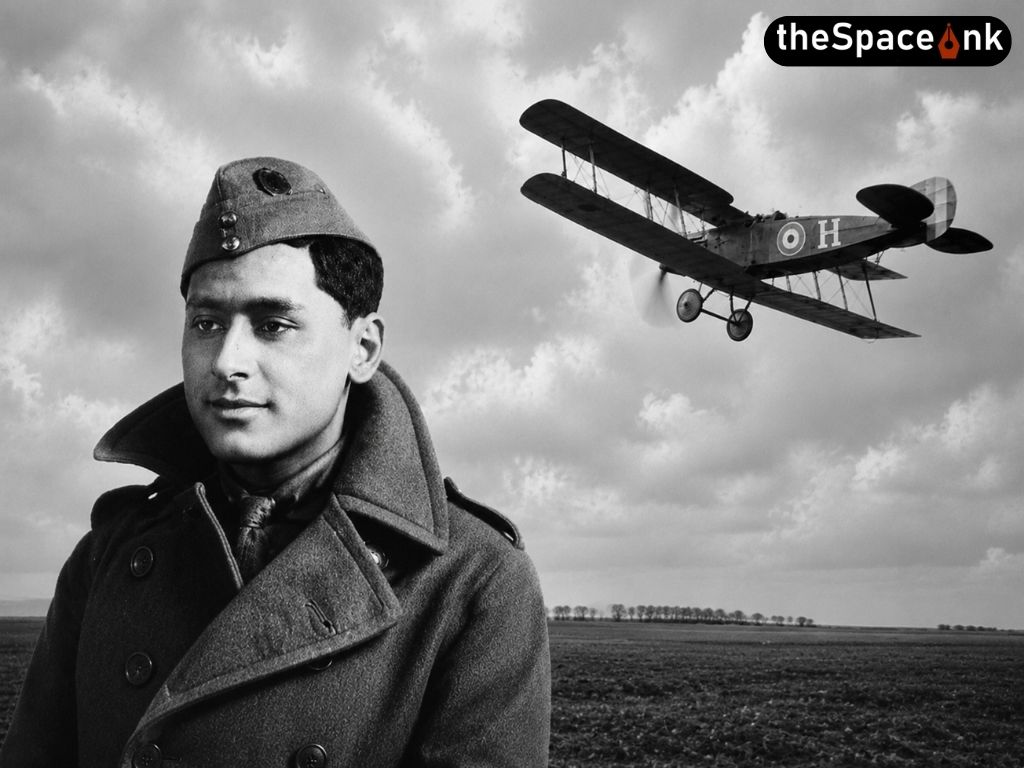
By July 1918, nineteen-year-old Roy was flying with No. 40 Squadron of the new Royal Air Force. Over thirteen intense days, from July 6 to 19, he fought above France with rare nerve and precision, mastering the unforgiving Sopwith Camel and bringing down ten enemy aircraft. In doing so, the Bengali teenager became a flying ace on the Western Front, where pilots often survived only weeks.
Also Read: Bengal Sketches [13],[14],[15],[16],[17],[18],[19],[20],[21],[22],[23],[24]
The Western Front was waking beneath a veil of mist on the morning of July 22, 1918. Across the battered fields of France, trenches cut through the earth like scars, while artillery had reduced villages and farmland to a landscape of mud, smoke, and ruins. Above it all stretched the vast summer sky, beautiful and indifferent to the slaughter below. Into that sky climbed Lieutenant Indra Lal Roy, a nineteen-year-old Indian pilot at the controls of his Sopwith Camel. In the thirteen days before that morning, he had been credited with destroying ten enemy aircraft. He had become a flying ace. Now, he was climbing into the sky once more. This time, he would not return.

Thousands of miles away, Lolita Roy learned her son would never return. After his death, Roy received the Distinguished Flying Cross, becoming its first Indian recipient. His record was extraordinary: ten enemy aircraft in thirteen days, achieved at nineteen in one of the first World War’s deadliest arenas. Yet, his story was more than numbers. Rejected for poor eyesight, presumed dead after a crash, and born into a colonial world that denied Indians equality, Roy still found his way into the cockpit of one of the time’s most advanced fighter aircraft.

And his family’s story did not end with him. His elder brother, Paresh Lal Roy, would become known as the “Father of Indian Boxing.” His nephew, Subroto Mukerjee, followed a different path into aviation and eventually became the first Indian Chief of the Air Staff of the independent Indian Air Force. Decades after Roy’s death, India began to commemorate the young pilot whose life had ended so far from home.


In 1998, on what would have been his hundredth birthday, India Post issued a commemorative stamp bearing his image beside his aircraft. Another stamp followed in 2019. By then, the empire for which Roy had fought was gone, and the country from which he had come was independent. The young Bengali pilot who had disappeared into the skies over France had become part of India’s own aviation history.
In his short life, Indra Lal Roy flew in combat for only a few extraordinary months. Yet, he refused every limit placed before him: poor eyesight, a death mistaken for final, enemy fighters in greater number. Each time, he rose again. On his last morning, he climbed once more into the sky, leaving behind a story that outlived the war, the empire, and the generation that watched him fly.
For me, Indra’s courage is not only the bravery of a pilot in battle, but the quiet defiance of a young man who would not let circumstance dictate the limits of his life. His story reminds me to meet fear with purpose, to rise after failure, and to carry forward the belief that even a brief life can leave a lasting light.
Images: AI, Wikipedia, Wikipedia, Wikimedia Commons, Wikipedia, Wikipedia, Picryl, Get Archieve,

Dr. Jamil is a passionate oncology commercial leader whose two-decade journey has been driven by a deep commitment to improving the lives of people with cancer. As Head of the Early Commercial Team at Merck Oncology and an Adjunct Professor at Columbia Business School, he shapes innovative pipelines while mentoring and inspiring future healthcare leaders. Beyond work, he is a soulful armchair historian of Bengal, a devoted Manchester City fan, and someone whose heart is forever tied to the culture, stories, and spirit of Kolkata.