

The Sovereign Paradox: Part 3
“The aim of art is to represent not the outward appearance of things, but their inward significance.”
– Aristotle
A Walk Through Power, Time, and Imagination
The first thing you notice about the Vatican Museums is the silence, or rather, its absence. While still adjusting to the dimness, you are accosted by a long corridor overflowing with masterpieces of every conceivable kind – paintings, tapestries, sculptures, maps, frescoes – and the endless murmurs of a hundred languages, all colliding at once.

There is no gentle introduction, no gradual build. Instead, there is a relentless deluge – vying for attention at once, overwhelming the senses from every direction. And that, perhaps, was always the point.
Like St. Peter’s Basilica, the Vatican Museums do not merely seek admiration. They seek to overpower — through sheer scale and abundance. The quiet authority of an institution that did not just witness history, but actively shaped it.
Also Read: The Sovereign Paradox: Part [1],[2]
The irony is that the mind, after a point, simply surrenders. Another Renaissance masterpiece! Yet another impossibly detailed ceiling!
Despite the overwhelming artistic genius compressed into every square metre, tourists begin to casually wander past rooms containing works that would be a national treasure elsewhere.
A Humble Beginning
It all began with a single statue.

In January 1506, workers excavating a vineyard on Rome’s Esquiline Hill unearthed an ancient marble sculpture known as the Laocoön and His Sons—a dramatic depiction of a Trojan priest and his sons being attacked by sea serpents. Pope Julius II acquired it and placed it on public display within the Vatican.
I entered a radiant tunnel of gold and blue. Known as the Gallery of Maps, it is 120 metres long and 6 metres wide. The walls are lined with vibrant topographical paintings of every region of Italy, and its vaulted ceiling displays a relentless sea of golden frescoes, casting a warm glow over the entire space.
That single decision grew into something far larger. Subsequent popes, sponsors, and connoisseurs began to collect artworks from all over the world to be displayed there. But this was probably never about ‘pure love’ for art. Renaissance popes viewed classical sculptures and paintings as symbols of intellectual authority and cultural power—a way of positioning the Church not only as a religious institution, but as the self-appointed guardian of civilisation itself.

What began with a single sculpture eventually evolved into one of the largest and most influential museum complexes in the world, accumulating five hundred years of ambition, patronage, and power.
So, What Are the Vatican Museums Actually Like?
The Vatican Museums hold roughly 70,000 works across 54 galleries, connected by corridors stretching for miles and arranged along a single one-way route. The official path passes through ancient Roman and Greek sculptures, an Egyptian collection, two long tapestry corridors, the 120-metre Gallery of Maps, four rooms frescoed by Raphael, numerous painted ceilings, and finally culminates in the Sistine Chapel, the ultimate crowning glory of the museum, painted by Michelangelo himself.

That single one-way rule shapes the whole tour. Skipping a room means you lose it. However, the collection is so vast that even a five-hour visit falls short. It would be wise not to aim for seeing everything on display. Pick the sections that matter to you and walk through the rest without guilt. Given below are the ones that appealed to me the most.
The Egyptian Collection (Museo Gregoriano Egizio)
My tour began here—not merely because it was right at the threshold of the one-way trail, but because I, like the ancient Romans, suffer from a chronic and incurable case of “Egyptomania.”
Staring at the towering statues of gods and pharaohs, particularly that of Sekhmet, the lion-headed goddess of both war and healing, it was impossible to believe that they were manually transported to Rome by various emperors between 30 BC and AD 300 to decorate their villas and temples. One could not be more grateful to Pope Gregory XVI, who collected all those scattered pieces and founded this museum in 1839.

Moving around these rooms triggered a sudden shift in time. The sombre, heavy presence of massive basalt statues, ornate sarcophagi, white muslin-clothed mummies, and intricate hieroglyphics transported me to the glorious era of Egyptian civilisation. I stood speechless before the exquisite funerary shroud known as the Lady of the Vatican—a remarkably well-preserved, life-size linen portrait dating to the 3rd century AD (Room II of the Egyptian section).
There is a profound irony in seeing these objects here. Intended to grant eternal rest to pharaohs and nobles in the quiet desert sands of the Sahara, they are now showcased at the absolute epicentre of the Roman Catholic Church—surrounded by the iconography of a faith that replaced them and viewed by millions of tourists annually. The silence they were made for is the one thing they will never have again.

It was also my first encounter with the visitor’s central dilemma. The sheer age and splendour of these objects demanded more time, but the miles of corridors ahead urged me forward.
From Sacred Shadows to Imperial Marble
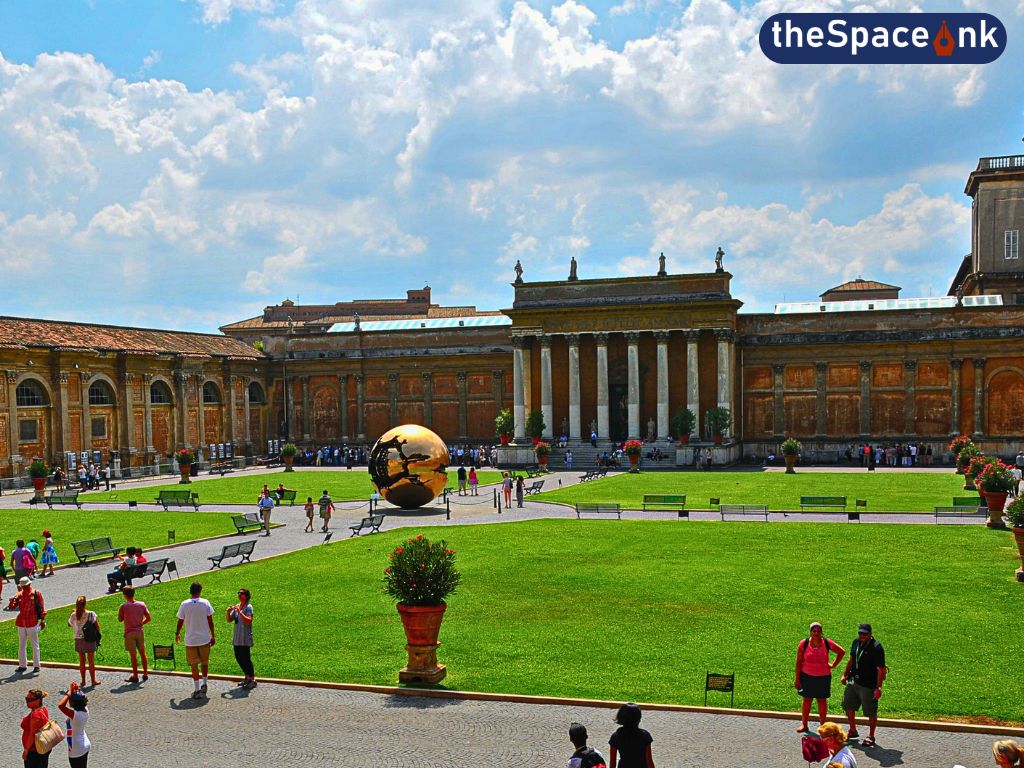
From the shadowy world of the pharaohs, I stepped out into the sun-drenched Pinecone Courtyard (Cortile della Pigna)—a blaze of azure sky and lush greenery framing two objects that had no business being next to each other. At the centre stood a four-metre Roman bronze pinecone from the 1st century AD, facing Arnaldo Pomodoro’s sleek, fractured modern sphere. The ancient world’s reverence for nature stares down a metallic vision of modernity.

Back indoors, the Chiaramonti Museum offered an endless corridor of marble faces—emperors, gods, citizens. Their stone eyes followed you in silence until the Pio-Clementino rooms finally appeared. Standing before the agonising, twisting Laocoön and His Sons and the rugged, fractured Belvedere Torso, I could discern why Michelangelo had been so obsessed with them, drawing inspiration that would find its way into his own creations.
Walking Through the Length of Italy
After spending some time in the Gallery of Tapestries admiring the intricate embroidered wall hangings, I entered a radiant tunnel of gold and blue. Known as the Gallery of Maps, it is 120 metres long and 6 metres wide. The walls are lined with vibrant topographical paintings of every region of Italy, and its vaulted ceiling displays a relentless sea of golden frescoes, casting a warm glow over the entire space.

There were forty map murals in total. Commissioned by Pope Gregory XIII between 1580 and 1585 under the guidance of mathematician and cosmographer Ignazio Danti, each panel is enormous—about 14 feet tall and 11 feet wide. The left wall showcases the towns bordering the Tyrrhenian Sea, while the right depicts the cities along the Adriatic. On the ceiling, directly above each region, the frescoes highlight the major religious events that took place there.
To be continued…
Photos by Subhasis Banerjee

Monideepa Banerjee is an avid explorer and a passionate writer from Bangalore, India. Her articles on travel, art and culture have been featured widely in many prestigious dailies and magazines, photo-journals and web-portals in India and abroad. She has a Master’s degree in Journalism, a B. A in English, a B.Ed. and a Diploma in Early Childhood Education. She is well-versed in Bengali and English and writes spontaneously in both languages. Her published books, ‘The (mis) adventures of Teddy Tumbledore, ‘Tilly’s Squad in Jungle Beats’ and ‘ঠাম্মা ও গাভাস্কর’ are well accepted by young readers for their engaging, simple narrative and emotionally resonant content. Her latest work, a three-book series in Bengali ‘টেডির মজার কাণ্ডকারখানা’ is enjoying a good run.



One Response
This article masterfully contrasts opulent architectural grandeur with its incredibly humble origins, using a sharp journalistic eye to reveal the hidden ironies of a global monument. The pacing is swift and engaging.