

The Sovereign Paradox: Part 2
“The interior of St. Peter’s is a world in itself, where the scale of things is so vast that the mind must expand to grasp it.”
— Nathaniel Hawthorne
The Architecture of Eternity
And then, the collective chatter simply dies. Even social media influencers stood frozen, their selfie sticks poised like antennas before the sprawling Nave of St. Peter’s Basilica. In an age of digital over-stimulation, the Vatican had managed to evoke a rare, unfiltered awe.

The majestic equestrian statues of Constantine and Charlemagne, the emperors who initiated and defended the faith, respectively, guard the entrance like celestial bouncers. But nothing prepares you for the psychological impact of the longest Nave in Christendom. Brass markers in the marble denote the lengths of other great cathedrals—St. Paul’s in London, Notre Dame in Paris, the Cathedral of Florence—each falling short by more than a hundred feet. The sheer scale makes it difficult to reconcile that this opulent edifice honours a fisherman who owned nothing but his faith.

The guidebook, however, reveals that the Nave was an afterthought. Donato Bramante designed the basilica as a compact central structure. After his demise, a succession of Renaissance great minds toiled to transform the basilica into a grand imperial cathedral. The Nave was extended by architect Carlo Maderno in the 17th century to create this long, golden spine—a tactical expansion designed specifically to hold the very millions of Jubilee crowds I had been reading about.
The Illusion of Immortality
Lining the Nave are massive images emanating the luminous aura of classic oil paintings. But as I drew closer, the illusion shattered. There is virtually no paint in St. Peter’s Basilica.

Every “painting”—from the scenes of martyrdom to the delicate faces of angels—is actually a mosaic. Millions of tiny glass and stone tiles are fitted together with microscopic precision to mimic a brushstroke. The Vatican chose stone and glass over paint because paint is mortal. Paint fades; stone endures. By committing every image to mosaic, the Church ensured that while the world outside succumbs to decay, the glory within remains untouched.
Also Read: The Sovereign Paradox: Part 1
This was both a proclamation of immortal faith and a tactical defence system. For over a millennium, the Papacy wielded immense temporal power, crowning emperors and commanding armies. But power also brought vulnerability. During the political upheaval of the 14th century, the Papacy was forced to relocate to Avignon in southern France. The abandoned Vatican was left to livestock and scavengers who dug up graves looking for food or treasures.
Yet the entire weight of the Vatican—its gold, its art, its power—rests on the bones of a man who owned nothing but his faith. An empire was built to protect a legacy of dust.
Upon their return, the Papacy demanded a fortress to withstand every onslaught. Pope Julius II hired the first Swiss Guards in 1506, bypassing untrustworthy Roman factions for the most feared mercenaries in Europe, known for their unbreakable loyalty.
Today, the Swiss Guards may regale tourists with their colourful costumes, but their presence is a stark reminder of an era when the Vatican defended itself with iron and blood. Even the most devout saint could not achieve immortality through miracles alone.
From Human Sorrow to Heavenly Grandeur
Amidst this intimidating grandeur sits a statue in pristine white marble: Michelangelo’s Pietà. The Virgin Mother, portrayed with an achingly tender face, cradles the lifeless body of her son with a grace that seems impossible to carve from cold marble.

Michelangelo was only twenty-four when he sculpted this deeply humane portrayal. Legend says that upon hearing the sculpture attributed to a rival, he sneaked in at night to chisel his name across Mary’s sash. It is the only work he ever signed.

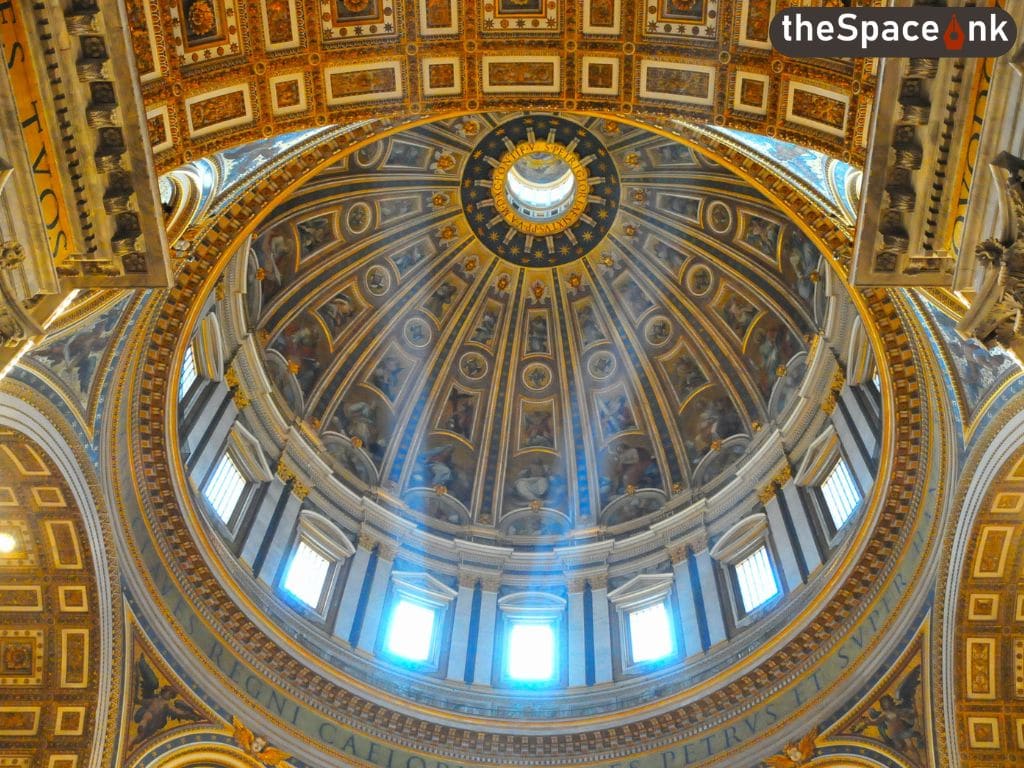
Decades later, at seventy-one, he designed the immense dome rising 136 metres above the ground. He worked for free, claiming he served God, not gold. Around its base, gold mosaic letters declare: TV ES PETRVS—“Thou art Peter.” Though the letters appear as elegant decorations, in reality, they are over two metres tall—large enough to swallow a human being within their folds.

The Legacy of Dust
Directly under the soaring dome stands the Baldacchino, a four-storey bronze canopy designed by Gian Lorenzo Bernini. Four colossal columns spiral upward like giant vines, their bases richly decorated with flowing drapery, marking the most sacred point in the Basilica. Deep beneath the marble floors sleeps the modest fisherman from Galilee, venerated as the first Pope of Christianity.
Suddenly, the entire symbolism of the Basilica became clear to me. The tomb, the altar, the canopy, the dome soaring upward—perfectly proportioned in a single vertical line—claiming a direct connection to heaven.

Yet a dark irony lingers. The sixty tons of bronze used to forge the Baldacchino were stripped from the ancient Roman Pantheon, a temple built for the pagan gods. A history scholar stated cynically, “What the barbarians didn’t do, the Barberini did.” The Pope, a member of the Barberini family, even ordered his family crest (three bees) to be woven into the design, hinting at the patron’s identity. He further explained that the spiral columns resembled the pillars of the Temple of Solomon in Jerusalem, framing the Vatican not just as another church, but as the sole inheritor of a sacred biblical lineage.

Looking down into the crypt, illuminated by eternal oil lamps, the ultimate incongruity hits you. Above is the most expensive dome ever built, supported by bronze stripped from a pagan temple, framed by a Nave designed to overwhelm the senses. And beneath it all, a dark, silent hole in the ground.

The Vatican had fought dearly for this ground. Imperial troops invaded the basilica in 1527. The Swiss Guards sacrificed their lives on the very steps of the altar while the Pope escaped through a secret passage. Following decades of standoff after Italian unification, the 1929 Lateran Treaty between the Holy See and Mussolini’s government formally recognised the Vatican as a sovereign entity, with compensation of 1.75 billion lire (approximately £800 million).
Also Read: Hopelessly Lost in Paris
Yet the entire weight of the Vatican—its gold, its art, its power—rests on the bones of a man who owned nothing but his faith. An empire was built to protect a legacy of dust.
To be continued…
Photos by Subhasis Banerjee

Monideepa Banerjee is an avid explorer and a passionate writer from Bangalore, India. Her articles on travel, art and culture have been featured widely in many prestigious dailies and magazines, photo-journals and web-portals in India and abroad. She has a Master’s degree in Journalism, a B. A in English, a B.Ed. and a Diploma in Early Childhood Education. She is well-versed in Bengali and English and writes spontaneously in both languages. Her published books, ‘The (mis) adventures of Teddy Tumbledore, ‘Tilly’s Squad in Jungle Beats’ and ‘ঠাম্মা ও গাভাস্কর’ are well accepted by young readers for their engaging, simple narrative and emotionally resonant content. Her latest work, a three-book series in Bengali ‘টেডির মজার কাণ্ডকারখানা’ is enjoying a good run.



4 Responses
This article masterfully contrasts the opulent grandeur of the Vatican with its humble, apostolic origins, using a sharp journalistic eye to reveal the hidden ironies carved into St. Peter’s Basilica.
Thanks for your encouragement.
It is a tightly written, evocative piece that balances cultural critique with historical depth beautifully.
Thank you for liking my article. Your comments are encouraging for me.