

Pune – A Memory Lost & Found
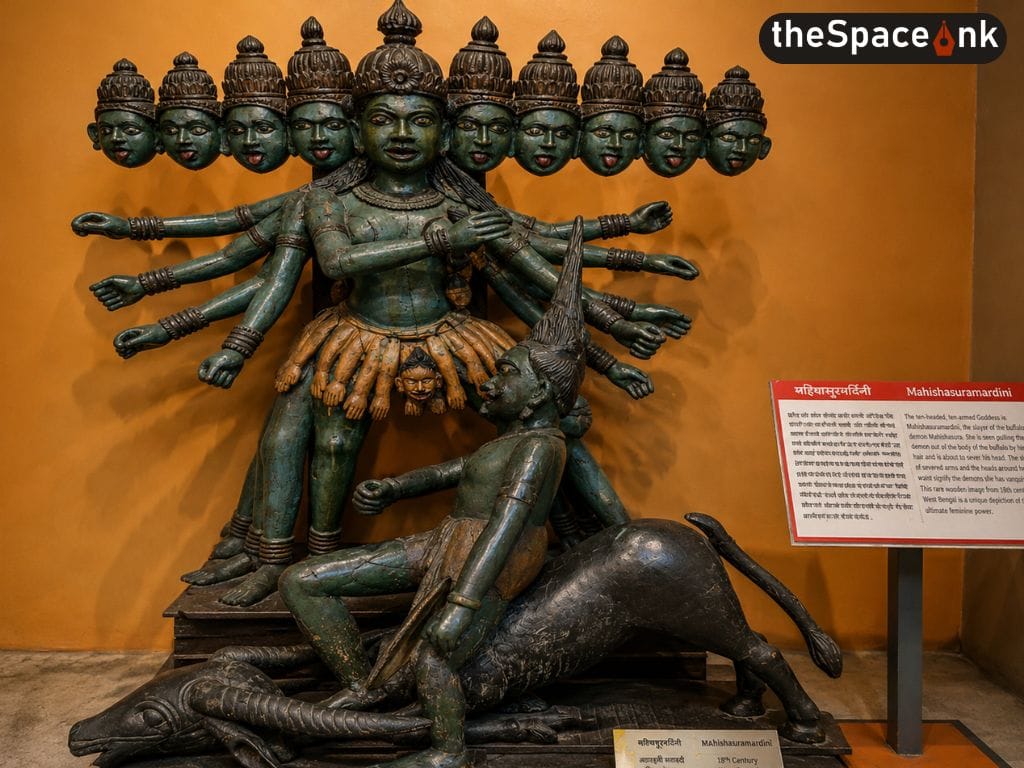
She is carved out of wood, painted a mysterious dark shade of green bordering on, but not quite, teal. She wears a skirt of severed arms and a head (all belonging, presumably, to countless Asuras she has vanquished in cosmic battles) around her waist. She has ten arms, ten legs and ten heads. The heads, with their eyes staring and tongues protruding, resemble the familiar image of the Goddess Kali.

She holds no weapons. But she is frozen in the act of decapitating the most powerful and evil Asura of them all, as far as Indian mythology goes. Who is she, you wonder, awestruck. Is she Durga? Or is she Maha Kali, the ultimate primordial force arising from the bottomless void, beyond time, space, and causation?
It doesn’t matter because she already has a designation. I present to you, the one and only, the ultimate Adi Śakti – Mahiṣāsuramardini.

From July 2004 to December 2011, I was in Pune working as a Senior Technical Support Engineer for Sybase Software India Pvt. Ltd. Moving from one’s hometown to IT hubs like Bangalore, is normal these days, but back then it was a major change.

It was tough, at first, for me, who had never spent more than a week away from Calcutta. But Pune, a tiny city tucked away in the folds of the Western Ghats, somehow grew on me, and the natural kindness and warmth of the people made me feel at-home away from home for eight long years.

I would never have imagined at that point in time that twenty-two years later, I would revisit Pune on a completely unrelated mission, with two of my dearest friends Mousumi and Kumkum, and discover a unique and extremely rare work of art that had such deep connections to my own state of West Bengal.

And yet there I was, embarked on an immersive Proustian journey, through the narrow winding streets and lanes that had lost nothing of the quaintness and old-world charm that had attracted me in the first place. The interior of Kayani Bakery on East Street was redolent with olfactory memories that were exactly the same two decades ago.

So was the long queue of customers outside the entrance waiting patiently for their turn at the counter because the taste and quality, as I explained to Mousumi, made it worth their while. From the array of mouthwatering biscuits, cookies, cakes, and snacks, both sweet and savoury, beckoning at you from behind glass cases, to the chalkboard on the wall with the long list of items and their prices scribbled on it, I was delighted to see that nothing had changed.

The ruins of Shaniwar Wada Fort towered majestically over the city exactly as it had since I last saw it. A hidden gem of an antique store, SilkyWorld, in Pune Cantonment, Poolgate, next to Fernandez Bakery, was a new experience for me, but once we went inside and talked to the owner Shamshir Bhai, I felt I had never left!
Also Read: Dream of the Mermaid
Lakshmi Road and M. G. Road, where I did most of my shopping, brought back fond memories, as did Artists’ Katta and Deccan Gymkhana, a stone’s throw away from Fergusson College.

Here was Dorabjee & Sons, in the bustling Camp Area, which I frequented on weekends to satisfy my gourmet cravings. And there was Dagdusheth Halwai Ganapati Mandir, a star attraction during the Ganapati Festival that is celebrated for ten days, outlasting our own Durga Puja by at least a week.

And that brings me back full circle to the opening paragraph – the last day of our trip and the enigmatic encounter I had not anticipated in the least. Raja Dinkar Kelkar Museum on Shukrawar Peth contains the collection of Dr. Dinkar G. Kelkar (1896–1990), dedicated to the memory of his only son, Raja. The three-storey building houses anything between fifteen and twenty thousand art objects dating back to circa 14th century. There are sculptures (some of them massive in size), ornaments made of ivory, silver and gold, musical instruments (a particularly fine collection), war weapons, and vessels.
Also Read: “Operation Spider’s Web: A Real-Life Mission Impossible”
As we meandered through the galleries, we were struck by the sheer variety of the collection. Ornate door and window frames, statues of various gods and goddesses in wood, marble, and metals, gorgeous Paithani sarees, shadow puppets, beautifully crafted household utensils – some local, others from states like Rajasthan, Orissa, Gujarat, Karnataka, and Tamil Nadu – dating from the 17th, 18th and 19th centuries. We saw hand operated noodle-maker machines used by women almost a hundred and fifty years ago. There were even intricately embroidered Indian clothes, courtesy of the Federal Republic of Germany!

We almost missed her, you see, the Goddess, tucked away as she was on a mezzanine level between the 2nd and 3rd floors. But her ten arms and the dead buffalo at her feet caught my eye and we climbed the short flight of steps down to where she was ensconced in a niche in the wall. The plaque at the foot of the image read, “18th century, West Bengal”. We were astonished, to say the least.

And once we saw her, we couldn’t take our eyes off. Everyone knows the legends surrounding the Devas and the Asuras (symbolic of the eternal struggle between good and evil, although not all the Asuras were a hundred percent evil – it is not as simple as that) and the final battle in which the Goddess Durga annihilates Mahiṣāsura, the Buffalo-Demon once and for all.
The particular shade of dark green, along with the ten heads, resembling the Goddess Kali, the ten legs and the skirt of severed arms around her waist, makes you wonder – could it be the sculptor’s way of reinforcing the concept of Dasha-Mahāvidyā, where each Mahāvidyā is one of ten manifestations of the same deity?
This has been the central theme, the leitmotif of the Durga Puja festival in West Bengal for the last couple of centuries. An entire population of about eleven crores – men, women, and children – go simply berserk once a year for four days, in honour of the Goddess, a celebration for which planning begins virtually from the very day the previous year’s festivities end.

But I think very few Bengalis would be able to stomach a depiction of the Mahiṣāsuramardini with ten heads, let alone ten legs! Because this is not the typical image of “Maa Durga” – the beloved daughter who comes home from her husband’s dwelling in Mount Kailāśa once a year to visit her parents with her children Lakshmi, Saraswati, Kartik, and Ganesh – that we worship in the month of Ashwin in West Bengal.

The absence of weapons in her hands could indicate that the image was used for ritualistic purposes. Perhaps they were added on ceremonial occasions when the Goddess was worshipped to invoke her powers of protection against unknown, and therefore intractable, unholy forces. She is seen dragging the demon out of the body of the buffalo by his hair with one hand and is about to sever his head with another. That alone would strike terror in the hearts of all who dared to watch!

The particular shade of dark green, along with the ten heads, resembling the Goddess Kali, the ten legs and the skirt of severed arms around her waist, makes you wonder – could it be the sculptor’s way of reinforcing the concept of Dasha-Mahāvidyā, where each Mahāvidyā is one of ten manifestations of the same deity?
It is possible, but we may never know for sure. I for one, am no expert on the Vedas, Upanishads or the Puranas that deal with all the complexities of the worship of Shakti in India, but this is not an image that evokes love or devotion.

This is a much deeper, darker, elemental rendition of power that affects you on a subliminal level. All we can see on the surface is that the imaginative power behind the sculpture imbues it with a formidable and devastating natural force that emanates from the image – the ultimate feminine energy that destroys the universe, and all of creation along with it.
Finally, the image is a product of the rich tradition of wood carving dating back to 18th century Bengal, with its intricate craftsmanship and deeply reflective study of the themes of conflict, power and victory of good over evil.

With that fascinating experience firmly fixed in my mind palace, we wended our way back to our lodgings, as it was time to pack our bags and take our leave of “Punakavishaya” as it was known in the 8th century CE, meaning “holy land”, or “Kasbe Pune”, during the reign of Shahaji, father of Chhatrapati Shivaji Maharaj. Pune will always be an integral part of me, of some of the best years of my life, so it will always be difficult to say goodbye.
All I can say is, “Au revoir, till we meet again!”.
Acknowledgements:
Image Courtesy: Mousumi Duttaray

Prateeti is an English Lierature major from Presidency University Kolkata who took up the technology challenge without an Engineering degree in 1993 and embarked on a full-fledged technical career, becoming a RDBMS expert. She worked as the CoE Manager for Sybase products, platforms and technologies at SAP Labs India Pvt. Ltd., Bangalore. She is a great admirer of Augusta Ada King and Marie Curie.
She is also the author of ‘Green Rose Wild Earth’ a collection of poems published by StoryMirror Infotech Pvt. Ltd.


One Response
Beautiful write up…