

Monsoon Melodies of the Culinary Kind
The first monsoon downpour, accompanied by the overpowering smell of petrichor, awakens a certain indescribable longing for beguni, peyanji, alur chop, kichuri, ilish maach bhaja, fish fry… all together creating wondrous ‘somethings’ for your palate. They do combine to create monsoon melodies! Just a mention of khichuri and Ilish maach bhaja… makes my heart go boom boody boom boody boom boom boom. Thanks to Peter Sellers, this line plays in my heart and soul whenever alur chop, fish chop and cutlets are mentioned as the rain pours outside! Goodness Gracious!

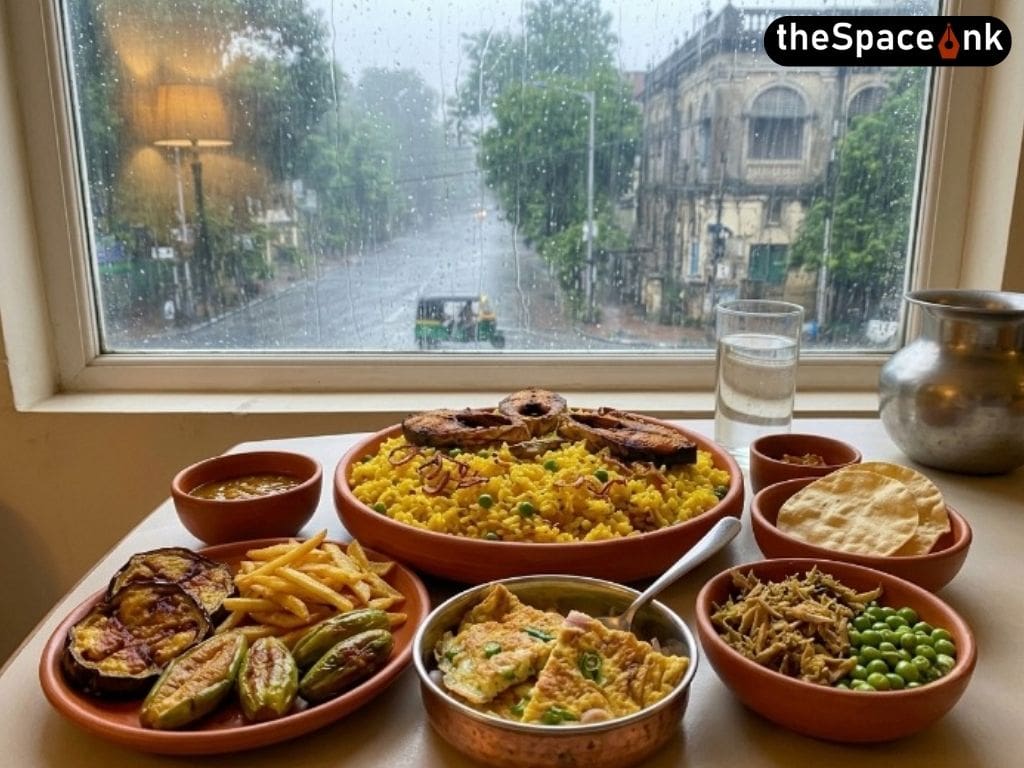
Upon hearing the pitter-patter of raindrops, one subconsciously anticipates a lavish spread of khichuri with a variety of bhajas… maybe just dim bhaja (meaning the snooty, fluffy omelettes), the simple papad, and kancha aamer chutney or aamer aachar. A complete emotional and a drool-worthy package.
Lakshmi Narayan Shaw is commonly known as Netaji’s telebhajar shop. This 103-year-old establishment takes pride in having served as a meeting place where Subhas Chandra Bose and his associates would gather. Shaw, the shop’s proprietor at that time, is said to have supplied them with telebhaja, muri, and fried green chillies during their clandestine meetings.
Khichuri is a wholesome meal in itself and lends itself perfectly for experimentation. Derived from the Sanskrit word ‘khiccha’, khichuri is nutritious as it can be cooked with minimal oil and can use a mix of dals or lentils, along with seasonal vegetables or just potatoes. The runny version of khichuri requires very little oil… just a teaspoon or two to fry the masalas, which can then be added to the already cooked rice and lentil broth.

In Bengal, the monsoon is as much a season of rain as it is of food. This season witnesses a rich haul of Ilish or Hilsa from opar (Bangladesh) and epar (West Bengal), prepared in fragrant mustard gravy or simply fried and served with hot rice. In Kolkata, standalone restaurants create food festivals weaving tales around Hilsa alongside most of the F&B outlets at five-star properties. It’s fascinating to see the marketing strategies adopted to woo customers with unique dishes usually not cooked at home… hilsa cutlets, bhorta, or served paired with pineapple slices or tamarind paste.

Besides Hilsa, there are many small freshwater fish that enrich the barsha menu at home, making every rainy afternoon a celebration of Bengal’s comforting culinary traditions. One can choose from deep-fried aamudi, morola and gaangmourola and many other varieties. Not only fish, seasonal vegetables are equally relished in their fried avatars!

Come evening, the aroma of frying besan wafts through many Bengali homes in Kolkata. Telebhaja, literally meaning “fried in oil”—is one of Bengal’s most beloved snacks. But telebhaja is an all-season indulgence, but people hanker for it more when the sky is overcast. This irresistible culinary delight is best enjoyed with a handful of muri, or puffed rice. Telebhaja is an integral part of Bengali cuisine. It is a well-known fact that Bengalis have a particular fondness for foods crisped in hot oil—whether eggplant, pointed gourd, potato, vegetable blossoms, fish, prawns, or anything else the kitchen happens to offer.
Also Read: Celebrating Hilsa: Bengal’s Favourite Fish
Almost anything can be dipped into a batter of gram flour, from slices of eggplant and onion to potatoes, prawns, and cauliflower, before being dropped into bubbling oil. It is worth remembering that bhaja and telebhaja are not quite the same. Bhaja refers simply to food fried in oil, whereas telebhaja specifically denotes vegetables or other ingredients coated in a gram-flour batter and deep-fried until crisp.

Dotting the city, there are numerous dedicated roadside telebhaja stalls selling these crisp, golden morsels in the evening. Wrapped in old newspaper packets and dusted with black salt and chilli, they possess a humble charm that is difficult to resist. In many ways, telebhaja is a complete dish in itself: simple, filling, and deeply satisfying. The popular ones are concentrated mostly in North Kolkata… such as Mitra Café, Niranjan Agar, Lakshmi Narayan Shaw, Potla’s Snack, Allen’s Kitchen and numerous others.

In fact, Lakshmi Narayan Shaw is commonly known as Netaji’s telebhajar shop. This 103-year-old establishment takes pride in having served as a meeting place where Subhas Chandra Bose and his associates would gather. Shaw, the shop’s proprietor at that time, is said to have supplied them with telebhaja, muri, and fried green chillies during their clandestine meetings. Mohan Kumar Gupta, the present third-generation owner, says that the shop, even till this date, continues to distribute free telebhaja every year on January 23rd… Netaji Subhas Chandra Bose’s birthday.

Bengalis love to romanticise the monsoons, or barsha. When the rain-laden clouds gather overhead, music joins the season to create an atmosphere of romance. Beneath a darkening evening sky, people sit outside Nabadwip Sweets in Ratanpally, Santiniketan, relishing alur chop and lebu cha to the accompaniment of a Tagore song… Pagla hawar badol-dine, Pagol amar mon jege othe—“On this wild, windy, rain-filled day, my restless heart awakens; for no reason at all, it longs to wander.”
But Gen Z’s food preferences are changing, as is evident from the numerous cafes congesting the lanes and streets of Kolkata. Kombucha it is, alongside cortado, macchiato, mango cold brew, accompanied with sourdough bruschetta, thin-crust wood-fired pizza, croissants and salads. Tastes are definitely changing, but they can never resist the good old fish fries, and neither can we oldies!
In Kolkata too, Radhu Babu’s shop on Janak Road is a similar adda den where cha and cutlets rule. Sankar’s Fry, Aapanjan and many other tiny outlets do brisk sales during monsoons. Now, with food delivery apps downloaded on everyone’s smartphones, people can sit at home and order to relish their favourite chops and cutlets while it’s pouring outside.

As one wanders through the bylanes of Kolkata, it is common to find sweet shops bearing signs that promise “kochuri, chholar dal and telebhaja.” These modest establishments are an integral part of the city’s foodscape. Their unassuming façades conceal a world of aromas, memories, and recipes passed down through generations. Take, for example, the prawn cutlets of Allen’s Kitchen. The special recipe has been handed down to the present-generation owners, who are still serving the same delectable ones! Most of these shops begin selling their fritters from early evening, offering such favourites as alur chop, phuluri, peyanji, and phulkopir chop, among others.
But Gen Z’s food preferences are changing, as is evident from the numerous cafes congesting the lanes and streets of Kolkata. Kombucha it is, alongside cortado, macchiato, mango cold brew, accompanied with sourdough bruschetta, thin-crust wood-fired pizza, croissants and salads. Tastes are definitely changing, but they can never resist the good old fish fries, and neither can we oldies! Though most Gen Z may prefer the above options, there are many who still like to savour all that is sinfully good, meaning the bhajabhujis. And why not? You only live once… so eat, relish and enjoy! I love the monsoons and will never recite “Rain, rain, go away…”
Images courtesy: AI, Facebook, Facebook, Fecaebook

Arundhati Gupta is a Kolkata-based writer, editor and communications strategist. She has contributed reviews, essays, and features in leading national, regional and online publications. In addition to her writing, she serves on the executive committee of a non-profit organisation. Outside of work, she enjoys playing scrabble and cooking.


One Response
A great read stirring all chords from nostalgia,loved platters and family bonding zone.Bengaliana beautifully expressed.