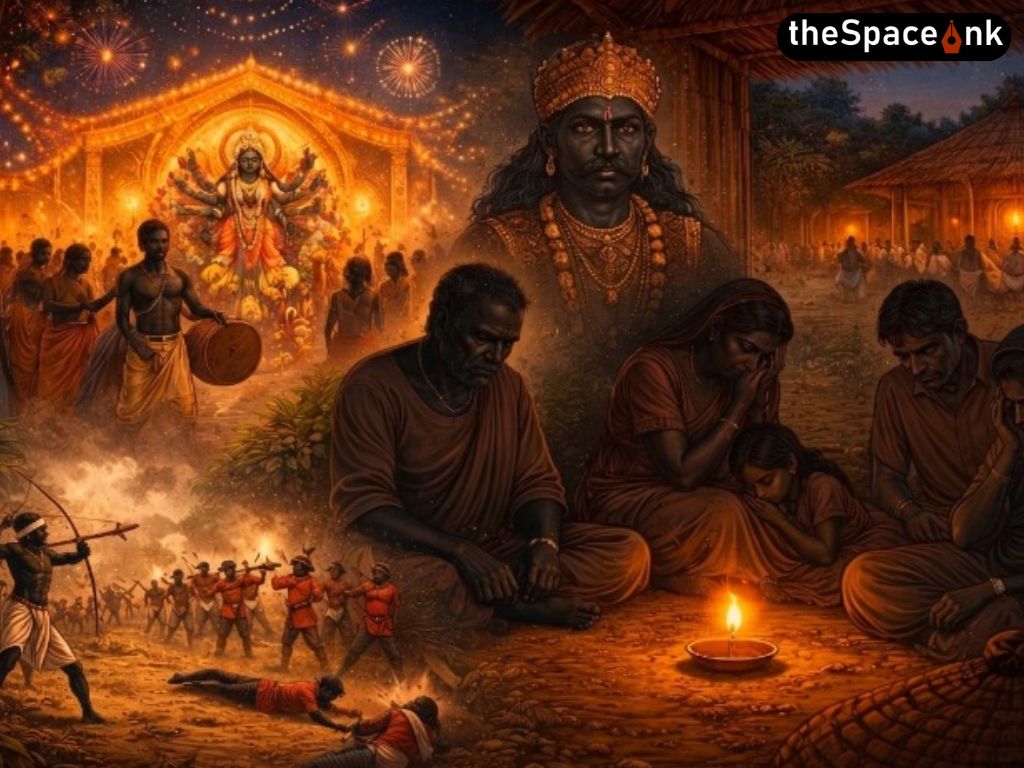
Bengal in Persian Shadows
My father studied Persian in elementary school in Birbhum, and I grew up speaking Persian words, eating foods with Persian origins, and listening to musical traditions such as qawwali and the ghazal that were shaped by Persian poetry. When Rabindranath Tagore visited Iran in 1932, he felt a deep cultural connection as well, having grown up hearing his father recite the poetry of Hafez.
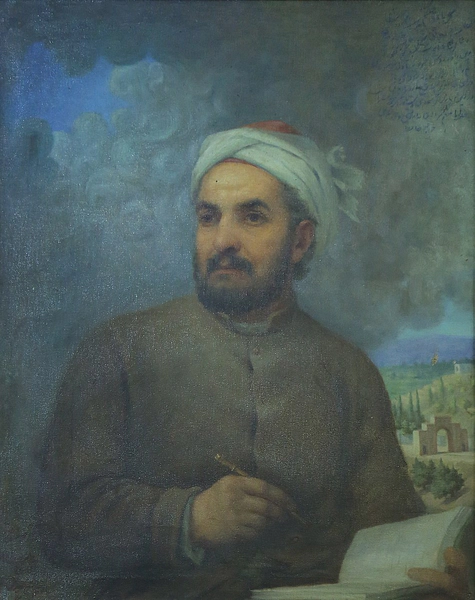
Bengali is spoken by 280 million people across Bangladesh and West Bengal. Over centuries of travelers, rulers, poets, mystics and merchants, the language gradually filled with borrowed words and shared echoes, until it became a home built from many journeys. In 1352, Bengal stepped out from the shadow of the Delhi Sultanate and became its own sultanate. With it came a tide of Persian influence that touched the courts, the arts, and the imagination of the land.
At a time when the learned elite held tightly to Sanskrit, 14th century poets like Chandidas and Shah Muhammad Sagir turned toward the living language of the people. They wrote in Bengali so villages could hear themselves in poetry. While Persian ruled the courts and royal correspondence, it left behind words; words that settled quietly into Bengali speech and never truly left.

When the British East India Company arrived, the winds shifted again. The English Education Act of 1835 placed English into the machinery of government and learning. Two years later, in 1837, Persian lost its official standing across British India. Yet languages do not surrender their past so easily. Persian remained woven through Bengali speech, like an old melody that continues long after the musician has gone.
আসমান (asman) ও জমি (jomi): Sky and Earth
Beneath the endless আসমান, Bengal breathes like a story too ancient to finish telling itself. The sky in the early morning is pale and gentle, as if the world has only just opened its eyes. By evening it deepens into copper and crimson, the sun dissolving into rivers of fading light. Sometimes it feels as though the heavens linger here longer than anywhere else on earth. Below that sky lies the patient জমি. Dark. Fertile. Quietly enduring.
This land is not defined by roads or borders but by water. A thousand wandering দোরিয়া move across it like veins carrying memory. Rivers slip past villages and rice fields, past temples, and mosques and silent ghats worn smooth by centuries of feet, rushing from distant hills and tides to the largest Bay in the world: Bay of Bengal.
When the তুফান (toofan) rises from the sea, the world shudders. The wind leans against the palm trees until they bow like worshippers. The open ময়দান (moydan) floods into shining sheets of silver beneath a restless sky. The earth drinks deeply, accepting the storm as a blessing. Within days the fields rise again greener than memory, brighter than hope. Under the vast ছায়া (chhaya) of banyan trees the air cools and softens. For a brief, quiet moment the land feels remarkably close to বেহেস্ত (behesht). Not a distant paradise promised somewhere beyond the world, but something gently present beneath bare feet and open sky.
Time has taken many things from Bengal, yet somehow the people endure. The great mansions of the জমিদার (zamindar) slowly collapse into vines and silence. Their balconies lean toward the earth; their courtyards gather dust. Yet beside the rusting gates the faithful দারোয়ান (darowan) still sits, as if memory itself asked him not to leave.
রান্নাঘর (rannaghor): The Kitchen
Walk through a market at dawn and you will see the earth’s generosity spread out like glistening treasure. তাজা (taja) শোবজি (shobji) lying in bright piles still cool with dew. Bundles of purple and white পেয়াজ (peyaj) hang from bamboo poles. Deep red আনার (anar) gleam among woven baskets like hidden lanterns. In winter, traders arrive with crates of pale, sweet আঙ্গুর (angur) carried down from distant hills.
The বাদাম (badam) seller sings his call through narrow lanes. Children clutch their hands and stare wide-eyed at mounds of sticky কিসমিস (kismis) and golden খুবানি (khubani). Somewhere nearby a knife splits open a waiting তোরমুজ (tormuj). The fruit breaks as the flesh glistens in the morning light, juice running down the wooden block.
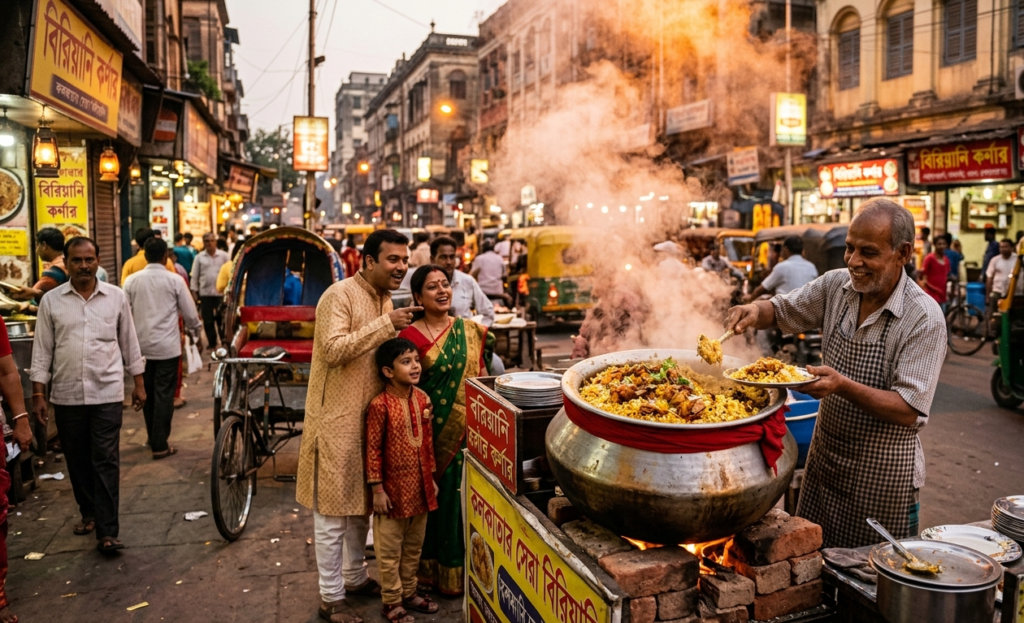
Afternoon brings another kind of magic. A single pot of বিরিয়ানি (biriyani) can perfume an entire street. Steam rises carrying the deep fragrance of rice brushed with saffron and sweet browned পেয়াজ. Beside it rests patiently simmered murgi (মুরগি), dark and rich with spices, and delicate কোফতা (kofta) that fall apart the moment they touch the tongue. Someone pours cool glasses of শরবত (shorbot).
Only water and গোলাপ (golap). Nothing elaborate. Nothing extravagant. Yet, it is pure মজা (moja), a joy that asks for no explanation. Later, soft পনির (ponir) rests in clay bowls. Gentle পোলাও (polao) cools beneath a thin muslin cloth. Warm নান (nan) appears in every guest’s hand ready to soak up delicate flavors.
রং (rong): Color
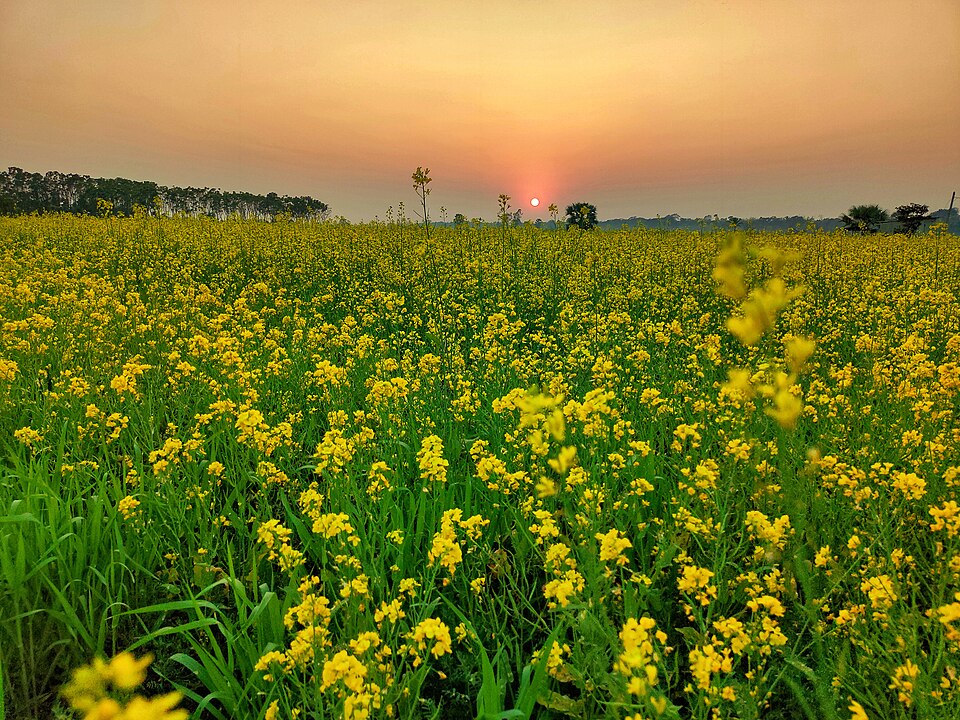
Bengal speaks through color the way poets speak through longing. The blazing লাল (lal) of a bride’s sari rises like a private sunrise. That same red stains the ancient mosque walls of Murshidabad where imprints of জাফরান (zafran) once touched plaster whisper of the past. In winter, the fields erupt into endless oceans of mustard flowers. Yellow spreads so brilliantly across the land that even the sky seems startled by the brightness.
Village ponds grow heavy with water hyacinth. Their surface disappears beneath deep শোবুজ (shobuj); a green so thick it feels as though sunlight has been caught and held inside every leaf. Before a storm arrives, the evening sky gathers a strange বাদামি (badami) along its edges and the petrichor remembers rain.
During doljatra festivals the land bursts open with flying রং. Nothing remains বেরং (berong) in Bengal. Drums thunder and clouds of colored powder rise into the air like fragments of the sun.
Languages remember more than people realize. They carry the past the way rivers carry silt; patiently, leaving traces wherever they flow. Bengali welcomed Persian words, giving them a home inside its breath. They live in the names of food, fruit and color. They live with greetings and prayers. They glow in the warmth of winter আতশ (atash) and run through the খুন (khun) of generations who once watched Persian Sufi mystics arrive along the rivers.
Even grief here carries color. At funerals soft গোলাপ petals fall gently upon white cloth until the road of farewell looks like a garden laid tenderly across sorrow.
মানুষ (manush): People
Time has taken many things from Bengal, yet somehow the people endure. The great mansions of the জমিদার (zamindar) slowly collapse into vines and silence. Their balconies lean toward the earth; their courtyards gather dust. Yet beside the rusting gates the faithful দারোয়ান (darowan) still sits, as if memory itself asked him not to leave. Under a small tin roof, the patient ওসতাদ (ostad) continues to teach. At the roadside tea stall a loyal দোস্ত (dost) waits with steaming cups already poured.
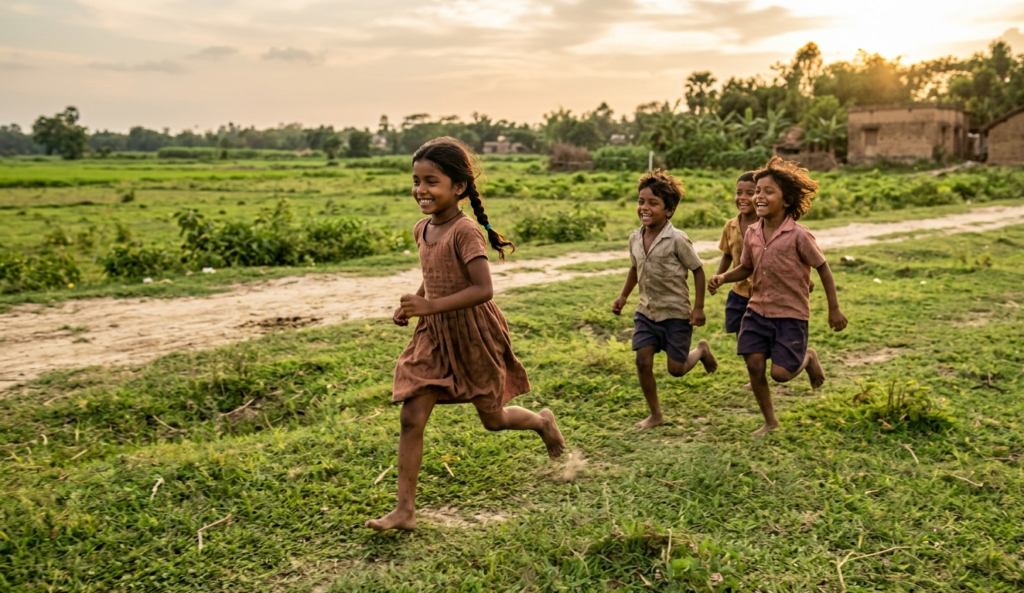
Barefoot বাচ্চা (baccha) race across harvested fields. Their laughter bursts upward into the sky like startled birds. Some young men loiter beside the tea stall. They are বেকার (bekar), caught somewhere between today and tomorrow. They watch the dusty road as if destiny might one day walk across the wide ময়দান of their lives. Others bend their খালি পায়ে বাচ্চারা মাঠে দৌড়ায়। (komor) to the same soil year after year.
Their hands carry the permanent রং of earth and harvest. In a narrow lane, the quiet মুচি (mochi) stitches worn shoes with slow, patient care. Sometimes the village পালোয়ান (palowan) arrives for the wrestling ground. His thunderous কুস্তি (kusti) draws crowds of children climbing every wall and tree branch to watch strength struggle against strength.
Also Read: Bengal Sketches – When One Festival Is Another People’s Mourning
The lingering ache of those who left and never returned. People still remember the বেইমান (beiman) who betrayed his দোস্ত long ago. The old বেইজ্জতি (beizzati) whisper. Bengal does not forget easily. But it forgives in its own slow season. That is its greatest কারবার (karbar): the patient business of endurance.
বিশ্বাস (bishwas): Faith
At the first gray light of dawn a voice rises over the winding দোরিয়া. It drifts across dew-covered fields and through swaying palm groves. Men and women spread their জায়নামাজ (jainamaz) upon the earth. Quiet rows form. Foreheads bow in নামাজ (namaz) facing the western horizon where the world feels older and deeper. During রোজা (roza) the rhythm of the village softens. Days pass slowly. Evening’s glow with quiet anticipation. Markets grow hushed as though the আসমান itself are listening. Here the name খোদা (khoda) is spoken warmly, familiarly; not with fear, not with distance. It is spoken the way one might speak of a neighbor who has always lived just beyond the courtyard.

Above the old mosque gate faded letters still read: খুশ আমদিদ (khush amdid). Welcome. At the end of their visit, travelers depart with খোদা হাফেজ (khoda hafez). May God protect you. Persian words spoken earnestly in a Bengali voice.
Languages remember more than people realize. They carry the past the way rivers carry silt; patiently, leaving traces wherever they flow. Bengali welcomed Persian words, giving them a home inside its breath. They live in the names of food, fruit and color. They live with greetings and prayers. They glow in the warmth of winter আতশ (atash) and run through the খুন (khun) of generations who once watched Persian Sufi mystics arrive along the rivers.
And so, one can only speak softly: সাবাস (sabash), Bengal. For carrying so many histories inside one heart. For holding entire worlds inside a single word. বাস (bas).
Image Courtesy: Printerval, World History Encyclopedia, Wikimedia Commons, Pexels, AI

Dr. Jamil is a passionate oncology commercial leader whose two-decade journey has been driven by a deep commitment to improving the lives of people with cancer. As Head of the Early Commercial Team at Merck Oncology and an Adjunct Professor at Columbia Business School, he shapes innovative pipelines while mentoring and inspiring future healthcare leaders. Beyond work, he is a soulful armchair historian of Bengal, a devoted Manchester City fan, and someone whose heart is forever tied to the culture, stories, and spirit of Kolkata.