The Grand Finale – From the Scandalous to the Sublime
“A good painter is to paint two main things: men and the workings of the mind of man.”
— Leonardo da Vinci, Notebooks
A Grudge That Led to an Artistic Holocaust
The Raphael Rooms hold some of the finest paintings in the Vatican, but I was more intrigued by the behind-the-scenes drama hidden within these four chambers. The story pulled open the curtain on the corrupt, calculating, and occasionally ruthless world of the Papacy that existed behind the holy walls.
Also Read: The Sovereign Paradox: Part [1],[2],[3]
It begins with Rodrigo Borgia, a Valencian aristocrat who bribed his way to the papacy in 1492, ascending the throne as Pope Alexander VI. He ruled with the instincts of a calculating schemer, was accused of ordering the murders of wealthy Cardinals whose estates would revert to the Pope upon their deaths. He turned the Borgia apartments of the Vatican into the private domain of his family—filling them with frescoes celebrating the Borgia name.
It was probably the most famous ceiling in the universe—over three hundred figures stretching across 500 square metres in an overwhelming tapestry of Genesis, from the separation of light from darkness to the iconic gap between the fingers of God and Adam in The Creation of Adam.
When his bitter rival, Julius II, became Pope in 1503, his revulsion at his predecessor’s shameful actions was absolute. He refused to sleep a single night in the Borgia apartments. Instead, he decided to wipe out anything and everything that belonged to him. He hired a brilliant 25-year-old prodigy named Raphael, and gave him one instruction: strip the walls completely, and paint over the existing frescoes. Julius did not care about preserving art; he wanted a total visual cleansing.
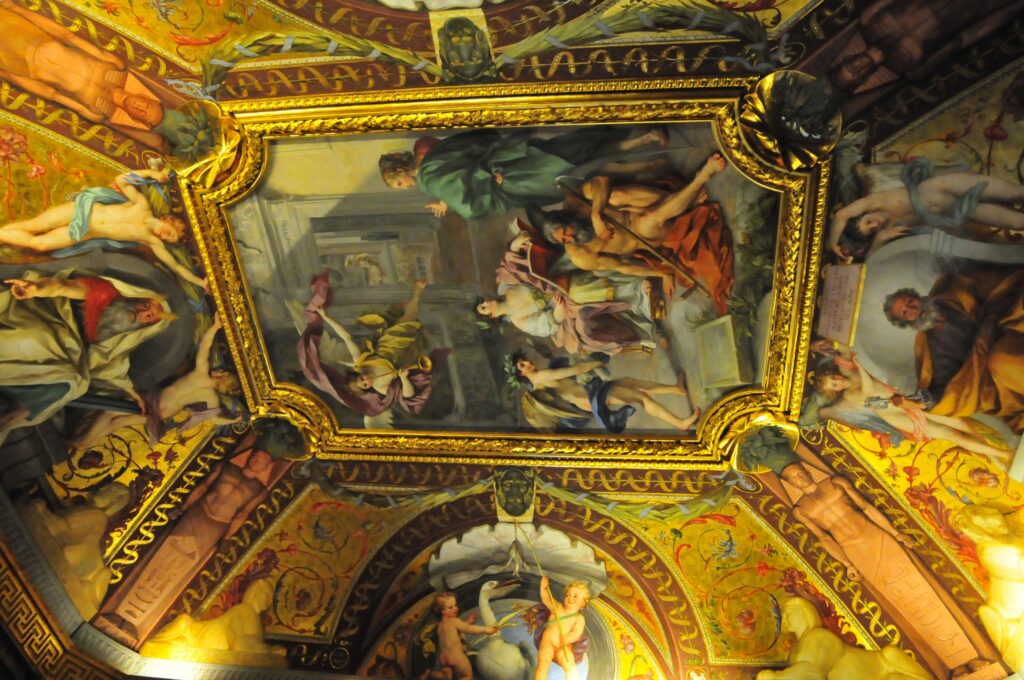
Raphael and his team set to work by destroying the previous masterpieces and applying fresh plaster. Then they repainted the walls with spectacular visuals. What began as a political act of spite accidentally became the pinnacle of the High Renaissance.
Of the four Raphael rooms, the absolute zenith is the Room of the Signatura, where Raphael painted The School of Athens. Rather than a biblical scene, it depicts a grand imaginary gathering of history’s greatest philosophers—Plato, Aristotle, Socrates—conversing in a vast, arched classical setting. The intrigue lies in how Raphael embedded his own rivalries and admirations into the work.
The two groups, entering and leaving simultaneously, could literally look into each other across the void, yet never physically collide. It was a revolutionary crowd-control mechanism disguised as a sublime work of art.
He used the faces of his contemporaries to portray the ancient thinkers: Leonardo da Vinci was immortalised as Plato. In the foreground, slumped against a block of marble, sits a brooding, solitary figure whose face belongs unmistakably to Michelangelo.
So, Leonardo’s observation—not just men, but the workings of the minds of men—their admirations, as well as their rivalries, all were frozen into fresco for eternity.
The Sistine Chapel – The Cappella Sistina
Out of the last Raphael Room, down a flight of steps, walk through a quiet, low-ceilinged corridor—and then a heavy door. Push it open and the Vatican delivers its grand finale. The Sistine Chapel.
Originally known as the Cappella Magna or the Great Chapel, it was constructed between 1473 and 1481 by Pope Sixtus IV to serve as a venue for both religious and functional papal activities.
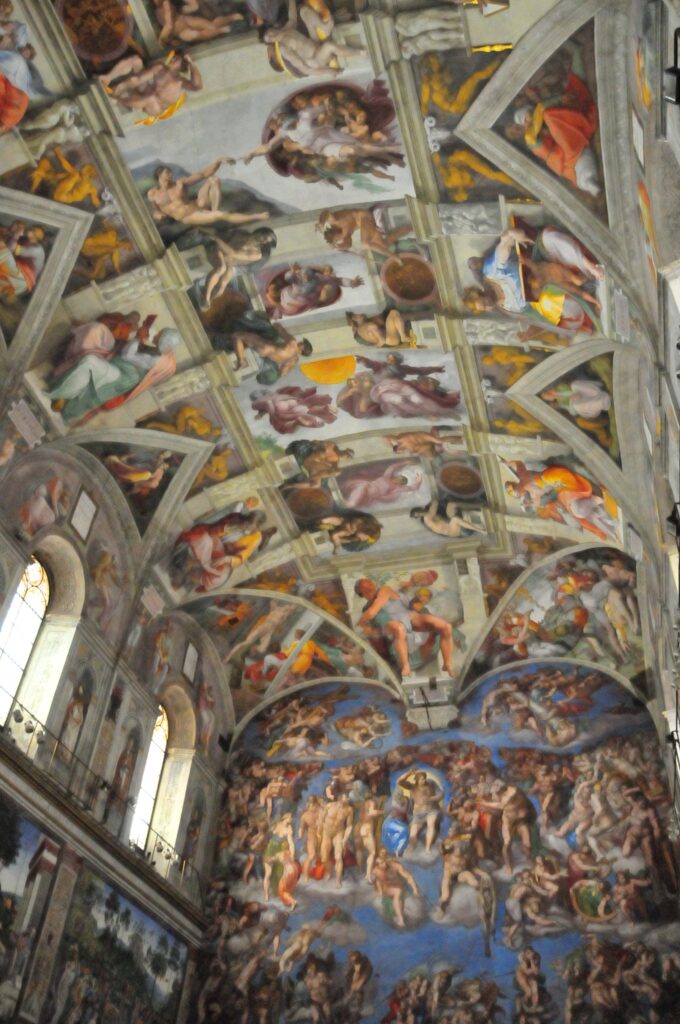
As a big fan of Dan Brown, I was keen to view the historic seat of the Papal Conclave, where Cardinals assemble in absolute secrecy to elect a new Pope. The smoke from the chimney signalling their decision to the watching world literally held me captive. But I must confess, I was quite sceptical about the painted ceilings I had read so much about. How extraordinary could a ceiling really be?
But the moment I entered, I forgot everything.
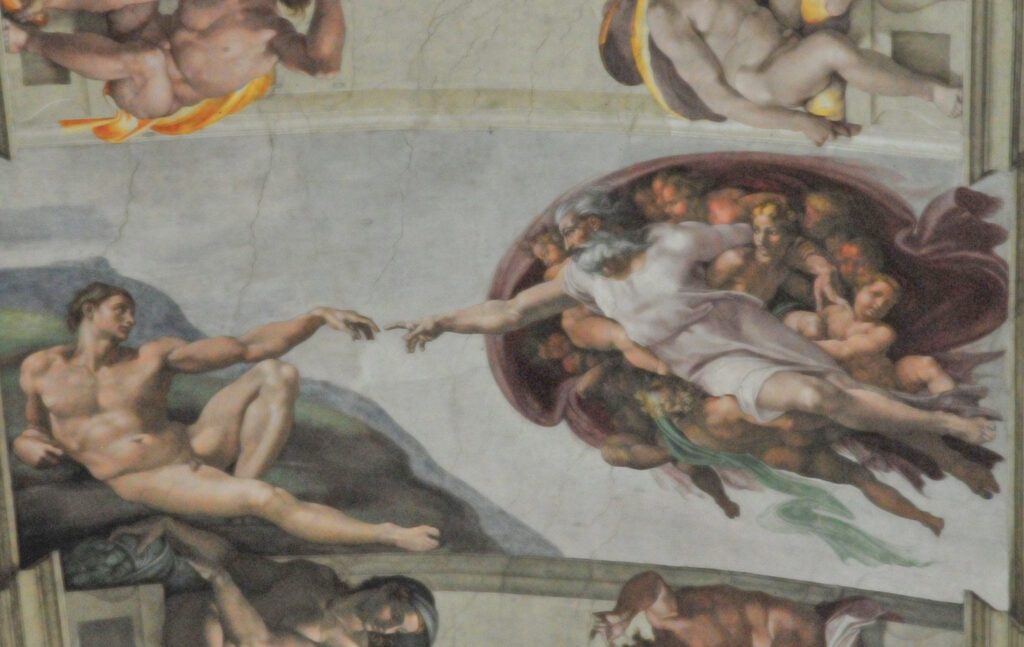
Guards whispered a constant rhythm of “Silenzio” and “No flash foto,” trying to maintain an atmosphere of reverence, but the crowd gasped louder and louder, their heads tilted back in collective awe. It was probably the most famous ceiling in the universe—over three hundred figures stretching across 500 square metres in an overwhelming tapestry of Genesis, from the separation of light from darkness to the iconic gap between the fingers of God and Adam in The Creation of Adam.
What makes this room truly haunting is the inhuman act of a human being. In 1508, when Pope Julius II approached Michelangelo with the commission, the artist resisted. He considered himself a sculptor, not a painter. Julius II was unmoved and trusted his instincts.
I realized that what I had experienced was not merely a Basilica or a museum, but a quiet, deliberate narrative of what human beings can achieve when driven by a fierce, unyielding passion—be it for power, for art, or for spirituality.
For four years, day after day, Michelangelo stood on wooden scaffolding, his neck craned violently backward, painting on wet plaster, breathing in toxic paint fumes, and blinking through a constant rain of blinding dust that dripped directly into his eyes. By the time he finished in 1512, having painted some 300 figures across 500 square metres of curved ceiling, his vision was permanently damaged. His back was hunched. His legs were so swollen from wearing his boots continuously that when he finally took them off, his skin peeled away.
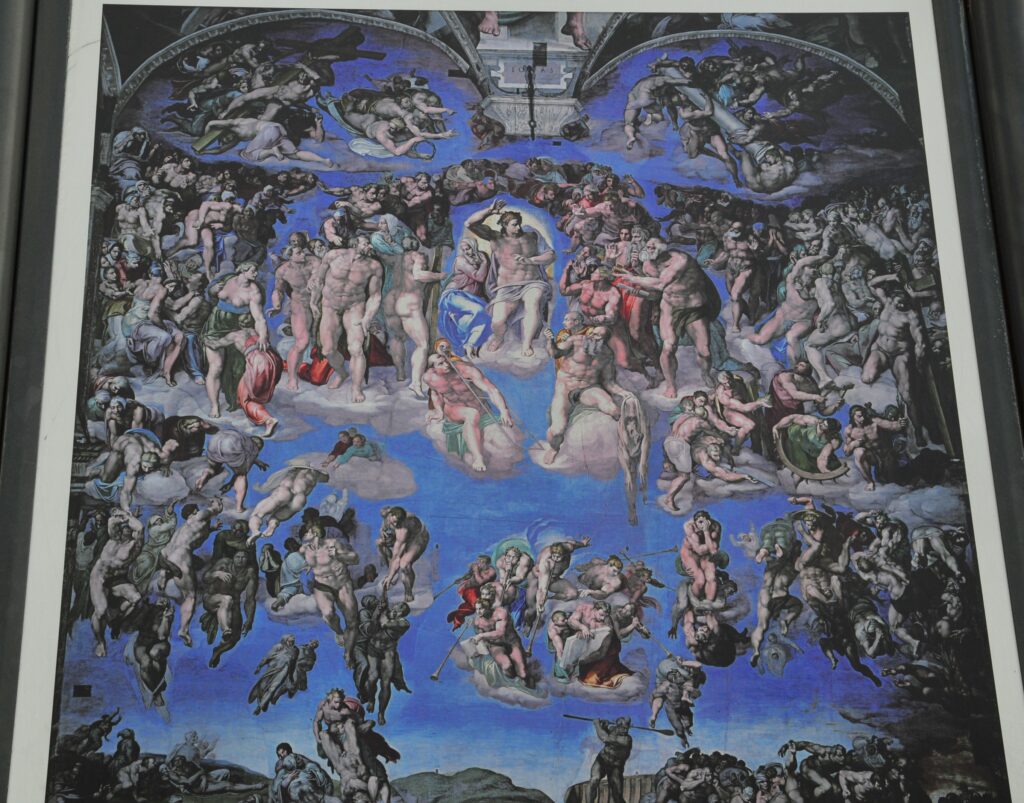
He was called back again in 1535 to paint The Last Judgment on the altar wall, which later on stirred a lot of controversy for the nude portrayal of holy figures. It was considered disgraceful, and an artist who went by the derogatory nickname, ‘Braghettone—the Breeches Painter,’ was asked to cover the genitalia!
Standing there in the crowded silence, I bowed to the creator, not only for his masterpieces but also for his absolute, brutal willpower. The restoration of the ceiling only took a team of four elite restorers over three times longer (1980–92) than it took a single tormented genius to create it.
The Farewell Spin
Just when I thought my overworked senses could not absorb any more shocking grandeur, the Vatican delivered one final, unexpected spectacle right at the exit.
The famous double-helix staircase, designed by architect Giuseppe Momo in 1932, is a visual illusion carved in stone and bronze. From above, it appears as a seamless whirlpool circling a vortex. In reality, there are two entirely separate staircases giving the illusion of an intertwined DNA strand—one descending and one ascending—allowing two streams of visitors to pass without ever crossing paths. Rimmed with an intricately carved bronze balustrade and illuminated by a massive glass dome overhead, walking down its gentle slope felt less like a museum exit and more like a lesson in geometry.
But why build an ascending staircase when the museum follows a strict one-way policy? Because of the Jubilee crowds, of course. (The Jubilee concept was described at length in The Vatican City – a Sovereign Paradox – Part 1.)
When Pope Pius XI announced 1933 as an extraordinary Holy Year of Jubilee commemorating the 1900th anniversary of the death and resurrection of Christ, the Vatican anticipated a large influx of global pilgrims. The existing entry-exit system was a bottleneck. To solve this, Momo was commissioned to design an entirely new entrance building whose staircase could handle the Jubilee traffic efficiently.
The two groups, entering and leaving simultaneously, could literally look into each other across the void, yet never physically collide. It was a revolutionary crowd-control mechanism disguised as a sublime work of art. Today, because of the one-way traffic flow, the ascending side stands eerily empty, leaving visitors wondering about its purpose—unless, like me, they, too, dig a little deeper.
By the time I was ready to leave, my mind was delightfully numb from the sheer weight of what I had just witnessed. I realized that what I had experienced was not merely a Basilica or a museum, but a quiet, deliberate narrative of what human beings can achieve when driven by a fierce, unyielding passion—be it for power, for art, or for spirituality.
Photos by Subhasis Banerjee

Monideepa Banerjee is an avid explorer and a passionate writer from Bangalore, India. Her articles on travel, art and culture have been featured widely in many prestigious dailies and magazines, photo-journals and web-portals in India and abroad. She has a Master’s degree in Journalism, a B. A in English, a B.Ed. and a Diploma in Early Childhood Education. She is well-versed in Bengali and English and writes spontaneously in both languages. Her published books, ‘The (mis) adventures of Teddy Tumbledore, ‘Tilly’s Squad in Jungle Beats’ and ‘ঠাম্মা ও গাভাস্কর’ are well accepted by young readers for their engaging, simple narrative and emotionally resonant content. Her latest work, a three-book series in Bengali ‘টেডির মজার কাণ্ডকারখানা’ is enjoying a good run.