

Bali and the Business of Paradise
Arrival: Feeling like a Billionaire
Bali has a peculiar way of making you feel wealthy. Everything in Bali exists in lakhs, even a simple meal. For the first few days, converting prices became an entertaining mental exercise. Eventually, however, one simply surrenders and embraces the illusion of extraordinary wealth. Reminded me of my time five years ago with the Dong in Vietnam.
Nonetheless, the real billionaire feeling arises because the island offers a version of luxury that feels effortless: the freedom to breathe fresh air, stroll along immaculate roads, swim in crystal waters, linger through warm tropical nights without constantly watching the clock.
Also Read: Blissful Bhutan: A Himalayan Secret – Part 1
Bali is among the most famous islands in Indonesia’s sprawling archipelago of more than seventeen thousand islands. Popular culture, especially films like Eat Pray Love, coupled with the island’s affordability, has transformed it into one of the world’s most sought-after tropical destinations.
The island experiences two principal seasons—summer and monsoon. Despite repeated warnings about the tropical heat, we chose to trust the Internet when it said June is the best time to visit Bali. The monsoon, while cooler, often complicates inter-island travel. We decided to brave the blazing sun instead.

Like many destinations, Bali wears different faces. Kuta, Seminyak and Canggu represent its urban personality. Kuta thrives because of its proximity to both the airport and the harbour, while Seminyak and Canggu pulse with beach clubs, cafés and nightlife. Further north lies Lovina Beach, famous for dolphin sightings at sunrise. Inland, surrounded by forests and rice terraces, rests Ubud, the artistic and cultural soul of the island, to name a few places.
Where the Adventure Began
The trip began at Benoa Beach. The morning air carried the smell of salt and sunscreen while boats buzzed across the water and vendors called out to passing tourists. The sea shimmered beneath a cloudless sky as we prepared ourselves for four different water activities, after much bargaining.

The most memorable of them all was parasailing. As I rose higher into the sky, the sounds of the beach gradually faded away. The roar of jet skis softened into a distant hum. Below me stretched an endless canvas of blue water punctuated by tiny boats and a golden sandy beach afar.
I was accompanied by kites far into the sky. Despite the scorching summer afternoon, the wind at that height was cool and gentle. For a few moments, suspended between sea and sky, Bali felt impossibly serene. A close second was the jet ski—a thrilling blur of speed, spray and adrenaline. Underwater-sea-walking followed closely behind, though my family strongly disagrees with my ranking.
Our first stop was Crystal Bay. It looked less like a beach and more like a film set. A crescent of pale sand framed calm turquoise water while forest-covered hills embraced the bay from either side.
What surprised me more, however, was not the adventure but the familiarity. It was while doing the water activities that we realised for the first time that the Balinese are highly exposed to Indian pop culture, especially Bollywood. While I was riding the jet ski, the local operator accompanying me suddenly broke into an enthusiastic rendition of Dhoom Machale. Elsewhere, a woman selling activity packages introduced herself as “Nita Ambani” with perfect comic timing simply because her name happened to be Nita. Thousands of kilometres from home, Bali often felt unexpectedly familiar.
Uluwatu: Sunsets, Monkeys and Ramayan
Perched dramatically atop a cliff overlooking the Indian Ocean, Uluwatu Temple appears less like a temple and more like a sentinel guarding the edge of the island. The scent of incense lingered in the air as waves crashed relentlessly against the cliffs below. Dressed in sarongs and sashes, visitors moved through the temple grounds under the watchful eyes of monkeys notorious for stealing food, sunglasses, hats, and anything else left unsecured.

As sunset approached, the temple transformed. The sky shifted from blue to amber, then to shades of crimson and gold. The sea reflected the fading light while hundreds gathered in the temple’s amphitheatre to witness Bali’s famous Kecak Dance. Unlike most traditional performances, Kecak uses no musical instruments. Instead, dozens of men sit in concentric circles chanting rhythmic “chak-chak-chak” sounds in hypnotic unison. The sound rises and falls like waves, at once mesmerizing and overwhelming.
Also Read: Blissful Bhutan: A Himalayan Secret – Part 2
Inspired by the Ramayana, the performance unfolds against one of the most spectacular natural stages imaginable, the setting sun disappearing into the Indian Ocean. Yet Hanuman’s playful interaction with the audience and his spectacular dance through fire ensured that the evening ended on a memorable note.
Nusa Penida: The Island of Priests
Everyday several fast-boats leave the Sanur Harbour, carrying eager travellers to head to several other islands, one such island is Nusa Penida, an island separated from Bali by the Badung Strait. Nusa means ‘island’ and Penida means ‘Priests’. Its name reflects its historical connection to Balinese Hinduism. Curiously, Dutch records from the early twentieth century referred to it as “Bandit Island”, likely because Balinese kingdoms once used it as a place of exile for ostracised criminals and outcasts. Today, Nusa Penida is a quintessential island vacation destination. Both of its east and west coasts boast pristine beaches, limestone cliff views, and vibrant marine life.

We boarded an 8:30 AM fast-boat from Sanur. The harbour was bustling with activity, with tourists wheeling suitcases across wooden piers, crew members shouting instructions over the rumble of engines, and the scent of saltwater mingling with diesel fumes in the humid morning air.
As the boat cut through the waves, Bali slowly receded into the distance. Fifty minutes later, we arrived at Nusa Penida, where our driver ushered us into a Suzuki APV and navigated the island’s rugged roads. The journey itself felt like an adventure. Dense greenery lined narrow uphill roads while occasional glimpses of the sea flashed through the trees.
A short walk away stands Pura Batu Bolong, this sister temple sits on a striking natural rock arch over the water. The walk to these temples features an extensive market offering authentic Balinese souvenirs, snacks, and local crafts.
Our first stop was Crystal Bay. It looked less like a beach and more like a film set. A crescent of pale sand framed calm turquoise water while forest-covered hills embraced the bay from either side.

Our second stop was Angel’s Billabong. Standing at the edge of the cliff, we watched waves crash against ancient rock formations before swirling into a natural whirlpool below. The sound was hypnotic, a constant rhythm of roar and spray. Tiny droplets hung in the air and caught the sunlight, creating fleeting silver mists.

Adjacent to it is the Broken Beach. Nature appears to have sculpted an enormous stone bridge over the ocean, creating a circular cove connected to the sea by a dramatic archway, wide enough for small boats to traverse through. Looking down from above, the water seemed almost impossibly clear. Even from the viewpoint, we could distinguish patches of algae and marine life beneath the surface. The beauty, however, came at a price. The rocky pathways between viewpoints felt relentless under the midday sun.

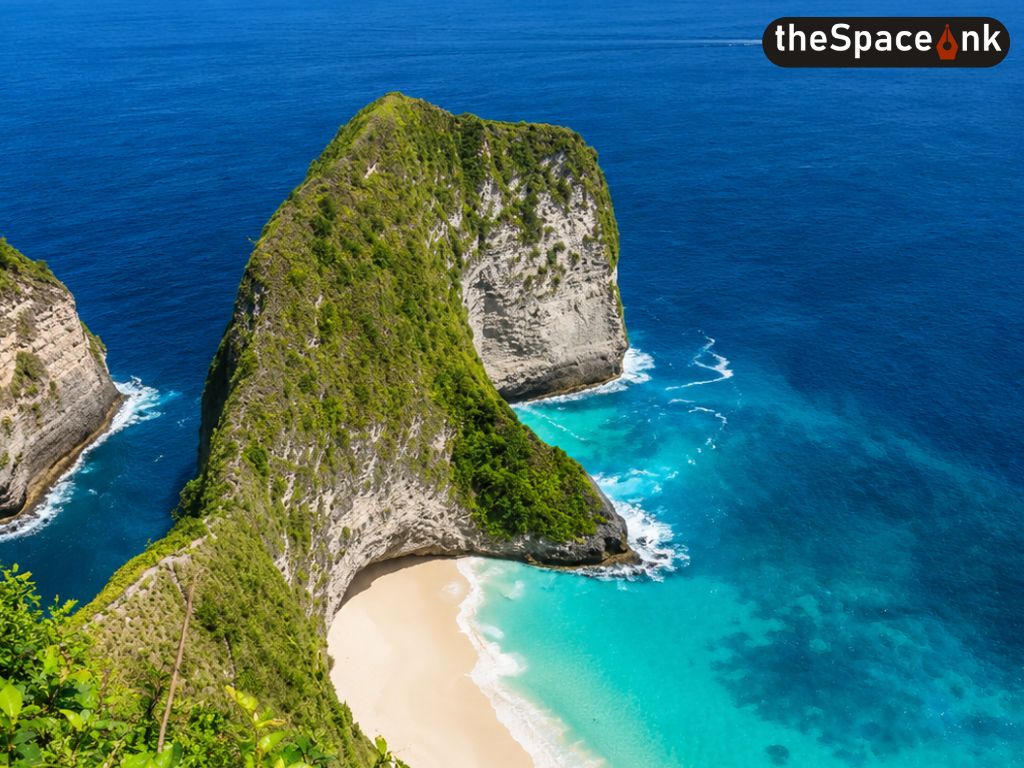
Following a local lunch of nasi goreng, we headed to Kelingking Beach -few photographs prepare you for the scale of it. The famous T-Rex-shaped cliff rises dramatically above brilliant white sand and water painted in impossible shades of azure. Even from the viewpoint at the top, we could see a Manta Ray gliding through the water near the shore.

The descent to the beach looked treacherous and exhausting, and we wisely decided against attempting it. Some views are best admired from a distance. We spent the remainder of the day at a modern beach club, where I tried Arak, local Balinese alcohol, before returning to Kuta on the evening ferry. Overall, the spectacular views are worth all the hype and every drop of sweat.
A Cultural Day through Bali’s Sacred Soul
If Nusa Penida revealed Bali’s panoramic natural beauty, the following day introduced us to its spiritual heart.
Our first stop was Tanah Lot Temple. Its name translates to “Land in the Sea”, an apt description for a temple that appears to rise directly from the ocean. Built upon a rocky outcrop accessible only during low tide, Tanah Lot is among Bali’s most revered sea temples. The mystery of the temple revolves around its dramatic “floating” appearance, mythological legends of snakes, and a local curse on unmarried couples.

However, entry into the temple is permitted only to Balinese Hindu, preserving the sanctity of the place like many other Balinese Hindu temples. A short walk away stands Pura Batu Bolong, this sister temple sits on a striking natural rock arch over the water. The walk to these temples features an extensive market offering authentic Balinese souvenirs, snacks, and local crafts.

From the coast, we continued inland. The landscape gradually transformed from beaches to rolling hills as we made our way towards Ulun Danu Beratan Temple. En route, we stopped at a coffee plantation where we were introduced to several varieties of coffee, such as arabica, vanilla, ginseng, to name a few. The most outlandish of it all was undoubtedly Kopi Luwak made from coffee cherries eaten and excreted by Civet Cats. It is marketed as one of the world’s most exclusive coffees.

The plantations have become tourist sites offering visitors an insight into civets wandering around and shitting, while guides explain the production process; bizarrely normal in Bali. When I finally tasted it, I found it surprisingly ordinary. It possessed a rich aroma and a strong, bitter flavour, like a regular black coffee, certainly nothing extraordinary.

By afternoon, we reached Ulun Danu Beratan Temple. Of all the temples we visited, this may have been the most atmospheric. Dedicated to the goddess of lakes and water bodies, the temple appears to float upon Lake Beratan surrounded by lotuses. Its tiered pagodas reflected perfectly on the still water while lush green mountains rose in the background.
The chilled Bedugul highland air came as a welcome relief after days spent under the coastal sun. We were fortunate enough to witness the Temple when it was surrounded by mystical hilly mist while a group of musicians performed in the temple complex, traditional Balinese music known as Gamelan; sacred rhythmic music performed by an orchestra of percussionists.
Next Part: 17 July, 2026
All Rights Reserved
Image Courtesy: Author

Aradhita Banerjee is an Advocate, practicing primarily at the Calcutta High Court. She has pursued law from Symbiosis Law School, Pune, after completing her under graduation in Political Science (Hons) from St. Xavier's College, Kolkata. She hails from a musical Bengali family in Kolkata. When she is not delving into legal texts, she is exploring new destinations, reading new books, and appreciating cinema and fine arts.



7 Responses
A wonderful read! Your storytelling and beautiful details brought Bali to life. Thanks for taking us along on your journey.The photographs are absolutely beautiful and perfectly complement the narrative, making the entire experience even more immersive.
Beautiful write up makes us visualize the wonder and mystery of the wonderful place. The words are pictures in words recreating the exuberance of nature. Our mind assumes a vivid role while Aradhya delineates vividly
Excellent depiction. You can be a travel blogger.
It’s really amazing. Our little Runjhun has not only grown up to be a lawyer but has turned out to be an excellent writer. Haven’t visited Bali but, from Aradhita’s description, I could visualize everything. Excellent photography too.
Lots of love, best wishes and blessings Runjhun.
I always love reading about your adventures! And your photos are incredible. I could almost taste the nasi goreng. I’m excited to read part two!
Beautiful article, enjoyed very much. Wish more such articles from her.
Very informative, lucid language supported by beautiful photographs, Aradhita’s article is going to be extremely helpful for a Bali tour I’m sure. Thank you!