

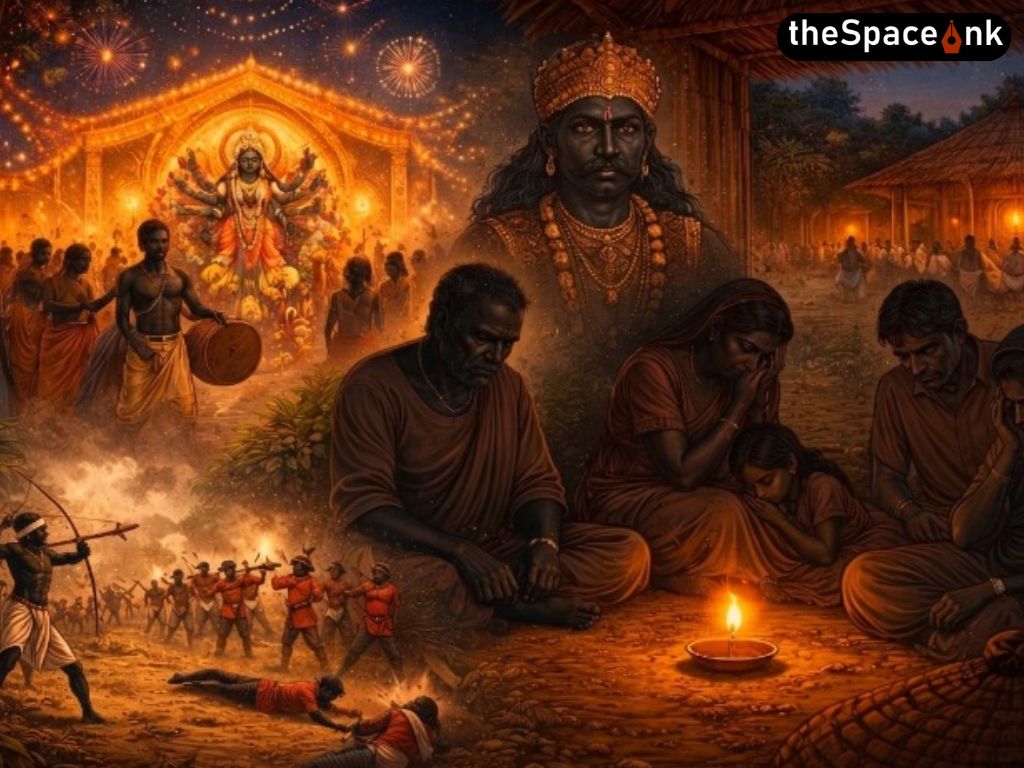
Durga Puja and Santhal’s Mourning
My ancestral village, Sansat, just a few miles from Bolpur, has always felt like a pause button on life. Every school holiday, we left behind Kolkata’s relentless rush, its noise and impatience, and returned to a slower rhythm where time stretched and breathed. On the rare, blessed winter days when the elders did not frown upon “unnecessary outings,” we would make our way to the Santhal farmhand’s makeshift shelters on the edge of the village to listen to their stories.
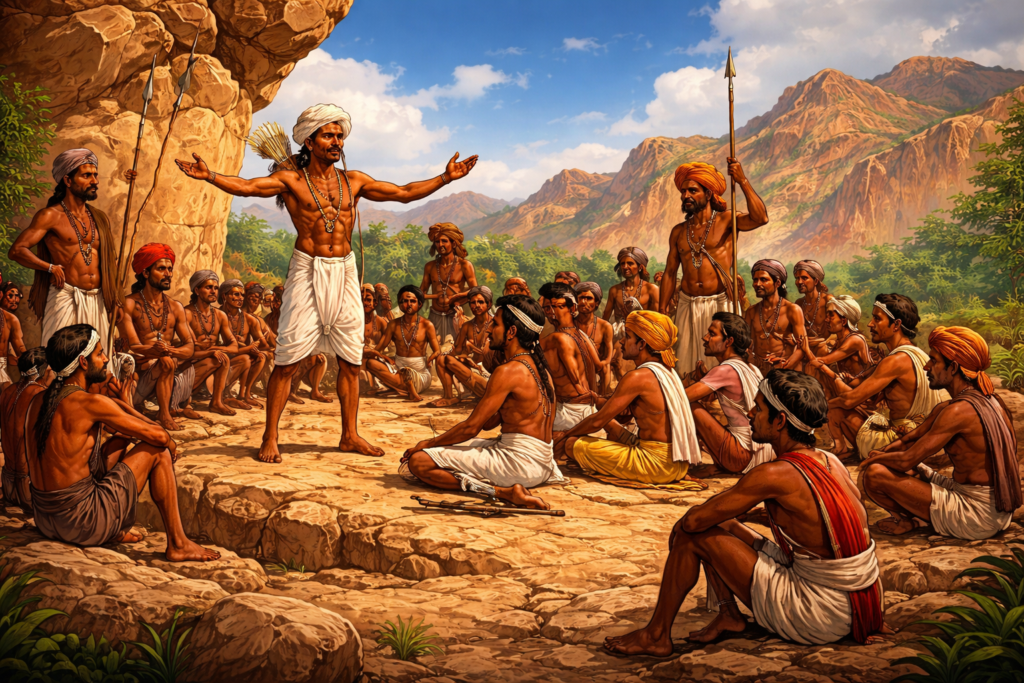
Long before ink touched parchment and empires carved their triumphs into stone, the Santhal people lived in quiet harmony with forests that whispered, rivers that sang, and red earth that held their footsteps. Their history was never trapped inside books. It lived instead in lullabies sung to restless children, in stories murmured beside dying embers, and in the steady heartbeat of drums beneath moonlit skies. In these living memories, their ancestors never truly left. They walked beside the living, offering courage, protection, and an unbroken sense of belonging.
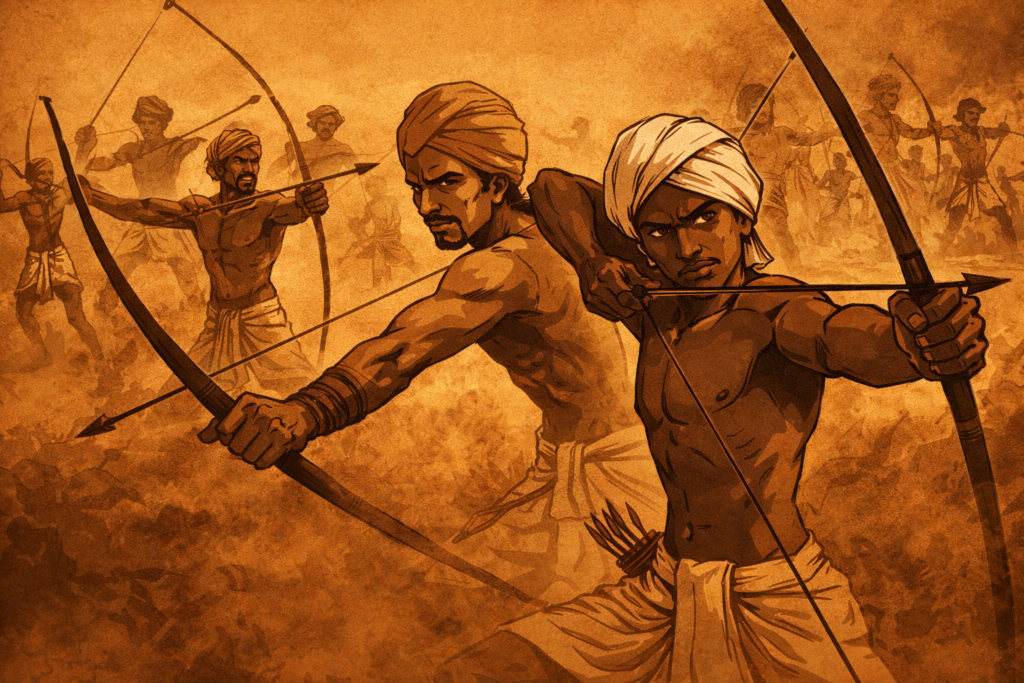
For thousands of years, the Santhals existed beyond the gaze of courts and chroniclers. Scholars now piece together fragments of their past from scattered languages, broken tools, and faint echoes in forgotten records. They were hunters who knew the secrets of the forest, farmers who trusted the seasons, and guardians who honored the land as sacred kin. Though their names may not appear in ancient scriptures or the travel accounts of distant pilgrims, their presence was deeply etched into the soil of eastern and central India.
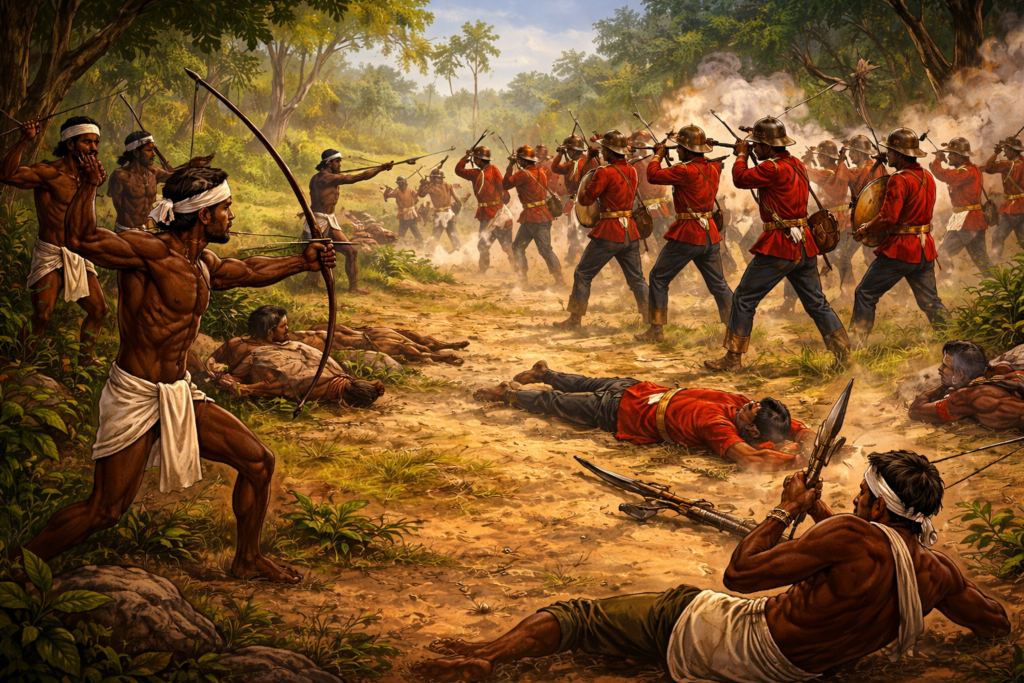
History finally took notice when conflict erupted. Early medieval records offer only vague glimpses of forest tribes, and Mughal documents mention them in passing. But it was under British rule, particularly after the Santhal Rebellion of 1855–56, that their existence was formally recorded. Even then, they entered history not as a people with rich traditions, but as subjects of control, resistance, and punishment.
In the earliest verses of the Ramayana, Valmiki never described Rama worshipping Durga before battle. That ritual emerged much later, woven into regional retellings such as Krittibas Ojha’s fifteenth-century Bengali version. From there, Durga Puja flourished, becoming one of India’s most cherished festivals. Yet as these newer narratives rose, older ones that were tribal, fragile, unprotected were quietly pushed aside, nearly erased.
At the heart of Santhal memory stands a beloved figure: Adura, also called Hudur Durga or Asur Durga. To his people, he was no monster, no demon of darkness. He was a just king, a fearless protector, a man who stood between his people and annihilation. Under his leadership, the land prospered and justice flowed freely. His reign was one of dignity, balance, and hope.
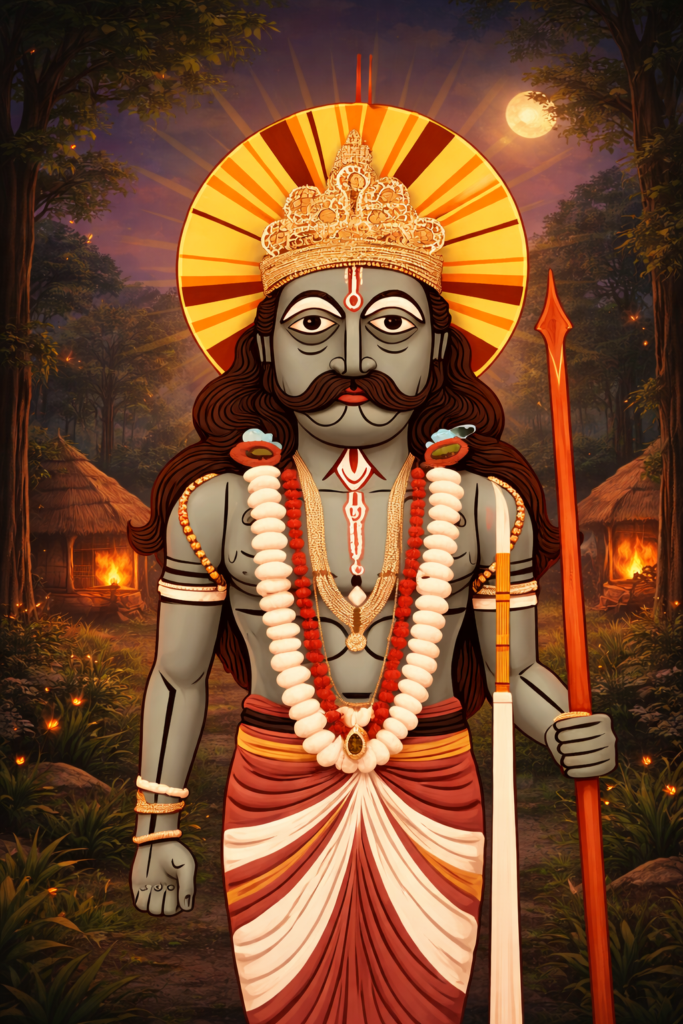
But strength alone could not save him. When brute force failed, deceit prevailed. Through betrayal and conspiracy, Adura was slain, not in open combat, not with honor, but through treachery. His death tore a wound into the collective soul of his people, a wound that time could not heal.
Centuries passed, and his story was reshaped by unfamiliar voices. The fallen tribal hero slowly transformed into Mahishasura, the buffalo demon. His tragic death became a divine victory, celebrated as the triumph of Goddess Durga. Across India, this retelling blossomed into Durga Puja; a festival of light, color, music, and overflowing joy, symbolizing the eternal conquest of good over evil.
In remote villages across Jharkhand, West Bengal, Odisha, and Bihar, the Santhals still remember. Elders pass the old stories to trembling young voices. Their restrained rituals guard truths too painful, too precious, to abandon. In their silence lies resistance. In their sorrow lives identity.
But memory does not surrender so easily. For the Santhals, the thunder of celebratory drums echoes like a funeral march. As cities glow with lamps and laughter, their hearts grow heavy. What others celebrate as victory, they remember as loss. The fall of Mahishasura is, to them, the martyrdom of their ancestral king. While crowds gather in splendor, Santhal homes grow quieter. They choose simplicity over adornment, silence over song, reflection over revelry. They do not dance. They do not celebrate. They mourn softly, solemnly, with a dignity shaped by centuries of sorrow.
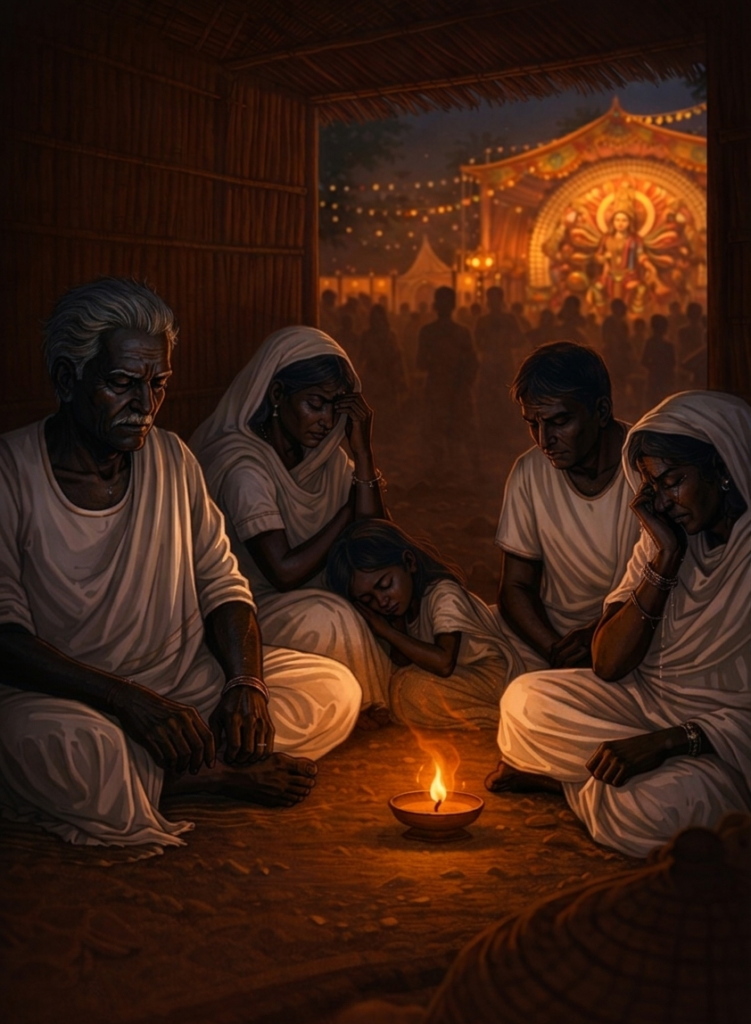
This is not rebellion. It is remembrance. Even the grand traditions of Durga worship were not always as they are today. In the earliest verses of the Ramayana, Valmiki never described Rama worshipping Durga before battle. That ritual emerged much later, woven into regional retellings such as Krittibas Ojha’s fifteenth-century Bengali version. From there, Durga Puja flourished, becoming one of India’s most cherished festivals. Yet as these newer narratives rose, older ones that were tribal, fragile, unprotected were quietly pushed aside, nearly erased.
Durga Puja, then, becomes a mirror reflecting India’s complex soul: radiant joy for some, sacred grief for others. It reminds us that history is never singular, that every triumph casts a shadow, and that every celebration may conceal a wound.
Nearly—but not completely. In remote villages across Jharkhand, West Bengal, Odisha, and Bihar, the Santhals still remember. Elders pass the old stories to trembling young voices. Their restrained rituals guard truths too painful, too precious, to abandon. In their silence lies resistance. In their sorrow lives identity.
Durga Puja, then, becomes a mirror reflecting India’s complex soul: radiant joy for some, sacred grief for others. It reminds us that history is never singular, that every triumph casts a shadow, and that every celebration may conceal a wound. While victors carve their stories into monuments, the wounded carry theirs in memory, song, and quiet tears. And so, in the hush beneath the festival’s roar, the Santhals keep alive the memory of a fallen king, a stolen legacy, and a promise broken long ago; yet still breathing in their prayers, their stories, and their unyielding sense of who they are.
As the wintry afternoons linger lazily over the rooftops of northern New Jersey, I hear the faint echo of the Santhal story; its details etched in memory, its ache settling deep into my chest, a quiet pang of a world both distant and intimately familiar.
Image Courtesy: Facebook, AI

Dr. Jamil is a passionate oncology commercial leader whose two-decade journey has been driven by a deep commitment to improving the lives of people with cancer. As Head of the Early Commercial Team at Merck Oncology and an Adjunct Professor at Columbia Business School, he shapes innovative pipelines while mentoring and inspiring future healthcare leaders. Beyond work, he is a soulful armchair historian of Bengal, a devoted Manchester City fan, and someone whose heart is forever tied to the culture, stories, and spirit of Kolkata.


3 Responses
Beautifully written words of wisdom. Model for personal power
Learned something new through this article. Very well written.
Wow! It is so moving. Beautifully written.