

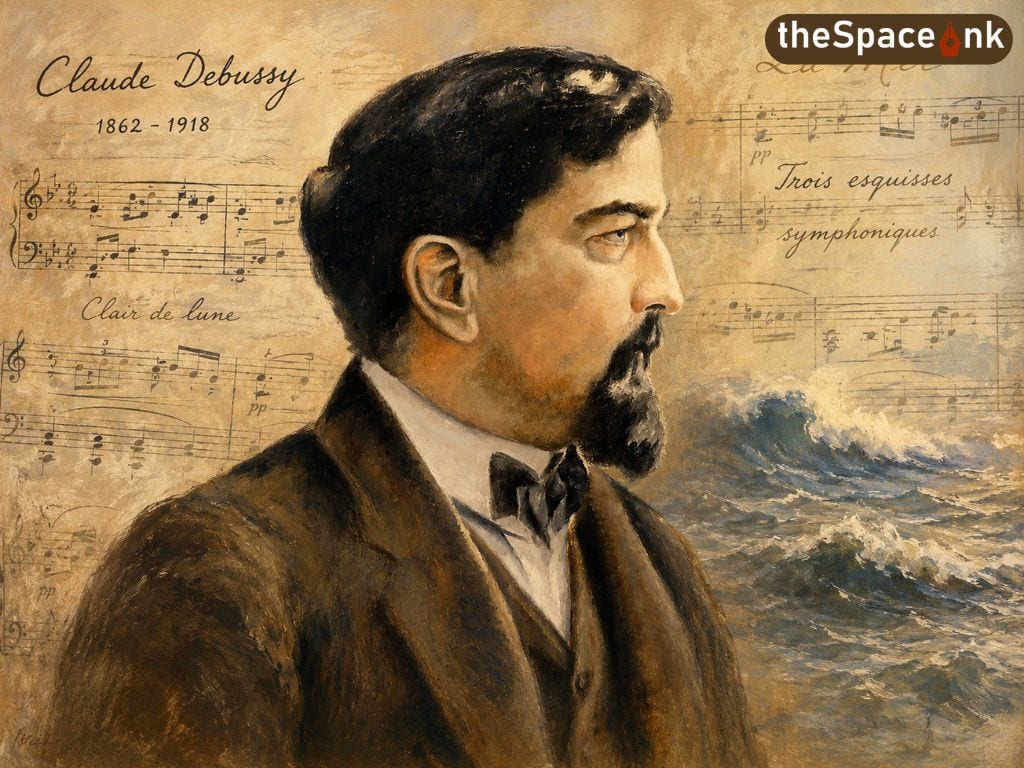
Achille Claude Debussy: A Musical Kaleidoscope
In the astounding galaxy of western classical music, Bach, Mozart and Beethoven are the brightest stars without a doubt. However, among other stars occupying a place of honour is Achille Claude Debussy, a French musical genius born in 1862 at Saint-Germain-en-Laye on the northwest fringes of Paris. To fathom the significance of Debussy’s works, we need to appreciate the fascinating evolution of western music.

Western art music listeners’ tendency to refer to this massive body of work as ‘western classical’ places Beethoven and Debussy in the same ill-defined box. In reality, composers in the pre-Mozart era, before 1750-1820, were actually ‘baroque musicians. Similarly, Tchaikovsky, Schumann, et al, belonged to the ‘romantic period’. The term romance here is a combination of passion and individualism, where raw emotions get a voice in the form of a composition.
Beethoven’s creations were more of a bridge between the classical and romantic worlds making it impossible to ‘box’ him in any way. After the romantic period, a movement emerged in France, where ambience, motifs and fleeting moods were brought to the forefront and passionate storytelling took a backseat. The key representatives of this period were Claude Debussy and Maurice Ravel.
Video: Strings of Silence Herald Revolution: The Musical Journey of George Harrison
The name of a period bears the fingerprint of the general ethos of an era which leaves its indelible mark on the creations of the time, and music is no exception to the rule. This is exactly the reason why I shall not shy away from calling Debussy an ‘impressionist’ although he allegedly hated the term, as it makes the discerning listener ready to listen to music which might not be as impactful as Mozart or Beethoven, but where motifs like the swelling sea or a silent night landscape have been ‘painted’ with a perfect sequence of notes.
Debussy had a strong emotional connection with the sea and strongly believed that he was “destined for a sailor’s life”. This fascination prompted him to write an orchestral composition: La mer, trois esquisses symphoniques pour orchestre (The sea, three symphonic sketches for orchestra), or simply La mer (The Sea), between 1903 and 1905.
This work, which is considered now to be one of the most influential orchestral compositions, was heavily criticized after its premiere in Paris on the 15th of October 1905. Even his admirer Pierre Lalo famously commented: “I do not hear, I do not see, I do not smell the sea”. They could not appreciate the composer’s urge to break new ground and create a new musical expression which does not ‘move’ the audience in the conventional sense of the term, but captures the imagination of the creator.
Debussy found conventional music rooted in the symphonic structure to be highly restricting and attempted to overcome the undeniable influence of the musical language established by the likes of Beethoven. Timothy Judd, a member of the violin section of the Richmond Symphony, writes, “Claude Debussy’s La Mer is not a literal portrait of the ocean.
However, the iconic avante-garde of modern culture, Jean Cocteau said on La Mer, “…as architecture reflected in the water, waves forming and disintegrating, but it was all an incoherent babble that had yet to find a human voice to express itself. Now, at last, a thousand indeterminate miracles of nature have found their translator”. In his introduction to Debussy, British pianist and writer Paul Roberts says:“…Debussy uses it as a symbol for our primal origins.
We emerge from the sea, life came from the sea, So, in a very big cosmic sense, the sea is a very profound symbol…in a movement called from dawn to midday, we have the dawn, we have the waking up of the world, specifically the waking up of the sea, and the sea wakes up, does it not, because the sun rises and it definitely does come out…”. Indeed, the use of a harp and the wind section gradually moving towards a crescendo aptly depicts the rush of waves. One can almost see the waves as we usually see them at daybreak.
Also Read: Two Faces, Twenty-Four Years: Finding Renoir at the Clark
Debussy found conventional music rooted in the symphonic structure to be highly restricting and attempted to overcome the undeniable influence of the musical language established by the likes of Beethoven. Timothy Judd, a member of the violin section of the Richmond Symphony, writes, “Claude Debussy’s La Mer is not a literal portrait of the ocean. There is no ‘program’ or story, as we might hear in Beethoven’s ‘Pastoral’ Symphony (the 6th symphony) or a Strauss tone poem. Instead, La Mer takes us deep into the world of atmosphere, metaphor and synesthesia (a blurring of senses)…”.
In a documentary on Debussy, Simon Callow says,“…German models were not appropriate for French musicians. He was looking for an entirely new aesthetic, a new language, a new way of speaking music…”. What helped the composer to find this new expression was his interest in Oriental cultures, especially Japanese art. Japan was largely cut-off from the Western Hemisphere during the so called ‘Edo Period’ (1600-1868). When trade routes opened up between Japan and Europe in the 1850s, there was a subsequent explosion of interest in Japanese art. In fact, a new term ‘japonisme’ was coined in this context.
Debussy’s work, on the other hand, is not as intense and might not appeal to the listener with an appetite for passionate compositions. It only attempts to draw a moonlit night with the help of notes instead of a paintbrush. Here, Debussy did what a Monet or a Renoir would do if they drew the night sky. It would not be a whirlpool of colours and textures like van Gogh’s starry night but simply the ratio of light and shade which we usually witness at night.
A number of painters, Monet, van Gogh, Degas, and others adapted the Japanese aesthetic. Keeping this backdrop in mind, it is not surprising that in the first printed version of the ‘La Mer’, featured Hokusai’s ‘The Great Wave off Kanagawa’, a tsunami wave almost devouring barges of Japanese fishermen.
This expression of boundless energy by Hokusai prompted Debussy to write music which also had the fluid, expressive quality of the painting. In fact, Debussy called his work ‘Three Symphonic Sketches’ as these three movements suggest a pictorial representation of the sea, where the composer does not attempt to depict the sea itself, but rather the feelings it generates in the mind of an observer, an atmosphere where the waves and the landscape are the main characters.
Another major work of the composer is called Suite bergamasque, a piano work which Debussy started to write around 1890 but significantly revised it just before its 1905 publication. The popularity of the third movement, Clair de lune, has made it one of the composer’s most famous works for piano, as well as one of the most famous compositions of all time.
Also Read: Remembering My Guru Maa Annapurna Devi
Clair de lune means ‘moonlight’ and was adapted from Verlaine’s poem bearing the same name. But how can the ‘motif’ of a moonlit night be something entirely new, when Beethoven had already composed his Mondscheinsonate, the ‘Moonlight Sonata’? The answer lies in the stylistic differences between the compositions. Beethoven’s work evokes the kind of emotions we feel on a lonely full moon night as we revisit all associated experiences. It is dramatic and turbulent at times, bordering on being stormy in the final movement.
Debussy’s work, on the other hand, is not as intense and might not appeal to the listener with an appetite for passionate compositions. It only attempts to draw a moonlit night with the help of notes instead of a paintbrush. Here, Debussy did what a Monet or a Renoir would do if they drew the night sky. It would not be a whirlpool of colours and textures like van Gogh’s starry night but simply the ratio of light and shade which we usually witness at night. This ‘shimmering’ or ‘fluid’ character makes Debussy’s interpretation stand out even in the presence of giants like Beethoven.
This work lacks the emotional depth of a Mozart, Beethoven or a Tchaikovsky, but is certainly less descriptive than La Mer or Clair de Lune and more passionate, where imagination takes a backseat for a change bringing feelings to the fore.
Among these examples of Debussy’s detached approach, where he focussed on impressions and sensations instead of intense emotions, there is a composition for solo piano by the master written between 1909 and early 1910 called La fille aux cheveux de lin, ‘The Girl with the Flaxen Hair’, where Debussy is not merely an onlooker, but takes us through an emotional journey.
The title was inspired by Leconte de Lisle’s poem by the same name portraying the image of a naïve Scottish girl. Interestingly, Debussy had written a composition from 1882 to 1884 with the same title. He dedicated most of his music composed during that period to a certain Marie-Blanche Vasnier with whom he had an affair.
Even a cold and solitary person like Debussy whose aim was to use notes like colours to merely paint a matter-of-fact picture, yields here to his emotions and let them flow. This work lacks the emotional depth of a Mozart, Beethoven or a Tchaikovsky, but is certainly less descriptive than La Mer or Clair de Lune and more passionate, where imagination takes a backseat for a change bringing feelings to the fore.
Also Read: Hindustani Classical Music in the Songs of Rabindranath Tagore
It is obviously a daunting task to capture the essential qualities of Debussy’s music through words. However, if I have been able to convince the reader to allow for music to be ‘visualized’ rather than ‘felt’, where a calm introspection replaces ups and downs of emotional surges, then I shall be more than satisfied. After all, ‘seeing music’ is not an oxymoron.
In the quantum world, our noses ‘hear’ vibrations in molecules, birds ‘feel’ their migratory routes through forces between electrons in their eyes and earth’s magnetic field, and indeed neurons make pictures in our brains from sounds. We just need to open our eyes to them.
Image Courtesy: dEpic, AI

Swapnasopan did his BS in chemistry and moved to Bengaluru to do his MS in Materials Science. Then he went to Germany to pursue research in a front ranking area in chemistry and has taken advanced training in that area.
Besides this, he studied western classical music under the tutelage of the renowned Violin Brothers. His parents have also contributed immensely towards helping him develop a taste in a musical horizon that covers Rabindrasangeet, rare gems from old Bengali classics, and Indian and Western Classical Music.
His other loves include literature, world affairs, cuisines, etc. among a number of other things. These interests prompt him to write articles in both Bengali and English, like the present one.





2 Responses
Thanks Swapnasopan for your good article with new information about Debussy .
Swapnasopan – as I know him – is a ‘Science man ‘ but his knowledge of music has always fascinated me – this article about Debussy is also well researched and indeed informative.