The Summit: Part 2
What followed was pure Dakshayagna—total, unmitigated chaos.
Supti Pishi’s shrill scream pierced the night’s peace like a jagged siren. Everyone came running. Ma stood frozen, her eyes blank. Looking at their curious, worried faces, I somehow managed to stammer, “Bhurshiyal…” Pishi finished the rest, adding her own juicy details. Boroma rushed to embrace Ma and murmured, “Sab thik hoye jabe. Dugga, Dugga. Don’t worry, Choto.”
Baba, who was not known for losing his temper, suddenly bellowed, “Thokriii!” Our old Bhojpuri darwan, who had been sitting on his charpoy, grinding tobacco and singing dreadful bhajans, was so startled that he leapt up in a panic, sending tobacco straight into his nose. The poor fellow exploded into violent sneezing and almost choked himself to death. In a panic, he rushed inside the house, shouting, “Kya hoilba?” amid terrible fits of coughing.
Meanwhile, Chhorda abandoned his maths lessons and began recounting every gory detail of the Bhurshiyal tale he knew, while Gogon Sir vainly tried to hush him. It was his moment of glory, his chance to boast about his news-gathering skills. Besides, Jethai loved me more, which perhaps prompted him to frighten me further with his tattletales.
“Sibling rivalry,” Toony muttered, glaring at Dhruv.
“Shasss… Thamma said no interruptions,” Riju chided.
With Thokri still sneezing and Chhorda and Supti Pishi jointly weaving horror stories, the house was a complete circus, but I was too terrified to laugh. Baba finally lost his temper. “Dhuttor! Worthless, all of you!” He stormed out of the house to organise a hunt to catch the beast.
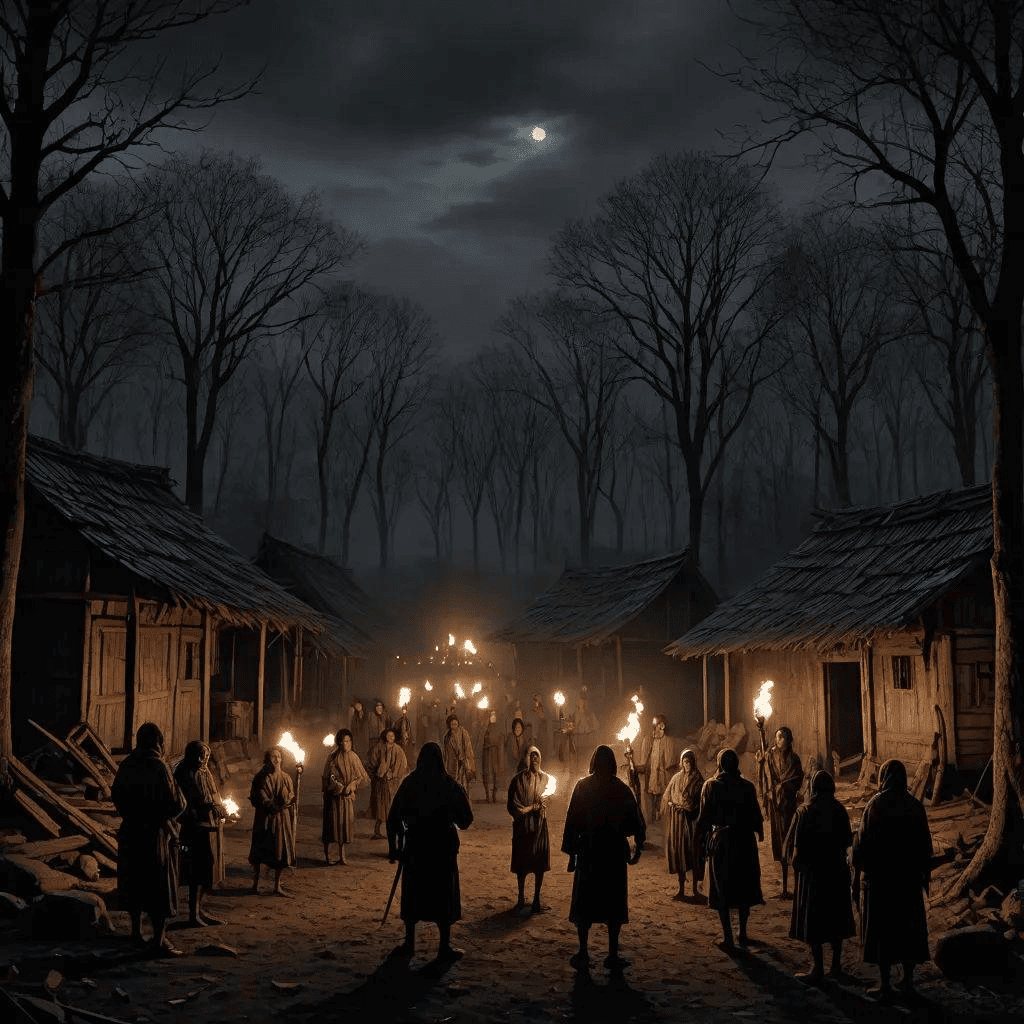
Within minutes, neighbours assembled with petromax lamps, flaming torches, and an eclectic mix of weapons: bamboo sticks, dried branches, iron-tipped poles, and even brooms. Splitting into groups, they began the hunt, the village echoing with desperate cries of “Khuku! Khuku!”
The torches could not banish the darkness; they only made it shift. Beyond the circle of light, the ominous night loomed like a bad omen. In the heavy, breathless silence between shouts, my chest tightened. Hoping, listening, wishing. Her soft whisper: Didi.
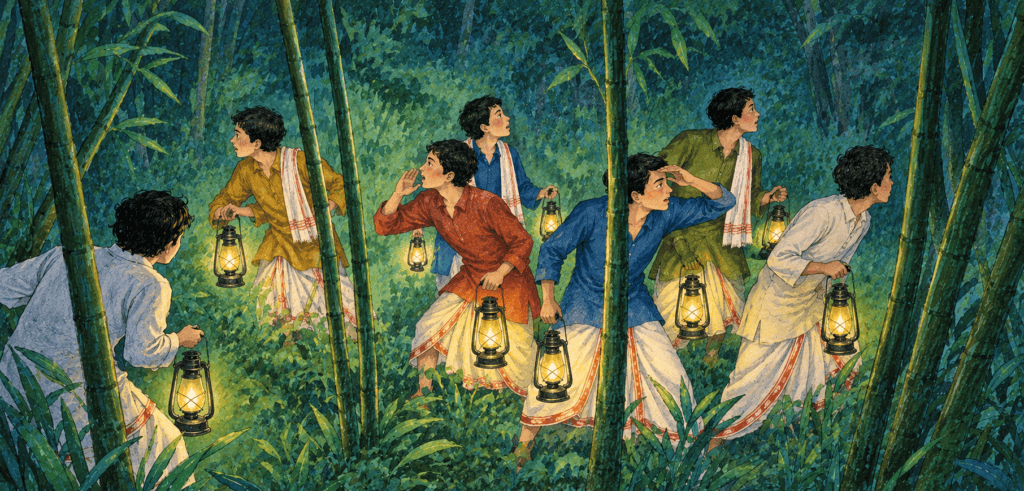
False alarms rippled through the search party. Someone spotted a dress, another saw a beast’s snout, and someone else heard a child crying by the pond. Groups rushed off with lanterns, only to return empty-handed and embarrassed. Still, there was no sign of her.
The night did not care that we were losing our minds.
Chhorda scurried about like a postman relaying news until the village priest insisted on calling an ojha, declaring, “You need mantras, not lanterns!”
Baba snapped, “No one’s calling any ojha. This is not a ghost story—my daughter is missing!”
The frantic search continued through the orchards and along the pond banks. Every shadow looked suspicious, every rustle terrifying. Curled up in a corner of the uthon, I cried silently, consumed by agonising fear. What if we never saw her again?
Just then, Jethai returned from a faraway village. As the only MBBS doctor in the vicinity, he often travelled long distances to see patients. He heard the commotion—shouting, running, and rising flames illuminating the night sky—and by the time he climbed down, he had a fair sense of the ongoing crisis. The tense courtyard fell strangely silent at his calm, gentle appearance, which gave his patients hope and assurance. I flung myself into his arms and burst into loud, helpless sobbing.
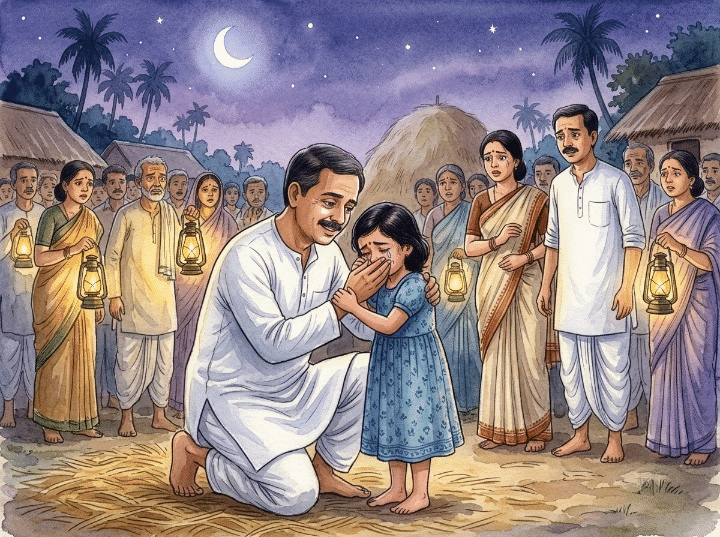
“I didn’t do anything, Jethai! It wasn’t my fault!”
Jethai had seen far worse things than a frightened child. He patted my head. “I know, sweetheart. You didn’t do anything wrong. Why are you crying for nothing?”
His soothing voice worked a miracle. Wiping my tears, I confessed through sobs about the haystack and leaving Khuku behind. Jethai listened patiently before asking, “You said a fox took her. Did you actually see it?”
I shook my head.
A ripple of whispers went through the courtyard. No one knew what to say or how to react.
Jethai turned to the crowd. “Bah, chamatkar! You all went chasing the kite, thinking it had flown off with your ears! But did anyone check if your ears were still in place?”
I paused, looking at the kids. “I didn’t understand the worth of those words back then. Now I do—the power of verifying the truth before chasing a ghost.”
“We now have Google to do that.”
“Ha! Your Google is sobjanta. How do you verify what it says?” My face wrinkled in annoyance before I began narrating again.
Together, they scaled the summit—not just the one from our childhood games, but the mountain of fear and superstition that had held us back for so long.
With Jethai by my side, I felt braver. Holding his hand, I led the search party towards the haystack. We crossed the temple ground, our feet crunching over dry grass. The banyan tree, with its hanging roots like the tangled hair of a forest spirit, cast an eerie shadow beyond which the haystacks emerged like looming golden spectres under the pale moonlight.
I whispered, “That one. We were mountain climbing on it.”
“And who made it to the top?” Jethai chuckled.
I blushed. “None of us did.”
“Enough of your stories. Let’s find Khuku!” Boroma snapped.
At Jethai’s command, the men began scaling the towering stacks. They climbed them so easily, without floundering once, that I watched, transfixed, mouth agape.
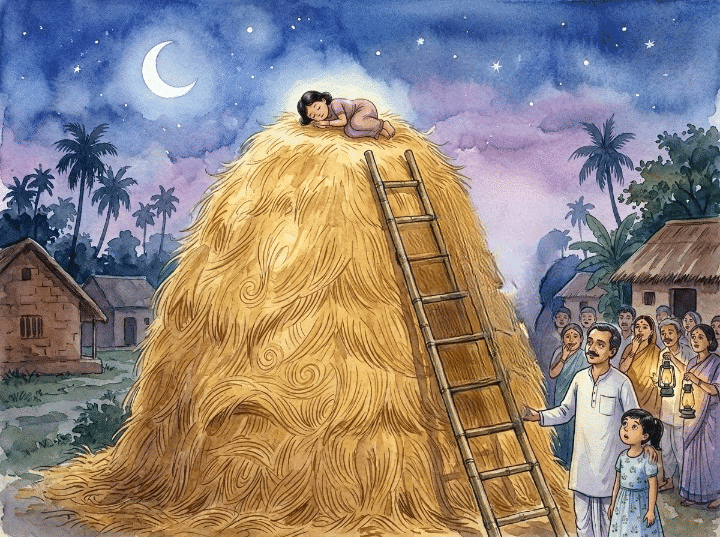
Suddenly, Dasu Kaka shouted, “Sir! Found her! Khuku’s right here, fast asleep!”
The night exploded in delirious joy. Ma cried, “Khuku re!” Baba breathed a heavy sigh of relief. Boroma resumed her chanting: “Dugga, dugga!” while Chhorda shouted some grand nonsense. Supti Pishi, in her no-nonsense manner, squawked, “That cursed girl—sleeping soundly through all this!”
I clutched Jethai’s hand tightly and wondered if finding Khuku would pardon my mistake or make it worse.
Jethai quickly ordered Dasu Kaka down. “With that screechy voice and you hovering like a Bhurshiyal, she’ll be scared stiff!”
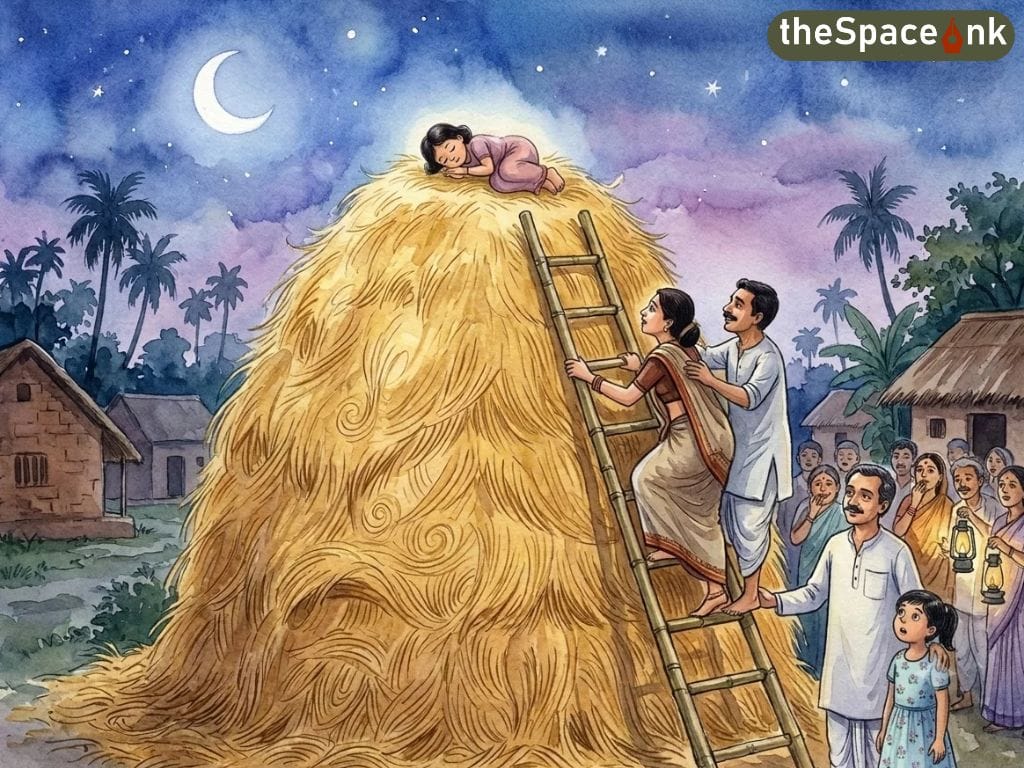
Then he called for a tall ladder and asked Ma to go up. But in those days, a daughter-in-law’s world was measured by the length of her veil. As she stepped onto the first rung, her sari tangled around her ankles, and the fabric slipped from her head, baring her face to the crowd. She faltered, trapped between maternal urgency and the heavy weight of her own modesty.
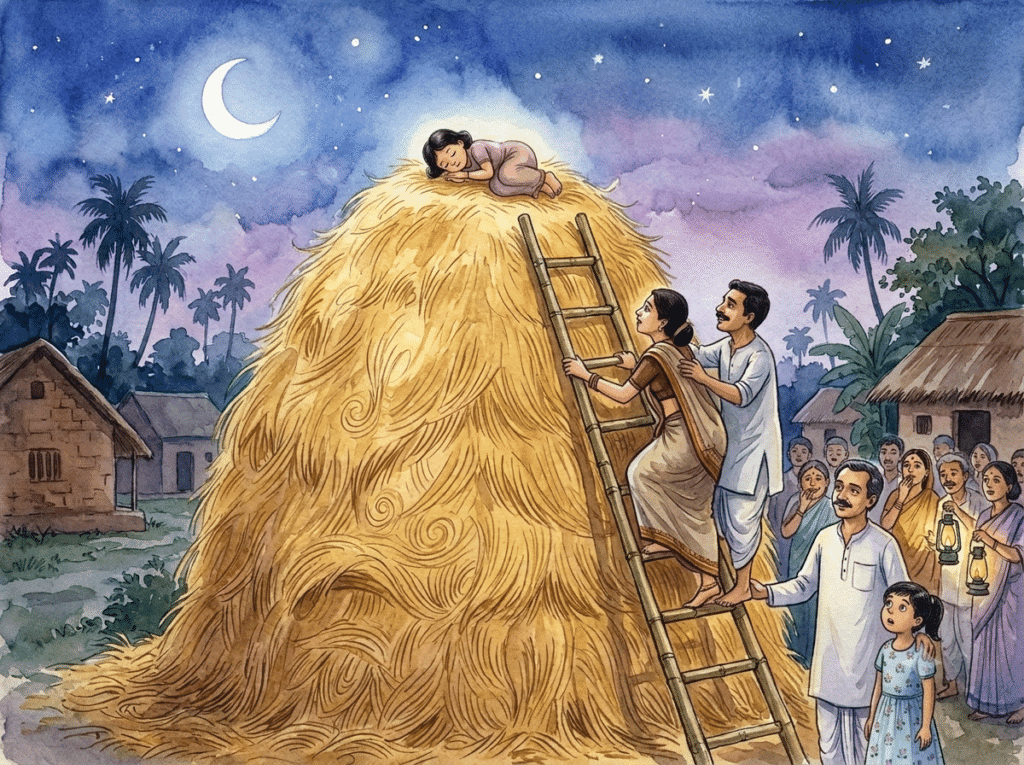
Jethai, ever the pragmatist, understood her dilemma instantly. He thanked the assembly, gracefully dispersing them with the promise of a grand feast of mangsho bhaat the following week.
Once the yard thinned out, he turned to her. “Tuck your sari and climb without fear, Bouma. Don’t look down.”
Ma didn’t hesitate. She gathered the loose ends, tucked them tightly into her petticoat, and began the ascent. Baba followed, gently coaxing her to move steadily forward. With her head uncovered and her movements free, she looked so confident, so radiant. Together, they scaled the summit—not just the one from our childhood games, but the mountain of fear and superstition that had held us back for so long.
And the girl for whom all this happened? She was peacefully asleep the whole time.
When Khuku finally blinked awake in the straw, she said, “Oh! Are you in the competition, too? I came first, you know.”
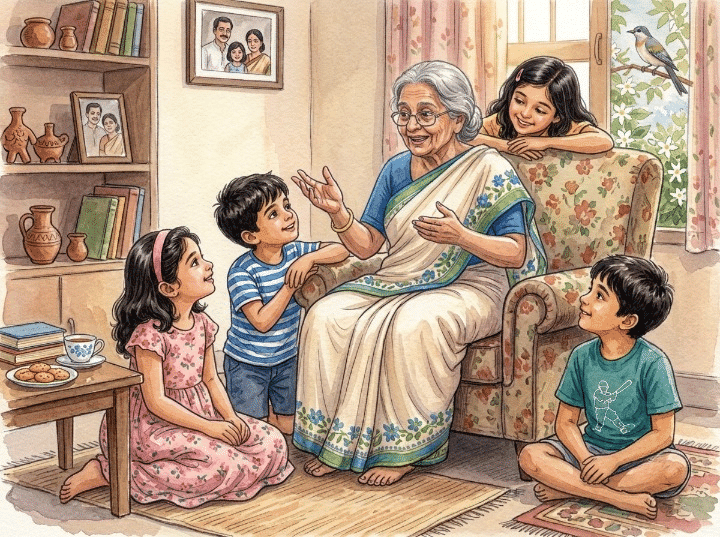
The kids listening in my lap held their breath. “Then what?”
“What else?” I chuckled. Baba carried her down while she sleepily insisted on her victory. “I came first! I came first!”
Laughter filled the room.
“Your childhood sounds like so much fun, Thamma!” Riju beamed.
“Yes.” A soft, lingering nostalgia washed over me as I looked into their bright faces.
“From now on, we only want your childhood stories!” they chorused.
“Ore baba! My mouth’s aching. Tell Kanai to bring me a cup of tea,” I groaned.
“Not tea, Thamma—Boost! You need energy for more summit climbing!” Toony giggled.
“Get lost, you brats!” I laughed. But in my heart, I whispered, If only you knew how many mountains I’ve climbed in this life.
Illustrations are generated by AI

Monideepa Banerjee is an avid explorer and a passionate writer from Bangalore, India. Her articles on travel, art and culture have been featured widely in many prestigious dailies and magazines, photo-journals and web-portals in India and abroad. She has a Master’s degree in Journalism, a B. A in English, a B.Ed. and a Diploma in Early Childhood Education. She is well-versed in Bengali and English and writes spontaneously in both languages. Her published books, ‘The (mis) adventures of Teddy Tumbledore, ‘Tilly’s Squad in Jungle Beats’ and ‘ঠাম্মা ও গাভাস্কর’ are well accepted by young readers for their engaging, simple narrative and emotionally resonant content. Her latest work, a three-book series in Bengali ‘টেডির মজার কাণ্ডকারখানা’ is enjoying a good run.