

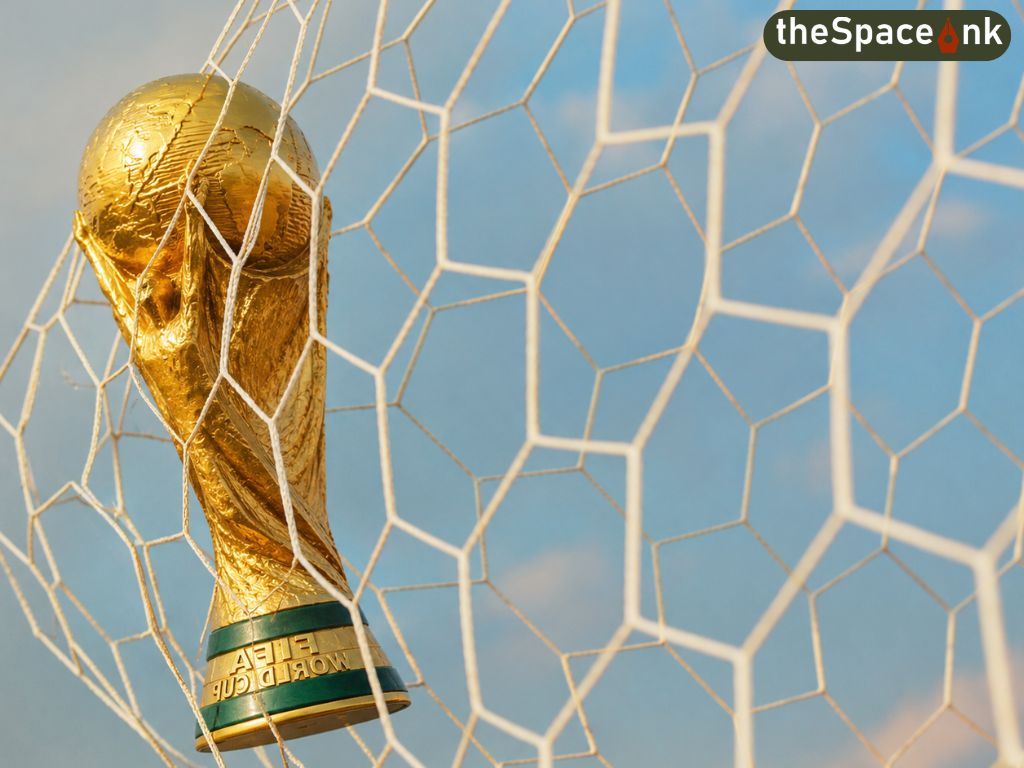
Another English Game in a Changed World
The FIFA website has a countdown to the first game of the men’s football world cup of 2026 in place; as I write this, we’re down to a little over five days. Perhaps we should call it the ‘soccer’ world cup, as two of the three host countries, Canada and the USA, would say (the other, Mexico, calls it ‘fútbol’). Much happens around a World Cup that has little or nothing to do with football, but that isn’t why we’re so excited by the Cup. And yet … it’s hard to separate the surrounding sounds from the games.

By now, in normal circumstances, we should all be urgently discussing difficult groups, the tragedies of great individual players who didn’t make it because their national teams were too inept or unlucky to have qualified, and likely new stars, form, and injuries. But perhaps there is too much happening in the world; and soccer isn’t enough of an opium for the masses now because it’s not strong enough. It is, however, a larger spectacle: this summer of soccer has an enlarged number of participants, 48 teams as opposed to 32 in the last edition in Qatar (in winter, to beat the heat), and two knockout rounds, not one.

And this time we’re not talking too much about deaths in the course of building stadiums and the difficulties of attributing those dead workers, or the evictions of people who lived too close to the stadiums, to the World Cup itself, as we had a few years earlier, in Brazil before 2014 and in Russia before 2018, and of course in Qatar before 2022. But even with the best of consciences, those last times around, by the time we got this close, we were already anticipating the action, and had left the dead behind, or at least had moved them to somewhere else in our consciences while we enjoyed the action.
Memories that are structured in this way are not necessarily about who won. For me, 1986 was the last time we saw the brilliantly casual Brazilians Zico and Socrates, the latter chain-smoking through the half-time breaks; and it is, apparently, not just a legend that Socrates came to play club football in Italy because he wanted to read Antonio Gramsci in the original.
This time, the dead are everywhere, and they are not football’s collateral damage. We can leave behind the dead of the October 7 Hamas massacres and the dead in Gaza thereafter: neither of the concerned teams will be represented at the World Cup, nor are any of the countries involved hosting it (the last Cup would have been a different matter). Iran will, on the other hand, be playing; the Islamic Republic is at war with the United States, and with its own people, who it has been killing in large numbers, but its team will turn up to kick a football around.
Also Read: Children’s Games Are Not Child’s Play
Since we know, however, that economic, political and social conditions will not achieve perfection before we can play or watch football, we will get on with the business of talking about the games, and watching them as they unfold. Our heroes and villains will emerge in the course of the next few weeks, and we will all have strong opinions – rather like we’ve had in the wars and other conflicts we have seen of late.
Perhaps we’ve had our football fever by other means already, and the energy to engage with the beautiful game at our militant best is impaired by this. On the other hand, we will have longer to form our emotional ties, because there are more teams, more rounds, more games, and more players to watch and to get involved with.
Until that happens, we can indulge in a bit of nostalgia for a more innocent age in which the worst violence we can remember is Toni Schumacher taking out Patrick Battiston in the semi-finals of the 1982 World Cup (and getting away with it), and the best thing is West Germany going on to lose the finals in Madrid to Italy, in a tournament marked by one Paolo Rossi always being in the right place to knock the ball in. ‘Jesus Saves’, said the graffiti of the time, ‘but Rossi scores on the rebound’.
Memories that are structured in this way are not necessarily about who won. For me, 1986 was the last time we saw the brilliantly casual Brazilians Zico and Socrates, the latter chain-smoking through the half-time breaks; and it is, apparently, not just a legend that Socrates came to play club football in Italy because he wanted to read Antonio Gramsci in the original.
Later memories include the first united German team winning in 1990 (1-0 on Andy Brehme’s penalty) and my hearing, on the streets of Munich, the chant ‘Sieg Heil’ on my walk shortly after the match, which I had watched alone on a black-and-white TV set; but I was also hugged by random strangers. And of course I remember Zinedine Zidane’s famous head-butt of 2006 that (I think) handed the Cup to Italy.
Peculiar football memories should include the pop duo Alan and Denise singing ‘The Rummenigge song’ in 1983, a song that for some odd reason resurfaced before the 1986 World Cup finals, though Rummenigge wasn’t at the time deemed likely to play the final – he did, and he scored Germany’s first goal to bring the score to 1-2 before Rudi Völler equalized and then Burruchaga scored the winner for Argentina.
And they practice beforehand, which ruins the fun’, the English comedians Flanders and Swann sang in the 1960s about England’s sporting adversaries, in ‘A Song of Patriotic Prejudice’. That was a song about nationalism, not about sport; the English gave the world a(nother) game that is now everyone’s beloved, beautiful game; even (in recent years) theirs again.
‘Karl-Heinz Rummenigge puts it in’, ‘Rummenigge, Rummenigge, all night long’ was the obvious double entendre that drove the song by an English couple with the surname Whittle, and it reached 43 on the German charts. I believe I heard the song on radio and recorded it on a cassette when I was in Munich at the group stages of Mexico ’86.
In my extended circles, it was every journalist’s dream job to get to report on the World Cup, which, insofar as it was work, consisted in drinking a lot before the games, and turning up to watch as many of them as you could, sending in a desultory line or two of your own while being able to get most of the details off any agency press release and then rework them a bit.
One correspondent for a Delhi paper managed to get himself that plum position in 2002, which I understood had taken quite some lobbying. He held his end of things as together as he was capable, given that he was rather fond of the pre-game activities even when there wasn’t a game on offer. His supreme achievement of that Cup was that he managed to miss the final in Yokohama, being too drunk or hungover (I don’t think he could remember which) to get out of his hotel bed and to the stadium. He now writes detective stories; but I don’t know if that’s now his day job or not.
That is a story that at least can be read as a throwback to a less professionalised age, in an age of professionalism. The further back one goes, the closer we are to the amateur origins of sport, where rules had to be made to change the game from a violent free-for-all in a town to the more genteel activity that could be played at an English public school.
‘And they practice beforehand, which ruins the fun’, the English comedians Flanders and Swann sang in the 1960s about England’s sporting adversaries, in ‘A Song of Patriotic Prejudice’. That was a song about nationalism, not about sport; the English gave the world a(nother) game that is now everyone’s beloved, beautiful game; even (in recent years) theirs again.
Cover Image: Talon Marks, Wikimedia Commons

Benjamin Zachariah works at the Einstein Forum in Potsdam, and with the project on the contemporary history of historiography at the University of Trier. He was trained in the discipline of history in the last decade of the previous century. After an uneventful beginning to a perfectly normal academic career, he began to take an interest in the importance of history outside the circle of professional historians, and the destruction of the profession by the profession. He is interested in the writing and teaching of history and the place of history in the public domain.


One Response
Really enjoyed reading this Ben. Brought back memories of Kolkata during the World Cup. Wagers of icecream during the 1986 World Cup.