

“The Vatican is a place where the past is never past.”
— Robert Harris
Power, Prayer and the Vatican Enigma
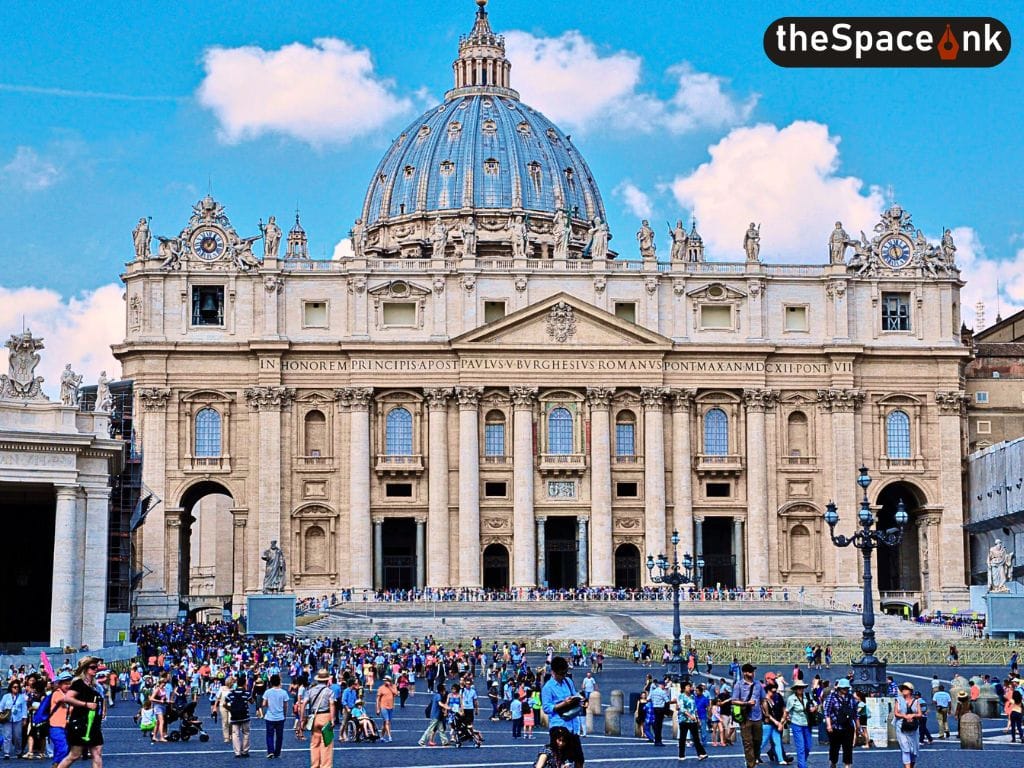
The square was already filled with thousands of people—pilgrims, believers, visitors, men, women, and children—in serpentine queues, excitedly waiting for the gates to open. Tour guides waved their colourful flags above their heads, shouting instructions in multiple languages. Cameras and mobile phones clicked nonstop as tourists rushed to capture the best spots for their reels and selfies.

Only the Swiss Guards, in their Renaissance-style blue, red, and yellow striped tunics with plumed helmets, stood motionless, defying the digital frenzy.
Standing there, not as a tourist or a believer but as a curious observer, I looked around at the magnificent St. Peter’s Basilica and found myself contemplating one of history’s most fascinating paradoxes.
Nearly two thousand years earlier, Roman Emperor Nero ordered the execution of the Apostle Peter and other Christians on these very grounds, using them as scapegoats for the devastating fire that engulfed Rome. Many historians, however, allege that it was Nero himself who started the fire to clear space for his extravagant palace. In an extraordinary turn of events, that execution ground has become the epicentre of one of the world’s most powerful institutions: the Vatican.

This is the smallest sovereign state on Earth, barely half a square kilometre in size, commanding the loyalty of over a billion people. A country with no natural resources and no permanent citizens by birthright, yet it maintains diplomatic ties with more than 180 nations. A country with no conventional army, yet it has survived every empire, every war, and every revolution. A country that preaches humility and detachment from worldly possessions, yet its galleries contain some of the most opulent treasures ever assembled.
Also Read: Hopelessly Lost in Paris
The smallest country on Earth is anything but small. It is an enigma: an empire of faith built upon martyrdom, shaped by politics, guarded by secrecy, and sustained by extraordinary power.
Walking Into the Paradox
Stepping inside the Piazza di San Pietro (St. Peter’s Square), designed by Gian Lorenzo Bernini to replicate “the motherly embrace of the Church,” felt less comforting than formidable. The magnificent columns stretched outward, forming a grand spectacle of authority, separating the mundane world outside from the spiritual powerhouse within.

At the centre stands a 300-ton pillar of red granite: the Egyptian Obelisk, a pagan emblem that predates Christianity by more than a millennium. Obelisks were originally erected at the entrance of ancient Egyptian temples dedicated to the Sun-God Ra, symbolising divine power and the immortality of the Pharaohs. The ancient Romans were obsessed with Egypt, its gold, and its daughters. Few love stories have been immortalised on the silver screen with the same cinematic grandeur as the romantic triangle of Julius Caesar, Cleopatra, and Mark Antony.

Seized from Heliopolis by Emperor Caligula, the obelisk was placed in the Circus on Vatican Hill. His successor, Nero, conducted his horrific “imperial spectacle,” slaughtering innocent Christians under its very shadow, often using them as human torches to light his evening garden parties.
For nearly three centuries, the faith survived quietly, away from prying eyes. Then history turned a new leaf. Emperor Constantine legalised Christianity in the fourth century and ordered the construction of a basilica directly above the humble grave of Saint Peter. The transition was remarkable; a religion once persecuted by emperors had become intertwined with imperial power.

My observant mind could not help but draw a parallel to another ancient religion—Buddhism—which suffered a similar fate until it received state sponsorship from Emperor Ashoka and flourished into a global religion.
The paradox intensified when the obelisk was shifted to its current location in 1586. Though only two hundred metres from its original location, the mammoth task required 900 men and 140 horses and took several months to complete. The golden sphere that once topped the obelisk, rumoured to contain the ashes of Julius Caesar, was replaced with a large bronze cross.

A guide, perhaps, offered the best explanation for the stolen monument standing at the heart of the square. The Vatican obelisk stands not only as a symbol of victory over evil but also as a reminder of how a conquered civilisation was integrated into the conqueror’s own. It is the ultimate trophy of a faith that not only survives but has become a powerhouse, controlling kings and emperors for centuries—and still does.
A Masterstroke of Strategy
As the line outside the basilica continued to coil across the square in a slow, zigzagging rhythm, I marvelled at the crowd’s stoic demeanour. It was as if any spark of impatience might somehow dilute the reverence of the moment.
I asked a gentleman whether this crowd was normal.
His answer was simple. “It’s the Extraordinary Jubilee Year, ma’am.”

What unfolded was an intriguing saga of historical strategy. In the face of great suffering caused by medieval wars, the Pope declared the first Holy Year in 1300, promising a “full pardon of all sins” to pilgrims who visited the basilica within a specific period. What began as a religious observance was actually a brilliant geopolitical move. Pilgrims arrived in astonishing numbers from every corner. Markets thrived, inns overflowed. The city, grappling with hardship, suddenly found itself benefiting immensely from this influx of religious believers.
A serpent of suspicion began to stir in my mind. Was the declaration of 2026 as yet another ‘Extraordinary Jubilee’ a strategic move to fill the gap? I swallowed my cynicism and shared these figures with the guide. His response was a breathless “Oh!”, laced with genuine reverence. “So many faithful the world over!”
Over time, the Jubilee tradition was formalised to occur every twenty-five years, though popes occasionally proclaim “extraordinary” jubilees to mark special occasions. During a Jubilee year, a Holy Door that otherwise remains sealed behind a brick wall is ceremoniously opened. For the believer, passing through this threshold signifies repentance and spiritual renewal.

The year 2026 has been declared the ‘Extraordinary Jubilee of St. Francis’, running until January 2027.
Watching this slow-moving river of people, I was reminded of our homegrown Kumbh Mela, where millions travel to take a ritual bath believed to cleanse the soul. Different faiths, different geographies, yet the same human urge to believe that a sacred moment in a sacred place might somehow bring redemption and eternal salvation.
Also Read: The Celestial Aura of Aurora Borealis
Beyond spiritual significance, both events serve as platforms for enormous economic growth, fostering close collaboration among faith, culture, and commerce. The 2025 Maha Kumbh, with its once-in-144-years auspicious allure, generated billions in revenue. The concurrent Jubilee of Hope also saw a record surge in visitors to Rome and approximately 17 billion euros in spending across multiple sectors, which reportedly fell short of expectations.

A serpent of suspicion began to stir in my mind. Was the declaration of 2026 as yet another ‘Extraordinary Jubilee’ a strategic move to fill the gap? I swallowed my cynicism and shared these figures with the guide. His response was a breathless “Oh!”, laced with genuine reverence. “So many faithful the world over!”
Indeed. The event meant to free the faithful from worldly burdens had brought worldly splendours in droves. Where I saw data, someone else saw devotion. That, perhaps, is the most enduring tenet of faith.
To be continued…
Photos by Subhasis Banerjee

Monideepa Banerjee is an avid explorer and a passionate writer from Bangalore, India. Her articles on travel, art and culture have been featured widely in many prestigious dailies and magazines, photo-journals and web-portals in India and abroad. She has a Master’s degree in Journalism, a B. A in English, a B.Ed. and a Diploma in Early Childhood Education. She is well-versed in Bengali and English and writes spontaneously in both languages. Her published books, ‘The (mis) adventures of Teddy Tumbledore, ‘Tilly’s Squad in Jungle Beats’ and ‘ঠাম্মা ও গাভাস্কর’ are well accepted by young readers for their engaging, simple narrative and emotionally resonant content. Her latest work, a three-book series in Bengali ‘টেডির মজার কাণ্ডকারখানা’ is enjoying a good run.



8 Responses
This is a very well researched article. A nice combination of travel and history.
Thank you sir.
A very well-researched article. A beautiful combination of travelogue and historical facts. Yet it never becomes boring. Loved Ms. Banerjee’s writing.
It is a tightly written, evocative piece that balances cultural critique with historical depth beautifully.
Thank you for your comments. I am glad that you liked it.
Wonderfully written article and the pictures add such fantastic visual depth to the words. Really enjoyed being transported to the Vatican and looking forward to subsequent articles in this series.
Thank you so much. Looking forward to your response to the next part as well.
This is a powerful, thought-provoking article. Moreover, the writing flows naturally making the history feel alive.