

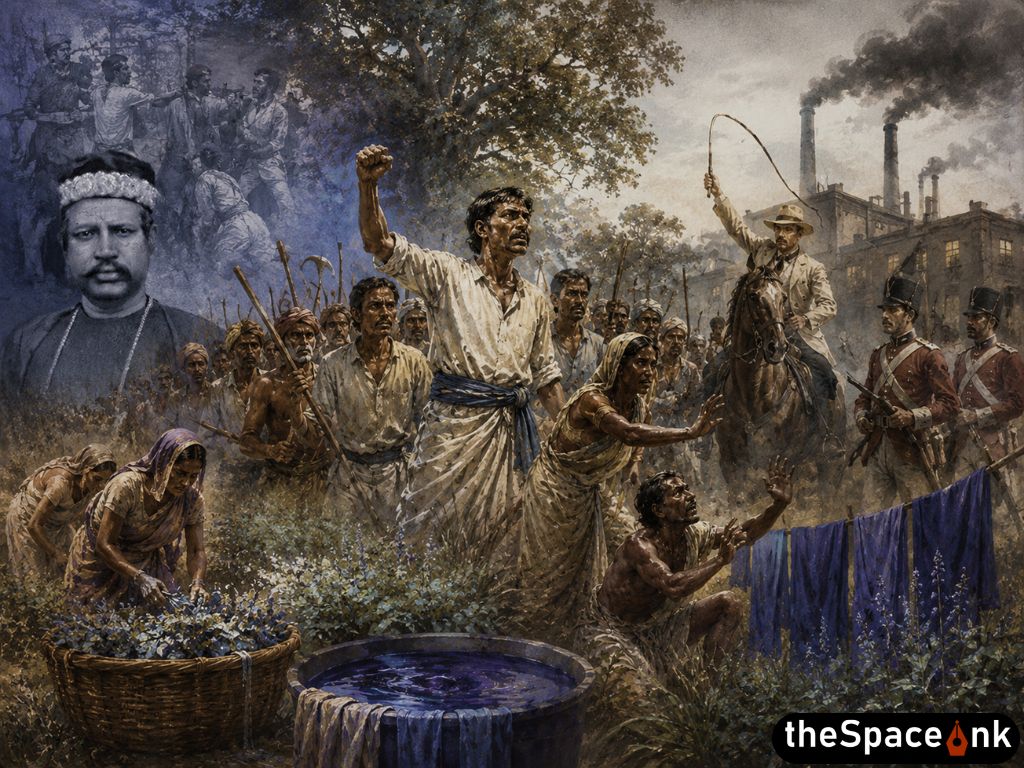
Indigo Revolution
Indigo is more than a mere color; it holds memories within fabric and has borne the significance of empires, labor, and desire over four millennia. Before becoming a fashionable hue or a subtle pigment in an artist’s palette, indigo was revered as the King of Dyes—cultivated from plants and woven into human history throughout Egypt, Asia, and India.

Ancient voices already carried a kind of bewildered fascination toward it. Pliny the Elder, a first-century Roman historian, tried to describe indigo as something almost unclean, a slime clinging to reeds. Yet even in his dismissal, there is awe. Once refined, this strange substance transforms into something unexpectedly profound: a deep blue that can tilt toward violet, as if holding twilight inside itself.

For centuries, indigo belonged only to nature. Until the nineteenth century, the Indigofera plant remained the world’s only reliable source of a blue that did not fade easily into silence. Across East Asia it was cultivated, but India stood at the heart of its global story—both revered and exploited for it. By the late fifteenth century, European powers had already begun to fear its dominance, even banning Indian indigo and branding it the devil’s dye, as though color itself could be heretical.
Also Read: Bengal Sketches [1],[2],[3],[4],[5]
But indigo did not remain in the realm of myth or trade alone. It became a system.
Under the East India Company and later the British Raj, indigo turned into one of the most profitable—and most brutal—commodities of empire. In Bengal and Bihar, fertile land was quietly reshaped into factories of blue. Through the zamindari system introduced in 1793, farmers were pushed into abandoning food crops to grow indigo instead, feeding distant textile mills in England while their own villages struggled to survive.

The cruelty was not only in force, but in arithmetic. Farmers were trapped in predatory loans with crushing interest rates, debts passed down like inherited chains. They received only a fraction—sometimes as little as 2.5%—of what their indigo earned in global markets. The rest disappeared into the machinery of empire, refined into profit far away from the soil that produced it.
And yet, even under such pressure, resistance took shape.
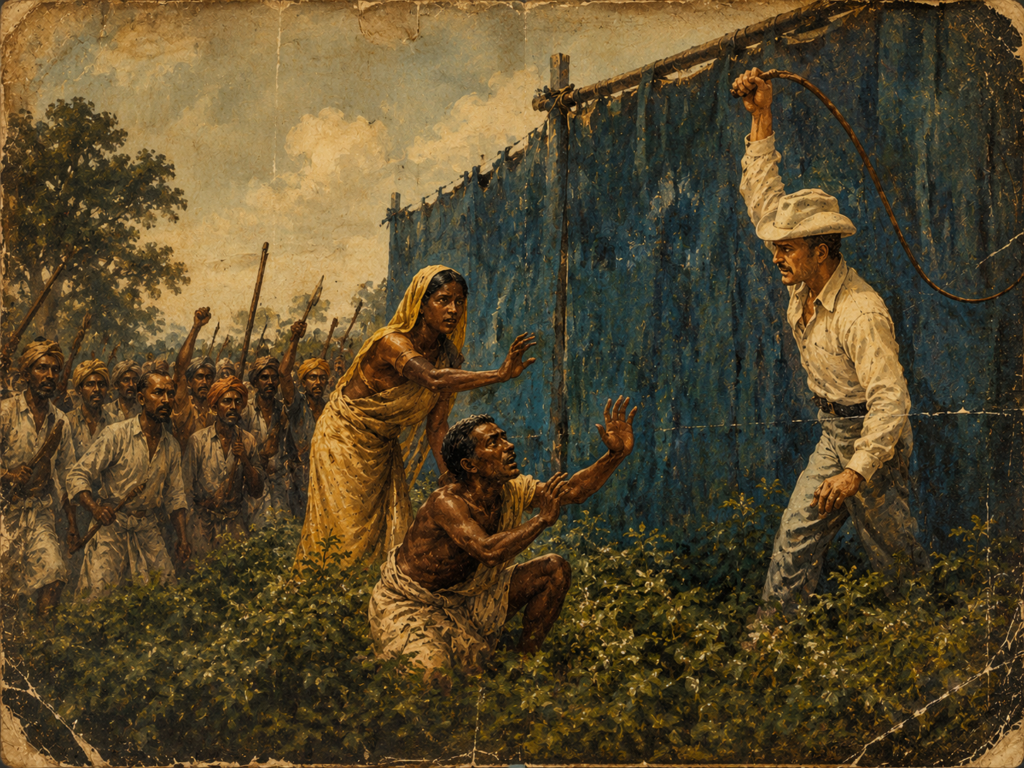
The Indigo Rebellion from 1859 to 1860 in Nadia district rose directly from the soil itself. Hindu and Muslim peasants, bound by shared hardship rather than division, began to refuse the system that had reduced them to instruments. Led in places like Nadia by the Biswas brothers—Bishnucharan and Digambar—and carried forward by figures such as Rafique Mondal in Malda and Kader Molla in Pabna, the movement spread like a quiet fire. It was not chaos, but coordination.
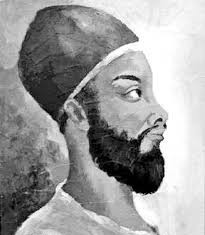
These rural challenges did not occur in isolation. The movement consolidated its influence by drawing upon earlier anti-colonial initiatives led by Dudu Miyan and the Faraizi movement, as well as the historical impact of Titu Mir, who mobilized farmers in resistance to British authorities and oppressive landlords in 1831 at Narkelberia’s bamboo fortress. This coalition structured its efforts through organized social boycotts and physical self-defense against planter militias.
The Bengali intelligentsia played a crucial role in supporting the people’s uprising, marking the first major alliance between the urban educated middle class and rural peasants against colonial oppression.
Through journalism, writers like Harish Chandra Mukherjee exposed the exploitation and brutality of European indigo planters, while newspapers such as The Hindoo Patriot, Som Prakash, and Gram Barta Prokashika spread awareness of the peasants’ suffering.
A dye that initially colored fabric ultimately left its mark on history itself, while simultaneously embodying a persistent element of human resilience.
In literature, Dinabandhu Mitra’s famous play Nil Darpan vividly portrayed the torture faced by indigo farmers and stirred public opinion, while the imprisonment of Rev. James Long for publishing its English translation further strengthened intellectual resistance. Educated Bengalis also provided legal aid to peasants, helped them draft petitions, and supported their fight in courts.
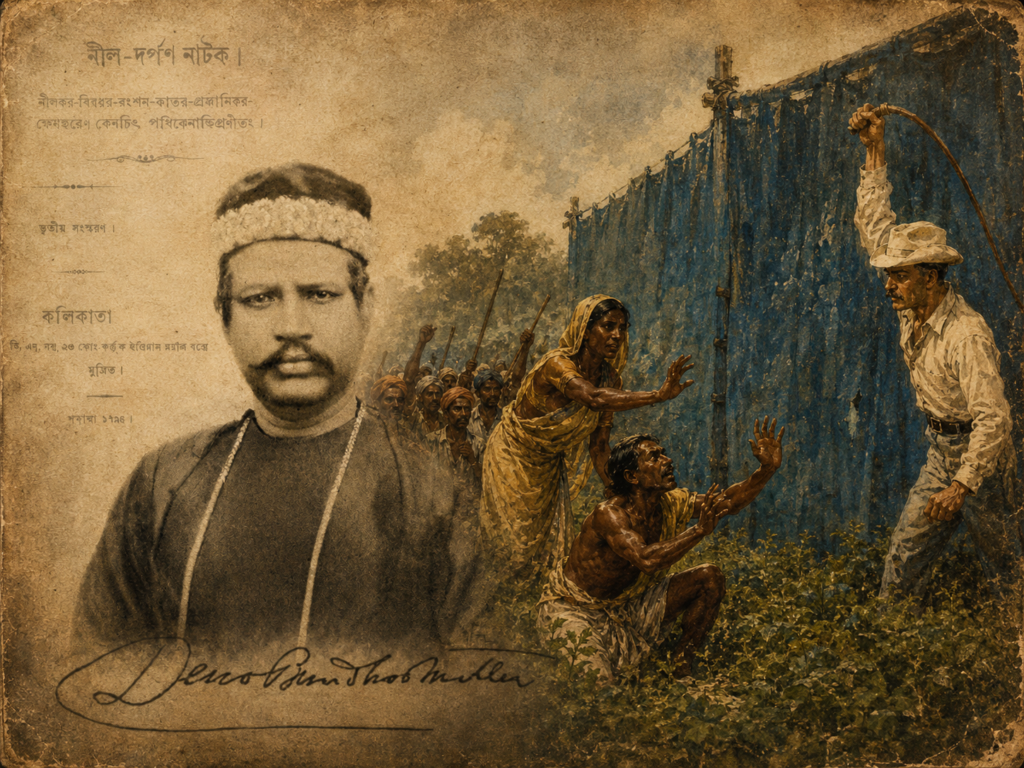
Their continued pressure, along with peasant resistance, compelled the British government to form the Indigo Commission in 1860, whose report confirmed that indigo cultivation was forced and unjust, leading to the gradual decline of the indigo system.
Pressure eventually forced the British administration to respond. The Indigo Commission of 1860 acknowledged what peasants had long endured: coercion could no longer be legally sustained. Indigo cultivation could not be forced. It was, in its own limited way, a rare moment where organized refusal bent an imperial system.
Also Read: Bengal Sketches ,[6],[7],[8],[9],[10],[11]
And still, the memory lingers—in places like Bongaon, where a memorial was recently vandalized, and Chouberia; in statues, institutional names such as Dinabandhu Mahavidyalay, and in local histories that refuse to fade into footnotes.
Many years later, in 1917, Mahatma Gandhi came to Champaran, Bihar, to launch his renowned Satyagraha movement in support of indigo farmers. History seemed to repeat itself: the same crop brought about similar forms of exploitation, but also offered new chances for resistance.
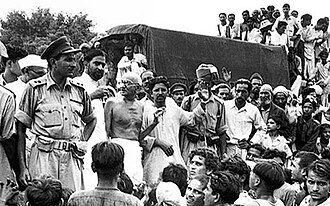
Indigo was no longer just a dye. It had transformed into a symbol of enduring struggle passed down through generations.
A dye that initially colored fabric ultimately left its mark on history itself, while simultaneously embodying a persistent element of human resilience.
Images: AI, Wikipedia, Wikimedia Commons, Wikipedia, Indian Liberals, Wikipedia, Chat GPT

Dr. Jamil is a passionate oncology commercial leader whose two-decade journey has been driven by a deep commitment to improving the lives of people with cancer. As Head of the Early Commercial Team at Merck Oncology and an Adjunct Professor at Columbia Business School, he shapes innovative pipelines while mentoring and inspiring future healthcare leaders. Beyond work, he is a soulful armchair historian of Bengal, a devoted Manchester City fan, and someone whose heart is forever tied to the culture, stories, and spirit of Kolkata.



One Response
Great nuggets of history.