

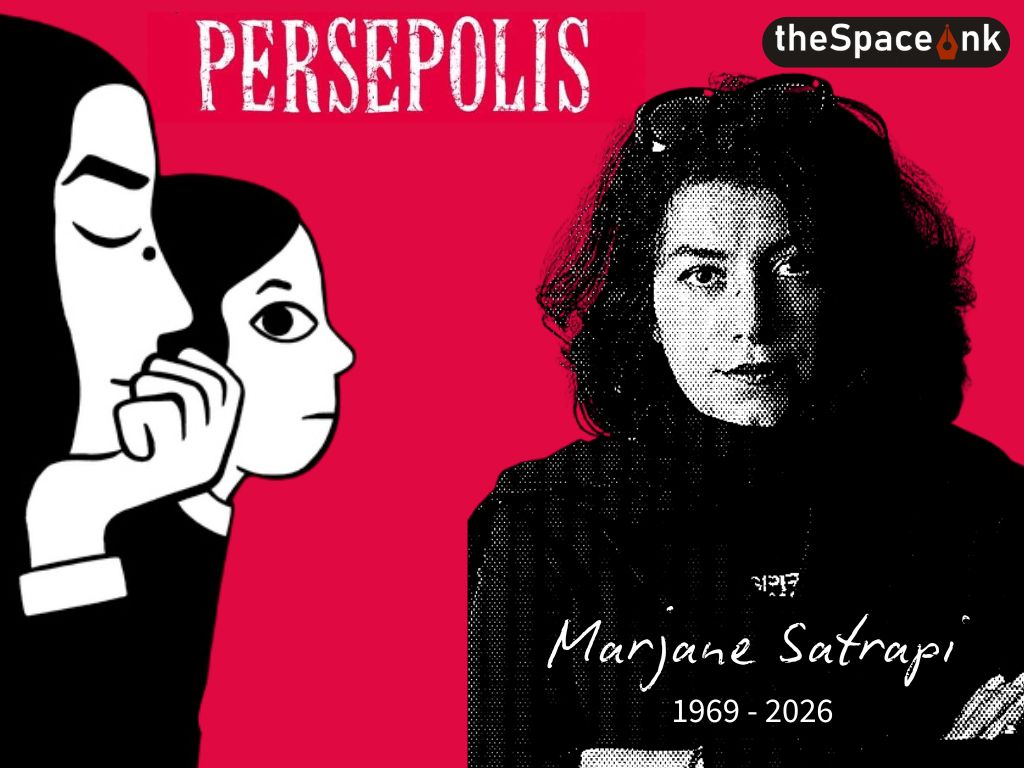
A Personal Obituary for Marjane Satrapi (1969–2026)
Marjane Satrapi died on June 4, 2026, in Paris. She was 56. Her family told the world she died of sadness — that after her husband Mattias Ripa left the earth in April 2025, she could not find enough reason to stay. No accident. No illness. Just grief, moving in and refusing to leave.
I have been sitting with that phrase for a few days. “Died of sadness“. Turning it like a stone, looking at what lives underneath.
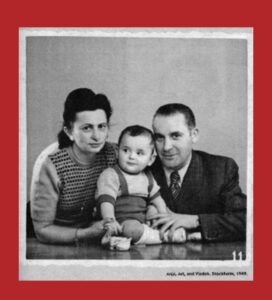
Forough Farrokhzad — the Iranian poet who died at 32 and packed several lifetimes into those years — already knew this territory:
What is silence,
what is it, my trusted friend?
What is silence but unspoken words? 1
She wrote that in her twenties. Some people are born knowing certain things.
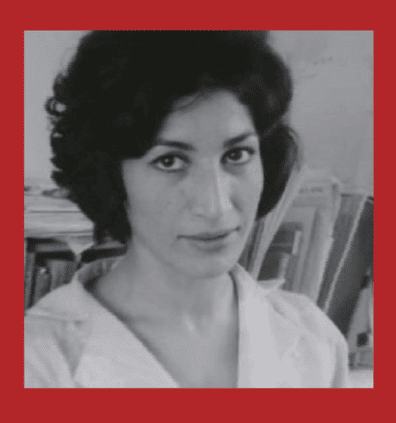
I first met Iran not on a map but in a woman’s laugh.
Shokat lives in Geneva now. But she came from a Tehran she had to fight her way out of — not because she didn’t love it, but because she loved herself more. I met her at a conference. She became a friend. She had told me about defying the hijab rules as a teenager, the courage it takes to be a rebel in a beautiful dress, fleeing and building a life in Europe without surrendering an atom of who she was.
She showed me that Iran and freedom were not opposites — that Iran produces a kind of woman the West has no vocabulary for. Warm to the point of overwhelming. Principled to the point of stubbornness. Fashionable in a way that is also a political statement.
Then there was Samir, a colleague at Amex. When he joined, everyone performed the slightly embarrassing curiosity people perform around Iranians, as if they had walked in from a war zone. Samir was patient. He mentioned that his aunt worked inside the Iranian government, side by side with men. His sisters are all college-educated. One is a scientist. Western media, he said, “paints it darker than it is”.
Restrictions exist. Injustice exists. But a country of 90 million people is not one long scream.
Both of them, without knowing it, were teaching me to read Satrapi correctly.
Education came first — always, without negotiation. In that house being a girl was not a condition to be managed. We were enough.
Because Persepolis is not a book about a country that is only darkness, it is a book about a family that refused to be only darkness.
Marji’s father explains politics to a child as if she deserves the truth. Her mother puts on lipstick before a protest — not vanity, but defiance, the insistence that beauty and resistance are not contradictions. They built a small private world inside a large public catastrophe and let their daughter be curious, angry, funny, wrong, and fully human while a revolution raged outside.
Forough understood that window — the border between the protected world inside and the dangerous world outside:
One window is enough for me
A window onto the moment of awareness and seeing and silence.2
That is what Marji’s parents did. They kept pointing at the crow. Spring is still possible.
I recognized that home. Because I had grown up in one like it.
Kolkata, in times that had their own darkness. The shadow of 1971 still lay across everything — the war, the refugees, the things adults knew and didn’t say. Then the Emergency years, when the country held its breath. And underneath all of it, quieter but no less persistent, the darkness that waited for every girl born in Bengal simply for being a girl.
I was darker-skinned, with thick prescription glasses — the kind of child certain relatives felt entitled to have opinions about. When they visited, they would remind my mother, gently, persistently, that she really must try for a boy. My mother would straighten and say, “They are my girls and my boys both.” No argument. No drama. Just a body placed between her daughters and whatever was coming.
Education came first — always, without negotiation. In that house, being a girl was not a condition to be managed. We were enough.
I was the Mani of my family. Just like Marji was the Mani of hers.
Different country. Different revolution. The same defiant normalcy.
Iran kept arriving.

Reading Lolita in Tehran — Azar Nafisi’s account of women gathering secretly to read forbidden books — is really a book about what literature does when a state tries to take everything else.
And Forough herself, whom I came to last but stayed with longest:
I sinned a sin full of pleasure
in an embrace that was warm and fiery…
I sinned in arms that were hot and vindictive and made of iron.2
She wrote herself large and left at 32.

Kiarostami‘s films move so slowly you have to slow yourself down to enter them — and once you do, you realize the slowness is the point. Life in close-up. Jafar Panahi kept making films after the government banned him, smuggled a camera into prison, and refused simply and stubbornly to stop. My friend Shreemoyee’s documentary, And Towards Happy Alleys, found joy running like an underground river beneath Tehran’s surface. Watching it, I thought: this is what Samir was telling us. This is what Shokat carries in her laugh.
Satrapi understood all of this from the inside.
Marjane was born in Rasht in 1969. Grew up under the Shah, then the revolution. Sent to Vienna as a teenager — for her safety, which was true, and heartbreaking. She fell apart the way people fall apart when the country that made them no longer exists, and they have nowhere to put that loss — completely. Went back to Tehran. Then left for good. Paris. French citizen. Never stopped being Iranian.
Persepolis came from all of that — the leaving, the returning, the never quite belonging, the insistence on truth about a place the world thought it already understood. She drew it in black and white because that was the only honest way.
Exile is not grey. Grief is not grey.
Cannes Jury Prize. Oscar nomination. Kept working, kept talking, kept being furiously, generously herself. She even directed a few films, including Radioactive, based on two-time Nobel winner, our famous scientist Marie Curie.
Then Mattias died. April 8, 2025.
Thirty years of love. When he was gone, she posted on Instagram — images slowly spelling out: For I lost the love of my life. She started a foundation in his name. She tried. She really tried.
But grief is not always something you survive.
I understand dying of sadness. I won’t call it weakness. When someone becomes your reason for breathing, and then they go, the breathing becomes a question.
But Satrapi spent her whole life making the argument against it.
Persepolis is a survival manual. Your parents can protect you with love. Books can protect you with other people’s courage. Humor can protect you when nothing else can. And your own refusal to be only what your circumstances made you — that can protect you too.
Forough wrote this near the end of her short life, in Another Birth:
I will plant my hands in the garden,
I will grow, I know, I know, I know.
And in the hollow of my ink-stained hands
swallows will make their nest.3
Also Read: A Life Well-Lived: Alice Munro (1931-2024)
Plant your hands. Grow. Let something nest inside your work.
That is the answer to dying of sadness. Not the denial of grief — the insistence on making something anyway.
Forough refused to apologize. Panahi refused to stop. Kiarostami refused to hurry. Shokat refused to disappear. Satrapi refused to simplify.
The same refusal, wearing different faces.
I do not want to die of sadness. I want to live the way Satrapi drew — strong lines, high contrast, no wasted space. I want to love people completely enough that losing them breaks something real. I want to read Rumi in the dark and feel less alone. I want to watch Kiarostami and remember that paying attention is itself a form of hope.
I want to carry Shokat’s laugh. Samir’s patience. Shreemoyee’s camera finding color in a grey city. And my mother’s voice — steady, unhesitating — saying: enough.
Forough left us this:
.I know a sad little fairy
who lives in an ocean
and ever so softly
plays her heart into a magic flute
a sad little fairy
who dies with one kiss each night
and is reborn with one kiss each dawn.4
That is Satrapi’s real legacy — not the grief that ended her, but the black and white map she left behind.
Made by hand. Free to use. For anyone willing to look.
Rest, Marji. You earned it. We’ll keep going.
Image Courtesy:
- From the Web and making collages
All Rights Reserved
Footnotes:
- Forough Farrokhzad, “Let Us Believe in the Beginning of the Cold Season.” ↩︎
- Forough Farrokhzad, “Sin” (Gonāh). ↩︎
- Forough Farrokhzad, “Another Birth” (Tavallod-e Digar). ↩︎
- Forough Farrokhzad, “Another Birth” (Tavallod-e Digar). ↩︎

Mousumi was raised in Kolkata but now call New York her home. She pursued her PhD from Indiana University Bloomington and currently works as a Marketing & Consumer Data and Design Analytics professional. She is Co-founder and Director at MDRK Partners. She loves to read, cook, take photos on her phone and travel.


2 Responses
Lovely read.
This touched my heart in ways I can’t fully put into words. Every sentence breathed fresh courage into my soul, reminding me to keep pursuing my dreams and to live beyond the invisible boundaries that life so often creates. It reminded me that there is a love so deep, so freeing, that no country, no person, and no circumstance can ever take away. That is the kind of love I want to carry within me and share with those whose hearts beat to the same beautiful rhythm of life.
Thank you for writing something so honest, uplifting, and deeply inspiring. It was exactly what my heart needed today and everyday. ❤️