Review of David Szalay’s Booker Prize winning novel Flesh
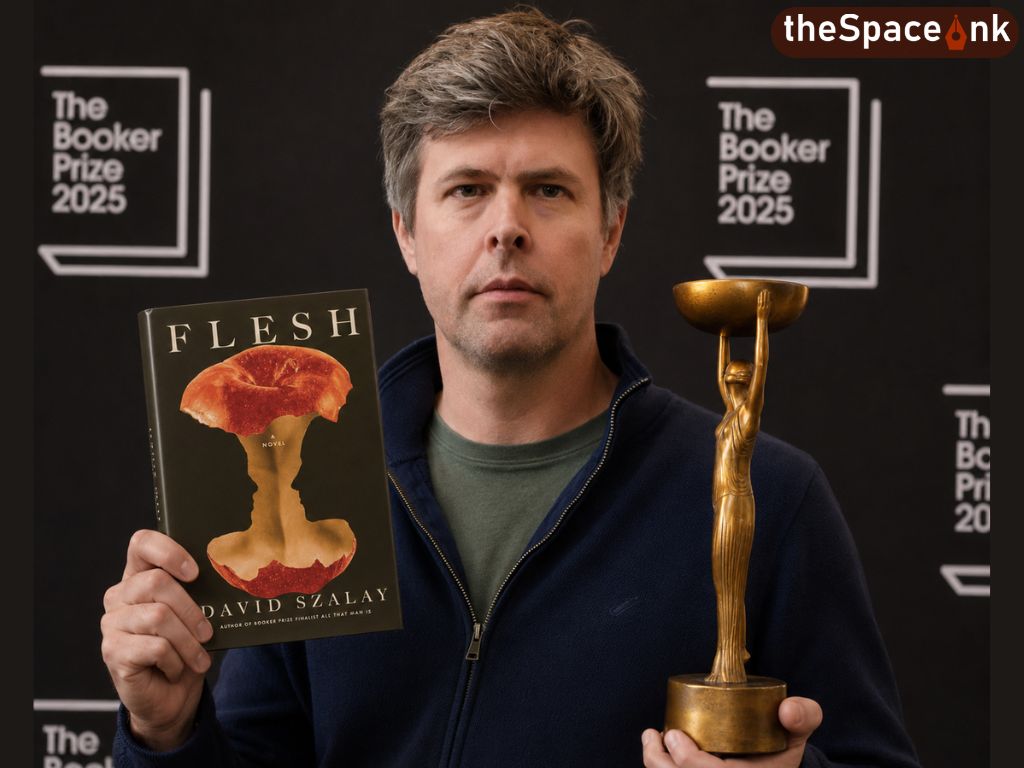
Title: Flesh
Author: David Szalay
Language: English
Publisher: Jonathan Cape, Scribner
No. of Pages: 368
Format: Hardcover
Price: Rs 1,737
THE SEX
David Szalay is not treading on new territory. The disjunction between sex and marriage, sex and romantic love and sex and any kind of sentimentality is at least more than 200 years old. The secularization of sex began in 18th century Europe with the rise of the libertines who turned sexual pleasure into a philosophy. Its most famous exponents were the Marquis de Sade and the French aristocracy in general. For Sade, sex was an adventure, full of excitement and energy.

Laclos’s Liaisons Dangereuses needs to be mentioned where libertinage becomes an intellectual assault on feminine virtue. After that, you have Stendhal who talks of sex as a heroic enterprise involving the emergence of a new man – the Romantic hero. Flaubert looks at emotions linked to sexuality with the dispassionate eye of a curious observer and as a social and psychological phenomenon. The delinking of sex and emotion continues apace until we come to the 80s of the last century when Szalay’s novel begins.

Istvan is a loner in school who finds a friend who is equally inexperienced in the affairs of sex as him. He, however, succeeds in seducing a girl and having sex with her before Istvan does and he offers to set Istvan up for a sexual encounter with her, and Istvan agrees. The encounter turns into a disaster as the girl walks out on him unconvinced that he wants it really.
Istvan is a throwback to the earlier romantic type, a distinctly uncool, emotional mess who approaches sex with an intensity all his own. His friend joins the other boys in the school, ceases to be a loner, leaving Istvan alone and uncared for, trapped in his archaic sentimentality. To be cool, to deal with girls with flamboyant unconcern, is to be part of the mainstream.

Istvan is subsequently seduced by a neighbor who initiates him into the secret art of love-making and they have a roaring affair together, until, that is, Istvan realizes that he is in love with the woman. For Istvan, the two things, love and sex, are not separate. He wants to belong to an identifiable community, but society is being dissolved by the new permissiveness. The woman breaks off her rendezvous with Istvan and refuses to have anything more to do with him. She is married to a man and she wants that to remain that way. Where there is love there is no sex; where there is sex there is no love.
Also Read: Review of The Loneliness of Sunny and Sonia by Kiran Desai
Istvan joins the army after being rebuffed by a girl with whom he was keen on having sex. She tells him that she has had sex with 23 people in the last one year, a figure that takes Istvan by surprise, but she doesn’t want to have sex with Istvan.
Flesh is about the persistence of the body, its recalcitrance vis-à-vis any superior intellectual design, without any transcendental scheme of things. Istvan tries to believe in heaven but he tells himself that he knows it’s not true. There is no consolation.
Istvan somehow lands up in England where he first works as a bouncer in a strip club and then, by luck, he turns into a high-end security operative (read celebrity bodyguard) and eventually ends up working for a tycoon. He is seduced by his employer’s wife and they have an affair. The tycoon dies of an illness, but his wife Helen, initially aloof during the illness, gradually succumbs to the demands her body makes on her and she and Istvan have fun while Helen’s husband is in agony. It is this guilt that finally brings Istvan into adulthood and into the mainstream. He starts leading a normal life.
Also Read: Revisiting the Kargil War in ‘Despatches from Kargil’ by Srinjoy Chowdhury
Szalay doesn’t say if Istvan loves Helen or not, but it is strongly implied and he remains faithful to her, which in the century we live in is pretty surprising, especially when one is dealing with the super rich. There is no decadence. Istvan has two more flings, one with his housekeeper’s wife and Szalay says he hates her for making him have sex against his will, and then a final affair with a bar girl back in Hungary. All these are inconsequential. He has sex with the housekeeper while his wife is in hospital battling for her life. That’s probably why he hates the encounter so much.
IN THE WORLD
Istvan, and not only Istvan, has three responses to the world around him. “Okay”, “I don’t know” and a shrug. “Okay” is a verbal tactic to indicate that he doesn’t want to continue that line of conversation any more, or that he is trying to conceal his real feelings on a subject, or that he is indifferent to it and, above all, to indicate that the subject holds no meaning for him.

“I don’t know” is when he really doesn’t know, or can’t be bothered to reply, or that he doesn’t want to expend mental energy on the subject being discussed or the question being asked. The shrug is a feature of silence. It means he doesn’t consider the topic to be worth any words. Istvan is not just inarticulate; he is detached, he doesn’t invest himself emotionally into things, and he treats what other people think is important with lackadaisical indifference.
WORK
Work is the domain of the arbitrary and the accidental. Life has no pattern. It lurches from one episode to the next and the episodes are not connected by any supreme design. Istvan lands up in London because he is a EU citizen. He gets his break when he saves a proprietor of a security agency from being mugged and the man repays the debt of gratitude by turning Istvan into a high-end security person.

Similarly, his employer’s wife seduces him and he acquiesces passively. Passivity is a notable feature of Istvan’s conduct; he is led into situations and then led out of them. The employer dies and his wife marries Istvan, the driver. And lo and behold, Istvan turns into a property dealer, something for which he is not qualified, something for which he has no experience. It’s all a matter of luck.
As is his exit from this exalted status. His stepson denounces him in the full glare of the media and his business career is over as suddenly as it started, principally because instead of dealing with the situation with tact and composure, he visits violence upon his stepson. His emotions get the better of him once again despite his best intentions. He has a son and he is a reasonably good father. Life is okay.
Flesh is about the persistence of the body, its recalcitrance vis-à-vis any superior intellectual design, without any transcendental scheme of things. Istvan tries to believe in heaven but he tells himself that he knows it’s not true. There is no consolation.
Image: AI, Wikimedia Commons, Wikipedia, Picryl, Wikipedia, Store Norske Leksikon

Soumitro Das has been educated in Delhi, Bombay, Calcutta and Paris. He is the author of Bombay - a novel and has recently translated 8 short stories by Rabindranath Tagore in a book titled Tales of Modern India.