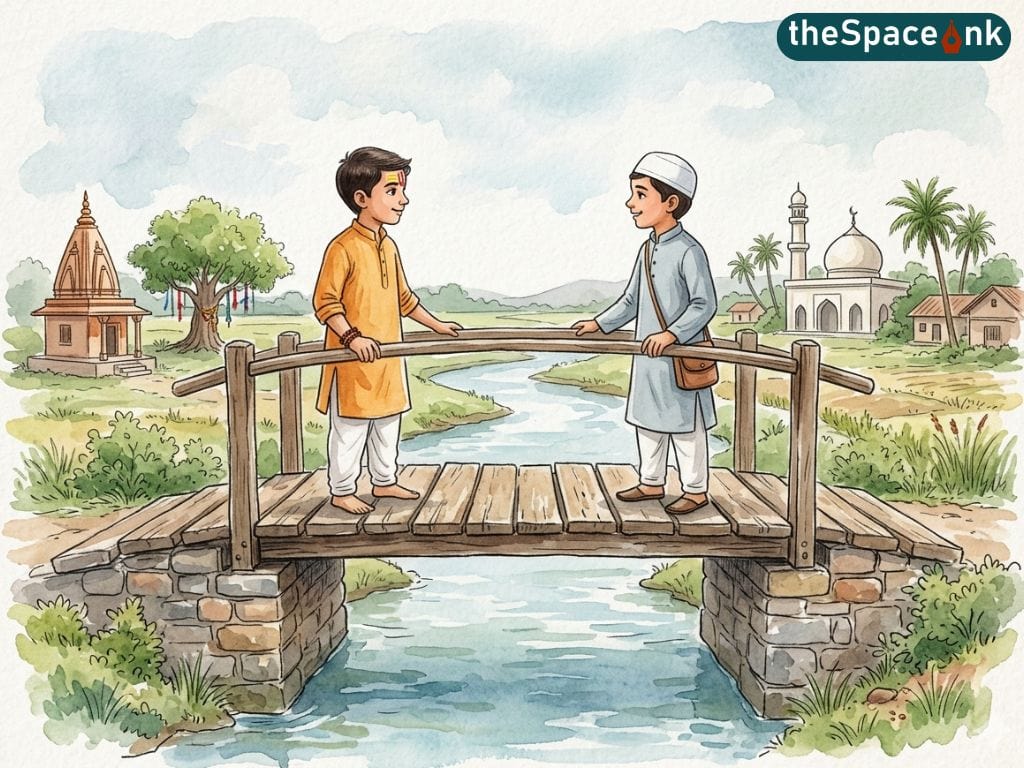
The Bridge
It was a small town. Ordinary. Unremarkable. Life moved on the wheel of hard labour.
Before dawn had fully broken, people were already rushing—towards schools, offices, and the daily hunt for work. By noon, the streets fell eerily quiet. Evening returned with tired bodies: those who had found work and those who had not, all dragging themselves home on aching legs.

There were few with money, many with worn-out bodies—salaried workers, petty traders, shopkeepers, cycle-vans, totos, autos. Everyone remained busy in their own way. Most people didn’t even have the leisure required to start a quarrel.
Rizwan and Raju, both in Class Ten. They shared a bench, shared tiffins, shared games. Rizwan’s father, Abdul, delivered bricks, sand, cement, and stone chips on his cycle-van for a distributor named Gangadhar, dropping them at construction sites across town. Raju’s father, Sukhbir, worked as a mason.
The fathers were friends too. They lived close by. When they met at work and managed to steal a few minutes, they lit two bidis and talked. Both knew their struggle was the same—the struggle for food, for survival. A daily battle against contractors and owners, their tricks, their cheating, their endless ways of squeezing labour dry. That was why religion, caste, and politics never entered their conversations.
One morning, as Raju entered school, he sensed a strange buzz in the air. Something was happening. A photograph was circulating on Facebook—someone had allegedly desecrated a mosque in town. The image was blurred, but the comments burned with fury.
Also Read: Karl Benz: The Man Who Got the World Rolling
By afternoon, unfamiliar men had entered the town. Slogans echoed. Marches formed. Threats were issued. The air grew hot. TV channels arrived. YouTubers followed. In front of cameras, a local leader screamed, veins bulging: “Our patience has limits! If those responsible are not arrested immediately and punished severely, we will shut the entire town down!”
Frightened, Rizwan asked his father, “What will happen now, Abbu?”
Abdul smiled faintly. “God knows.”

Two days later, Abdul returned with his van wrecked. The wooden platform was twisted, one wheel bent beyond repair. Mud covered his body. One eye was swollen shut; terror stared out from the other.
“Outsiders,” he said, choking. “They attacked before I could even understand what was happening.”
That night the stove stayed cold. The lamp went out. Sleep did not come.
Anger flared. The next day, while carrying lunch for his father, Raju saw Rizwan and shouted, “You’re all traitors! This town has become filthy because of you!”
At school the next day, Rizwan noticed whispers following him. One boy laughed. “This is what your people do.” Another sneered, “You foul the plate you eat from.”
Rizwan kept his head down and sat silently. Raju leaned over and whispered,“Don’t listen to them, Rizu. Everyone’s lost their minds.”
But madness had already entered Raju’s own home. That evening, Sukhbir said he’d heard that someone had broken the boundary wall of Doctor Trivedi’s newly built house, three neighbourhoods away.“This is their work. People like them don’t belong in this country.”

Raju’s mother said nothing. She only scrubbed the plates harder, the clatter sharp and loud.
A few days later, news spread suddenly, an attack on the Muslim locality. Shops burned. Tear gas filled the air. Several were injured. CRPF flag marches began. A night curfew was imposed. Bulldozers arrived. Several houses were reduced to rubble. Rizwan’s home survived—by a margin so small it felt accidental. He stopped going to school.
Mornings found him at the cement shop with his father, lifting sacks with thin, straining arms. He began making deliveries himself. Pedalling hurt. Breath came hard. Jaw clenched, Rizwan forced the van forward.
Also Read: Beyond the Screen’s Horizon
Raju, too, was changing—slowly, inwardly. One day, classmates provoked him: “Why do you talk to him so much? Makes us wonder if there’s real blood in your veins.”
Anger flared. The next day, while carrying lunch for his father, Raju saw Rizwan and shouted, “You’re all traitors! This town has become filthy because of you!”
Rizwan looked at him—speechless. Then he turned and walked away towards the empty school field.
Weeks later, one afternoon, darkness fell too quickly. The sky split open. Rain poured. At a construction site, Sukhbir was working on bamboo scaffolding. He slipped. A scream cut through the rain. Men rushed down. Blood streamed from his head, washed away by the downpour. His right arm twisted at an impossible angle. He was unconscious. The supervisor did not answer his phone.
When the plaster finally came off, the doctor said the arm would never fully recover. Sukhbir could no longer do the work he once did. The compensation money—no one knew how long it would last.
Raju arrived to find his father lying on cement sacks inside a half-built house. Rainwater rushed through like a river. “Did you call an ambulance?” he screamed. “We did,” they said. “They won’t come in this flood.”
Nearby residents shut their windows. Stepped back from balconies. One voice called out kindly, “There’s electricity in the water—be careful.”
Using a tarpaulin as a stretcher, the workers carried Sukhbir through rain and floodwater—how they managed, only they know.
There was no electricity at home. No phone battery. Raju’s mother cried. Raju said nothing. Then came a knock. Rizwan stood there, soaked and trembling. Abdul stood beside him. “Rafik chacha saw them bringing uncle home,” Rizwan said. “Come. We can’t waste time.” Raju stared. “You?”

“What did you think?” Rizwan said softly. “That I wouldn’t come?” Abdul’s cycle-van—repaired with borrowed money—waited outside. They wrapped Sukhbir in a bedsheet and set off. Through darkness, rain, broken roads, water rising from knees to waist—they reached the hospital.
The doctor said, “The head injury isn’t serious. But the arm will need surgery.” Raju’s mother clutched Abdul’s hands and sobbed. “If you hadn’t come—” Abdul interrupted gently, “Why say that, sister? If something had happened to me, wouldn’t you have stood by us?” Her head lowered.
When the plaster finally came off, the doctor said the arm would never fully recover. Sukhbir could no longer do the work he once did. The compensation money—no one knew how long it would last.
A month and a half later, Sukhbir found work at a neighbourhood lottery shop. Lifting anything heavy made his arm swell with pain.

One morning, Raju went to Rizwan’s house. Rizwan was repainting the van. Even now, he recognised Raju’s footsteps. He turned. Hesitated—just for a moment.
Raju lowered his head. “My head wasn’t right.”
Rizwan said nothing. Then he smiled. “Come inside.” Raju hesitated, then said, “I’m leaving school too. Will you teach me how to drive a loaded van? I need to start working.”
Between them, something fragile but real remained—
like a bridge still standing after a flood.
Image Courtesy: AI

A wanderer in words and wilderness, Koushik writes and translates to see the world — and himself — with mindful clarity.