(Discursive Power)
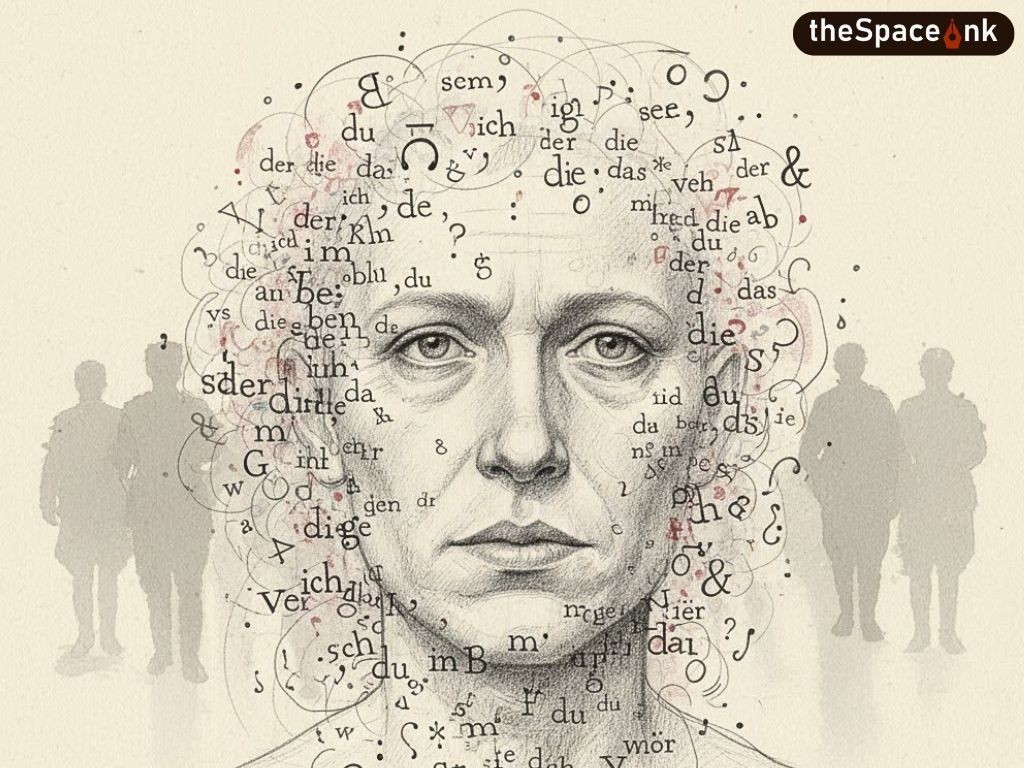
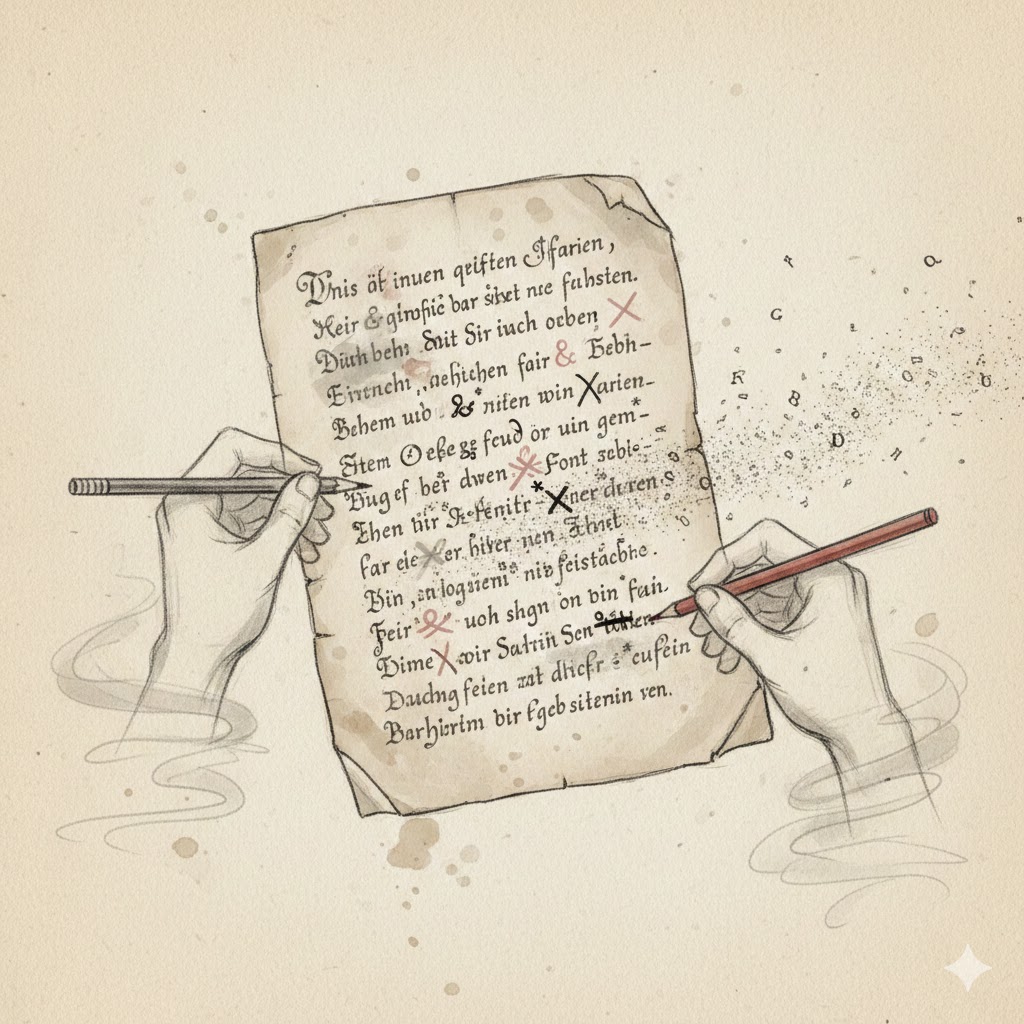
I just wrote a short magazine article in German on fascism viewed from a non-European perspective. I shortened and translated it myself, sending it on to editors whose first language was German (because mine isn’t, and there were bound to have been mistakes). When I received the edits back again, I discovered that all references to fascists had been gender-neutralised. (Discursive Power)
Those of you who are following the gender wars, not in real-world movements, but in the far more perilous playgrounds of the printed page, will be aware that this is a long-standing conflict (I shan’t use the terms ‘discursive apartheid’ or ‘genocidal invisibility’, with due disrespect to those who would like to). It is resolved differently in different languages. In English, for instance, ‘actress’ has become ‘actor’ regardless of what you have between, or what you like to put between, your legs; or how you prefer to perform in public. German has gone in the other direction.
Male and female, and then a colon or an asterisk denoting the TQI++++++ in LGBTQI++++++, standing for past, present, and future inclusivities – for people who have had, of course, first to declare their exclusion in order to be included again. Discursively, of course. For safety’s sake, I usually add an ampersand to make sure I’m not making any mistakes: then I’m ahead of the party line or have come too early to the party. (Discursive Power)
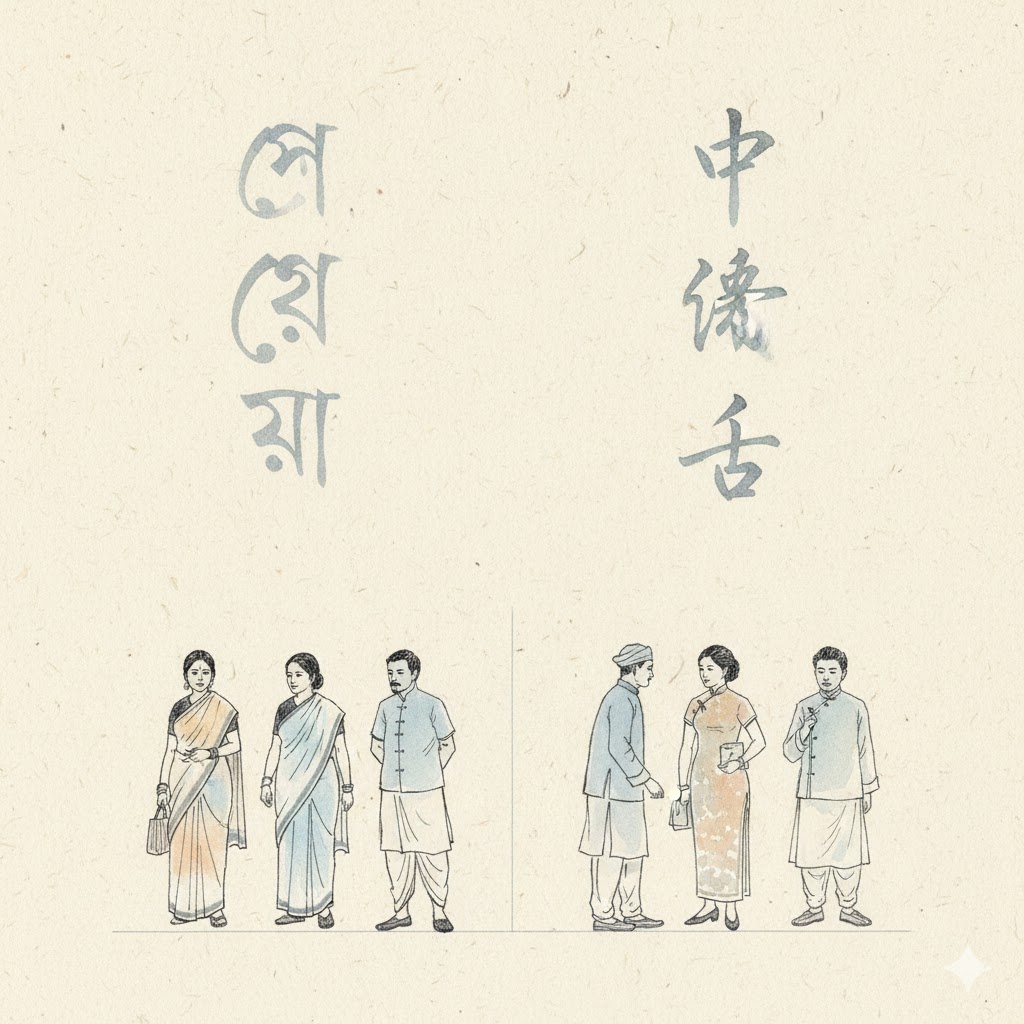
In Bengali and Chinese, of course, pronouns are gender-neutral (in Chinese, however, only when they are written down do you actually notice that they are indeed different, because they are pronounced the same). This piece of linguistic expertise is sometimes useful in that a Declaration of Pronoun Conformity would not make sense in the spoken word in Chinese, and in the spoken or written word in Bengali.
Now, depending on your perspective, we can decide that this is why the Chinese Revolution was so favourably received by Bengali-speakers, at least in West Bengal. (Lest it be assumed that I can speak and read Chinese: no, I tried, but failed; but I can still recognise the characters for ‘he’ and ‘she’). (Discursive Power)
The plural, however, can in neither language be used as a substitute for a gendered singular. (I have wondered, though, why when we say ‘they’ of an individual, we can’t say ‘they is’ to distinguish it from the plural: gendered verb conjugation might well be a thing of the future.) And in neither the Bengali nor the Chinese case, as far as I know, has the singular nature of accidentally anti-discriminatory singular pronouns had the slightest effect on really-existing gender norms. (Discursive Power)
“But returning via North America and Gays for Gaza to present-day Germany, we still have a good deal of gender trouble, (pro-)nominally at least on paper.”
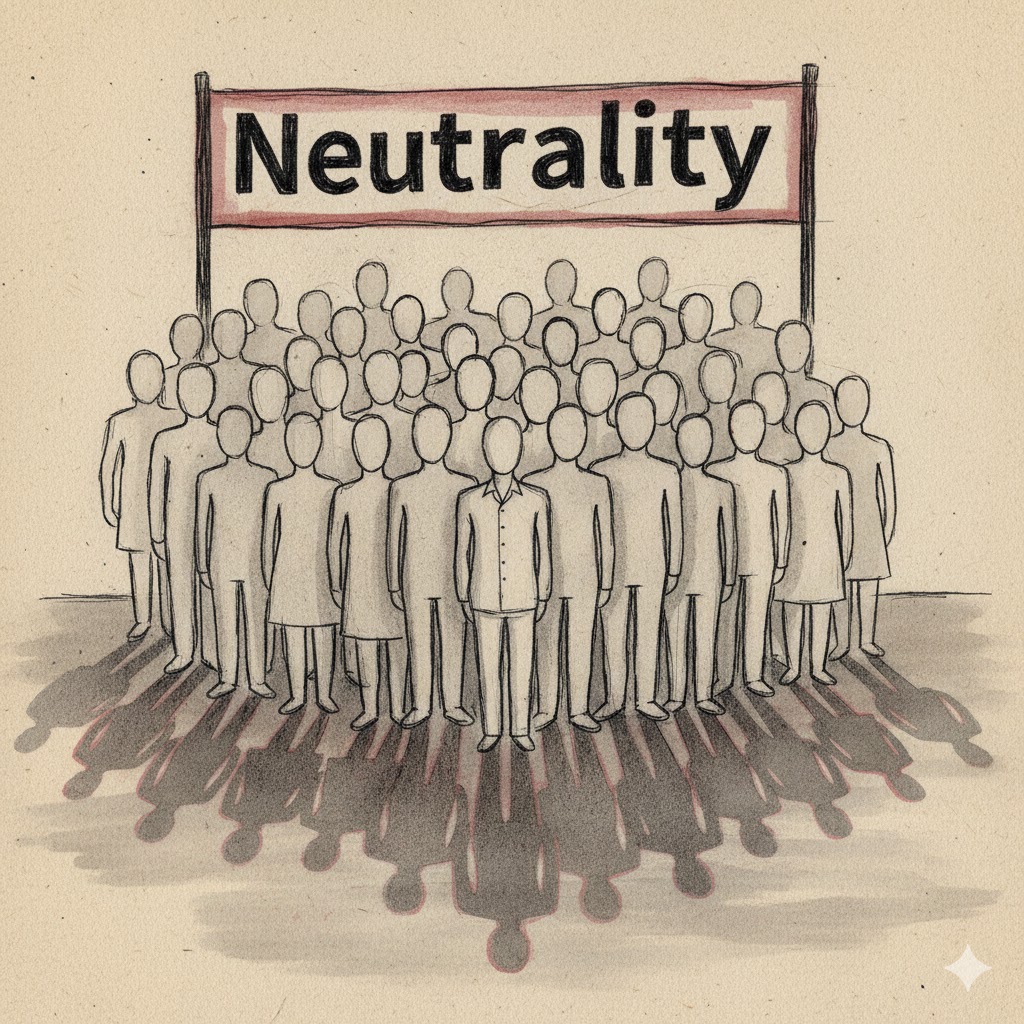
But this gender-neutralising or gender inclusivity, whatever you’d like to call it, raises a particular problem in this specific case: it makes fascism look like an equal opportunities movement. I have long been aware that the use of gendered singular forms for a general category is exclusionary or misleading: actors include actresses now, but didn’t before; and ‘all men’ either exclude women or include them, depending on whether you’re constructing or deconstructing an argument – but can we really read intention? (Discursive Power)
‘Men make their own history, but not in circumstances of their own choosing’ / ‘der Mensch macht seine/ihre eigene Geschichte, aber nicht aus freien Stücken’, etc. Verdammt nochmal, fascists weren’t gender-aware, progressive, or anti-TERF. So when I use a male pronoun, it’s usually perfectly correct. And I will use female pronouns when talking about female fascists. This whole problem only arises because you need to gender the plural in German. (Discursive Power)
Also Read: Also Read: It’s Not About Me, or Is It?
No, it’s not the (Judith) Butler wot dun it. She (now they) once told us that what we needed to do is to perform gender differently. We won’t go into what happens when the audience doesn’t turn up to the performance: that’s opening up a whole new can of worms, or set of toilet doors. Unless you’re in rural China, where toilets are a ditch dug into the ground with a narrow board to balance on over them – gender-neutral but nevertheless gender segregated (read the characters). (Discursive Power)
But returning via North America and Gays for Gaza to present-day Germany, we still have a good deal of gender trouble, (pro-)nominally at least on paper. Why not make it easier for all Ausländer by abolishing the feminine and masculine (grammatical) forms and retaining only the neutral das? Das Kind, Das Frau, Das Mädchen. Das Mann. The plural can already be confused for the feminine by people who don’t read the whole sentence or can’t conjugate the verb. Or is it possible that we who make the mistakes are the real progressives? On paper, at least. And then, too, we must ask: is a paper tiger also a paper tigress:*&? (Discursive Power)
Photos are Generated by AI

Benjamin Zachariah works at the Einstein Forum in Potsdam, and with the project on the contemporary history of historiography at the University of Trier. He was trained in the discipline of history in the last decade of the previous century. After an uneventful beginning to a perfectly normal academic career, he began to take an interest in the importance of history outside the circle of professional historians, and the destruction of the profession by the profession. He is interested in the writing and teaching of history and the place of history in the public domain.