


Perception, Reality, and the Einstein–Tagore Debate
The seminar hall of the well-known University College of Thiruvananthapuram was packed to its capacity.
Founded in 1866 as the Maharaja’s Free School and later developed into one of Kerala’s oldest and most prestigious institutions of higher learning, the college has long been associated with academic excellence, intellectual debate, and public life. Over the decades, it has produced distinguished scholars, scientists, writers, civil servants, and political leaders, earning a reputation as a cradle of modern thought in the state.
On this afternoon, that tradition seemed very much alive. Students from various departments had gathered to attend a special lecture by Dr. Vinay Nagraj, former student of the institute. The topic announced on the notice board was Science, Philosophy and the Future of Human Understanding—a title broad enough to attract everyone from literature enthusiasts to aspiring physicists.

After an hour-long lecture filled with historical anecdotes, literary references and reflections on modern science, Dr. Nagraj invited questions from the audience.
Several hands rose immediately. Questions ranged from artificial intelligence to geopolitics. Then, from the third row, a young man stood up.
“Sir, I am Rishi! Rishi Rangaraj. I am in the final semester of my M.Sc. in Physics. May I ask you something?”
“Of course, Rishi,” replied Dr. Nagraj. “Physics students are among the most trouble-making questioners. They have an unfortunate habit of asking questions for which nobody possesses satisfactory answers.”
The audience laughed.
Rishi smiled.
“Sir, in quantum physics people often say that reality exists only when it is observed or measured. Given the varied styles of observations, does every creature experience a different reality of the same event when they observe?”
For a moment, Dr. Nagraj remained silent.
“That, Rishi, is not merely a physics question. It is one of the oldest and deepest questions human beings have ever asked.”
The hall became quiet.
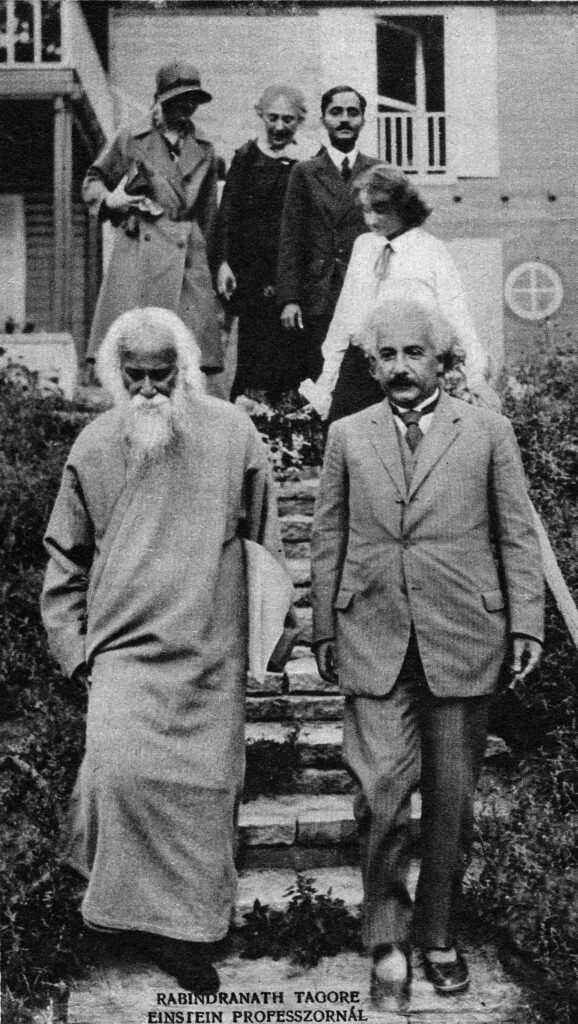
In 1930, Rabindranath Tagore visited Albert Einstein at his home in Germany. Their conversation soon turned to the nature of reality. Einstein argued that reality exists independently of human beings. A table remains a table even when nobody is looking at it. The moon continues to exist whether or not anyone observes it. This was the classical scientific position.
“Let us begin with something deceptively simple. Imagine a tree falling in a forest. What exactly happens?”
“It falls.”
“Quite so. But consider how that event appears to different observers. To a human being watching, it is primarily a visual and auditory experience. We see the trunk collapse and hear the crashing sound. A bat experiences the same event through changing echoes. A bee may perceive alterations in ultraviolet light patterns that are completely invisible to us. A snake may register changes in infrared radiation. An ant may experience the event mostly through vibrations propagating through the ground. The event appears singular, yet the experiences are radically different.”
“So, are they experiencing different realities?”
“Perhaps different realities of the same underlying event. More than a century ago, the German biologist Jakob von Uexküll introduced the concept of the Umwelt—the unique perceptual world inhabited by every organism. According to him, a bee, a bat and a human do not simply observe the same reality differently; they each construct an experiential world from the sensory information available to them. What is central to one organism’s universe may be entirely absent from another’s.”
Rishi nodded. “But surely there must be at least one objective reality behind all these perceptions, isn’t that true, Sir?”
“An excellent question. This is what has divided philosophers and scientists for centuries.”
“Why, Sir?” Rishi asked.
Also Read: The Accidental Statistician Who Became the Father of Statistics of Modern India
“Because modern neuroscience tells us that our brains do not directly perceive reality. They receive electrical signals from the senses and construct an internal model of the world. Consider the colour red. A rose is not intrinsically red in the way we experience it. It reflects light of certain wavelengths. Your brain converts those wavelengths into the sensation of redness. Another species might interpret the same information entirely differently. In a very real sense, perception is not a passive recording of reality but an active construction of it.”
“So, you mean, Sir, reality is partly created by the observer?”
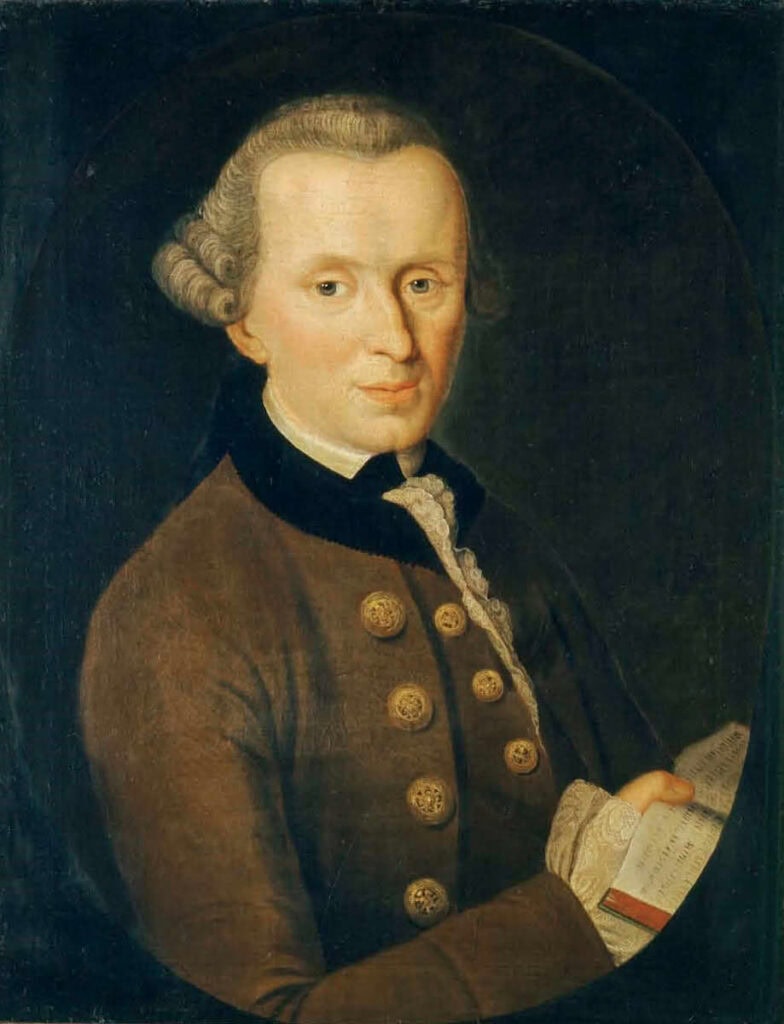
“Our experience of reality certainly is. This was essentially the argument made by Immanuel Kant. He suggested that we never know reality as it exists in itself. We know only that reality which appears through the structures of our perception and cognition.”
Rishi leaned forward and said, “That sounds almost like what some interpretations of quantum mechanics suggest. Isn’t it so, Sir?”
“Precisely. And this brings us to one of the most fascinating intellectual encounters of the twentieth century,” Nagraj replied.
“You mean the conversation between Tagore and Einstein on causality?” Rishi was confident.
A smile appeared on Dr. Nagraj’s face.
“I see you have done your homework.”
The audience laughed.
“In 1930, Rabindranath Tagore visited Albert Einstein at his home in Germany. Their conversation soon turned to the nature of reality. Einstein argued that reality exists independently of human beings. A table remains a table even when nobody is looking at it. The moon continues to exist whether or not anyone observes it. This was the classical scientific position.”
“And Tagore disagreed?” Rishi added.
“Yes, he did. Tagore argued that the reality we know is inseparable from human consciousness. His argument was that whatever we call reality is always experienced through awareness. A universe entirely divorced from consciousness might exist, but it would not be a reality that could ever be known or described by humans. For Tagore, truth itself was intimately connected to the human mind.”
“That means Einstein defended objective reality while Tagore defended observer-dependent reality? Am I right, Sir?” Rishi confirmed.
“Yes and no! Broadly speaking, yes. Einstein believed that science must describe a world existing independently of observers. Tagore believed that reality and consciousness could not be separated so easily.”
“But who won the argument, Sir?”
Dr. Nagraj laughed.
Also Read: Wilhelm Conrad Röntgen: That ‘Unknown’ Ray
“The fact that we are still discussing it nearly a century later should tell you the answer.”
The hall erupted in laughter.
Rishi persisted.
“But quantum mechanics seems to support Tagore, doesn’t it, Sir?”
“Not necessarily. Quantum mechanics is notorious for allowing multiple interpretations. Consider Schrödinger’s Cat. Before observation, a quantum system appears to exist in a superposition of possibilities. Observation seems to produce a definite outcome. Some people interpret this as evidence that observation creates reality. Others argue that reality remains objective and that our theories are simply incomplete,” Dr. Nagraj explained.
“And what about Wigner’s Friend?”
“Ah, now we are venturing into truly dangerous territory, my friend!”
More laughter followed.
“For the audience, in Wigner’s thought experiment, a scientist inside a laboratory performs a measurement and observes a definite result. For that scientist, reality has become settled. Yet an observer outside the laboratory may still describe the entire laboratory as existing in a quantum superposition. Two observers can therefore assign different descriptions to the same event,” Dr. Nagraj elaborated.
“That sounds as though reality itself depends on the observer.”
“Indeed. Some interpretations of quantum mechanics precisely suggest that. For example, Carlo Rovelli’s Relational Quantum Mechanics proposes that there is no absolute description of reality. Properties exist only in relation to systems interacting with one another. Reality becomes a network of relationships rather than a fixed stage upon which events unfold,” Dr. Nagraj continued.
Rishi sat quietly for a moment and said,
“Then perhaps every creature really does inhabit a different reality.”
Tagore would have responded that whatever we know as reality is inseparable from consciousness. A universe completely devoid of awareness may exist, but it cannot become part of human reality until it is experienced, perceived or understood. Reality, for Tagore, is not merely what exists; it is what enters into a relationship with consciousness.
“That depends on what one means by reality. A bat, a bee, a snake, and a human undoubtedly experience different worlds. Their sensory systems reveal different aspects of existence. Yet it does not automatically follow that there is no objective reality beneath those experiences.”
Rishi was not entirely convinced. He said, “Sir, let me put the question differently. If every creature experiences a different reality, if the brain constructs its own version of the world, and if quantum mechanics itself seems to make reality dependent on observation, then what is it that actually exists in this universe as real?”
The hall fell completely silent.
Dr. Nagraj paused before continuing.
“That question, Rishi, has been haunting human thought for centuries. Every civilization, every philosophy and every scientific tradition has tried to answer it.”
“Einstein would have said that there exists an objective physical universe independent of all observers. Stars burned before life appeared on Earth. Galaxies collided long before consciousness emerged. Physical laws operated whether anyone was present to observe them or not. Reality, in Einstein’s view, is like a vast book already written. Observers merely read different pages of it.”
“And Tagore? Sir!”
“Tagore would have responded that whatever we know as reality is inseparable from consciousness. A universe completely devoid of awareness may exist, but it cannot become part of human reality until it is experienced, perceived or understood. Reality, for Tagore, is not merely what exists; it is what enters into a relationship with consciousness.”
“So, what does modern science say, Sir?”
“Modern science is surprisingly modest on this question. It tells us how things behave with extraordinary precision, but it is often less certain about what things ultimately are. Take an electron. Is it a particle? A wave? A field excitation? Or a probability distribution? Quantum physics gives us mathematical descriptions that work astonishingly well, yet the underlying nature of what exists remains mysterious.”
“So, science describes reality without necessarily explaining what reality is?”
“Exactly.”
The students listened intently.
“Some physicists today suggest that relationships are more fundamental than objects. Others suggest that information may be more fundamental than matter. In such views, particles, fields, space and perhaps even time emerge from deeper structures that we do not yet fully understand,” Dr. Nagraj continued.
“And what do you think exists as ultimately real?”
Dr. Nagraj looked through the large windows of the hall.
“I suspect that reality is far richer than any description we have devised yet. Different creatures perceive different worlds. Human beings construct conceptual models. Physicists construct mathematical models. Philosophers construct metaphysical models. Each captures something genuine, yet none captures the whole.”
“So, there is no final answer?” Rishi asked with surprise.
“Not yet. But if I were compelled to offer one, I would say that what is most real is not the particular picture seen by any observer, but the deeper order that gives rise to all possible pictures. The bat encounters it through echoes. The bee encounters it through ultraviolet patterns. The snake through heat. Human beings through senses, mathematics, language and imagination. Each observer encounters a different face of the same underlying mystery.”
To be continued…
Image Courtesy: Wikimedia Commons, Facebook, Wikimedia Commons, Picryl, Wikipedia, Store norske leksikon

He studied in the Department of Radio Physics at the University of Calcutta. He chose information technology as his profession. After spending nearly eleven years working with various multinational organisations, he founded his own IT company in 1997. He continues to be actively involved in managing and running the organisation.
Amidst the demands of his professional life, he enjoys listening to music and reading on a wide range of subjects. Whenever he gets the opportunity, he loves to travel, capturing and preserving his experiences through photography.



One Response
That is precisely why STR.GTR,QP, QED is very mathematical, it can not be pictured, it is beyond common sesnses and perceptions, it only explains some observations that too at at an elevated level of measurement beyond common man’s purview.
As a human being, I am curious, but there are more observables which are closer to understanding.
So at this junture of age , with very little time in hand, priorities have changed.
Good deliberance you have offered, which is a food for thought, but at the same time stark trealities haunt life more than microscopic and mega macroscopic universe
Kudos
Saumya