The Paradox of Backlash
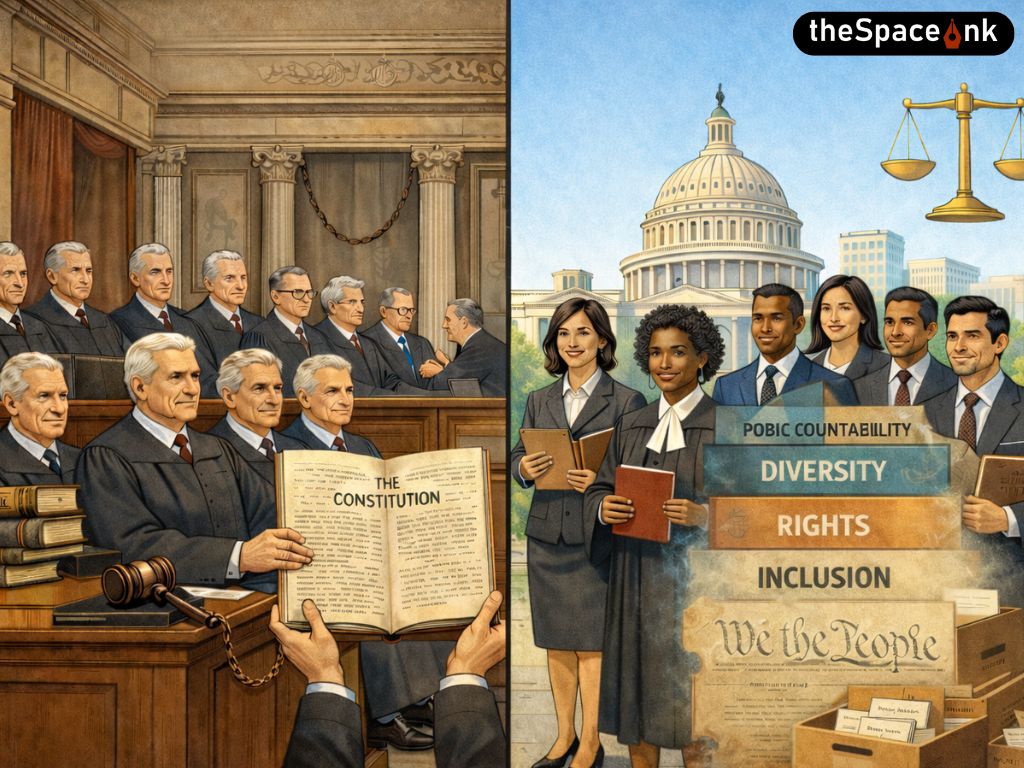
Here emerges one of the most counterintuitive aspects of this transformation: populist resistance to demographic change appears to be accelerating rather than retarding the epistemic transition. By delegitimizing traditional institutional authorities and questioning established interpretive frameworks, backlash movements have inadvertently opened space for alternative constitutional voices.
Also Read: America’s Constitution Is Being Rewritten: Without Amendment (Part I)
Consider January 6th’s aftermath as a crystallizing moment. Traditional conservative legal elites, federal judges, Republican-appointed attorneys general, career Department of Justice attorneys, rejected election fraud claims and defended institutional processes. This created a legitimacy crisis within conservative coalitions, but simultaneously elevated the credibility of diverse institutional voices who had consistently defended democratic norms. When traditional gatekeepers lose credibility through association with extremism, emerging voices gain comparative legitimacy.

The effect appears measurable in public opinion. Recent polling shows higher trust levels for diverse judicial nominees compared to ideologically extreme nominees regardless of demographic background. Citizens increasingly view demographic representation within institutions as a marker of legitimacy rather than a threat to it. This creates a reinforcing dynamic: as resistance movements become more extreme in their efforts to maintain narrow institutional control, they marginalize themselves within the very institutions that actually exercise constitutional power.
The result is faster, not slower, transition to multiethnic authorship. Institutions facing legitimacy crises have powerful incentives to diversify their leadership as a credibility-restoration strategy.
The Structural Forces
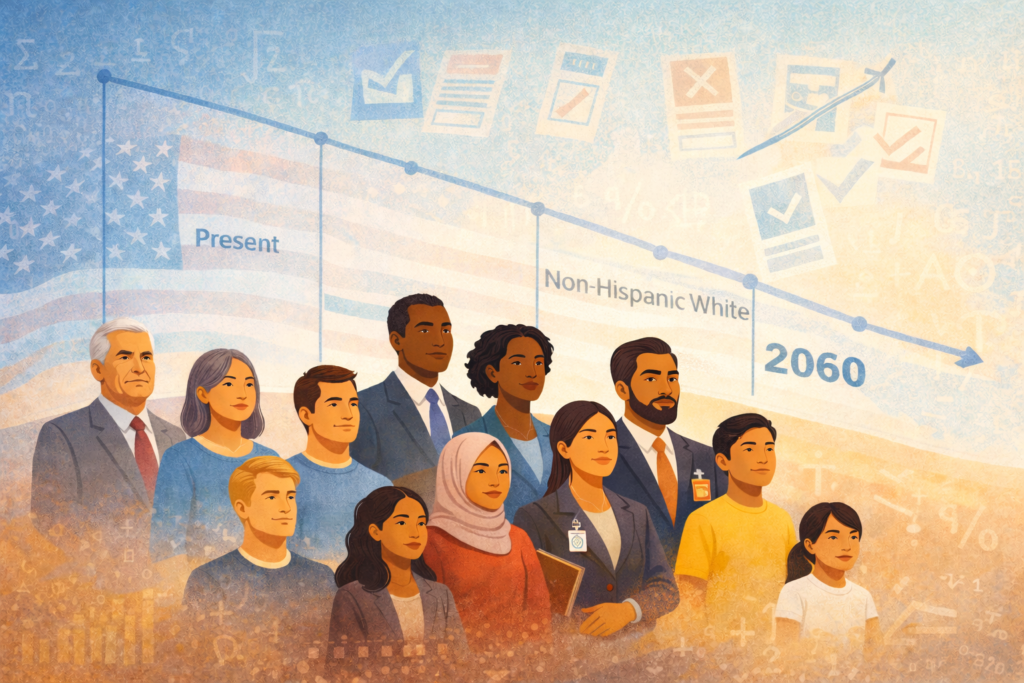
Several robust trends suggest this transformation will continue regardless of short-term political reversals. Demographic mathematics drives the underlying dynamic: America moves toward an older, more racially diverse population through 2060, with non-Hispanic whites declining as a percentage of younger cohorts. Political coalitions seeking durable majorities must construct multiethnic appeals, and constitutional interpretation follows electoral mathematics with roughly a twenty-year lag.
Also Read: Puppet in the Hands of Fate: A Memoir from the Margins (Part: 1)
Educational pipeline density reinforces demographic trends. Certain immigrant-origin groups now exhibit exceptionally high educational attainment and concentrate in states that anchor political and economic power, coastal regions, Texas, key swing states. This geographic concentration builds the philanthropic networks, media influence, and legal pipelines that feed constitutional authority.
Institutional demand amplifies these pressures. As Congress and state legislatures show steady diversification, judicial appointments follow with generational delays. Legal organizations face market pressures to demonstrate relevance to changing client bases and public constituencies. Cultural evolution provides additional momentum as religious affiliation declines, shifting rhetorical frameworks in constitutional discourse toward pluralist rather than sectarian idioms.
Critics might argue these forces could reverse through immigration restriction, economic disruption, or successful efforts to re-narrow institutional access. Historical precedent supports such concern, periods of backlash have previously constrained minority advancement within elite professions. However, the current transformation differs in scale and institutional penetration from earlier episodes. The pipeline changes operate across multiple levels simultaneously and have reached critical mass within key gatekeeping institutions.
How Constitutional Interpretation Will Change
Beyond demographics lies a more fundamental issue: how will constitutional interpretation itself evolve as interpretive authority broadens? Will new voices simply apply existing analytical frameworks to different factual situations, or will they develop fundamentally different approaches to constitutional reasoning?
Also Read: Puppet in the Hands of Fate: A Memoir from the Margins (Part: 2)
Early indicators suggest the latter. Emerging legal scholarship increasingly draws on comparative constitutional law, international human rights frameworks, and non-Western philosophical traditions. This represents not academic fashion but expansion of intellectual resources available for constitutional interpretation. As these approaches gain credibility within elite legal circles, they will inevitably influence judicial reasoning. Think of a future justice referencing South Africa’s post-apartheid constitution when evaluating equal protection claims, once unthinkable, now increasingly plausible.
Looking further ahead, the very tools of interpretation may evolve. We are beginning to see the first traces of algorithmic and AI-assisted legal research in appellate courts. Imagine a future judge, perhaps the child of immigrants, using a sophisticated AI tool trained not only on Anglo-American common law but on the constitutional traditions of the Global South, indigenous legal principles, and the lived experiences encoded in vast cultural datasets.
The stakes could not be higher. Constitutional interpretation shapes every aspect of American governance from business regulation to family law to criminal justice. As interpretive authority becomes more demographically representative, constitutional doctrine will likely evolve to reflect a broader range of American experiences and perspectives.
This judge wouldn’t be outsourcing judgment, but expanding the library of human experience and precedent from which constitutional reasoning can draw. The algorithm, in this sense, becomes less a cold arbiter and more a democratizing force, a tool that can help compensate for the historical blind spots of a traditionally narrow profession by systematizing access to a wider universe of argument and evidence. The successor generation might not just bring new perspectives to the bench; they might bring new tools to interrogate the Constitution itself.

The implications extend throughout American governance. Constitutional interpretation affects business regulation, family law, criminal justice, voting rights, and countless other domains of daily life. As interpretive authority becomes more demographically representative, constitutional doctrine will likely become more responsive to the full spectrum of American experiences and perspectives. Imagine housing law informed by the lived experience of redlining, or disability law shaped by lawyers who themselves use wheelchairs, that’s the future taking shape.
The Stakes of Succession
Three historical moments crystallized this transition’s acceleration. Barack Obama’s 2008 election demonstrated multiethnic coalition viability at the presidential level, triggering systematic investment in diverse pipeline development across Democratic Party institutions and allied organizations. The Trump era from 2016 to 2020, and the current, delegitimized traditional conservative legal authorities through association with norm-breaking and extremism, accelerating legitimacy transfer to diverse institutional voices who consistently defended democratic processes. The post-2020 period has witnessed the largest diverse law school graduating classes in American history coinciding with a legal profession hiring boom, creating permanent demographic shifts within constitutional gatekeeping professions.
Also Read: Happy New Year to America
Institutions recognizing these trends early gain strategic advantage. Elite law schools have dramatically diversified student bodies over two decades. Federal agencies recruit more aggressively from historically Black colleges and universities and Hispanic-serving institutions. State-level election administrators increasingly reflect constituency demographics rather than historical precedent. These adaptations reflect rational institutional responses to changing legitimacy requirements rather than ideological commitments.
This transformation requires neither revolution nor constitutional amendment. It proceeds through the patient work of institutional evolution, diverse law students becoming federal clerks, diverse clerks becoming professors and practitioners, diverse professionals becoming judges and administrators. The process appears robust and self-reinforcing because it operates through market mechanisms and professional incentives rather than political mandates.

Yet the transformation remains neither automatic nor guaranteed. It depends on sustained institutional commitment, continued demographic trends, and maintenance of democratic norms that permit peaceful transitions of authority. Economic crisis, authoritarian resurgence, or successful efforts to re-narrow access could alter trajectories significantly.
Writing Tomorrow’s Constitution
America stands at a unique historical moment. Its citizens are experiencing their greatest epistemic transition since the founding era, the movement from narrow to broad constitutional authorship. The Constitution’s text remains unchanged, but the community authorized to interpret it expands dramatically. This expansion reshapes not merely who holds constitutional authority, but how that authority gets exercised, justified, and transmitted.
The stakes could not be higher. Constitutional interpretation shapes every aspect of American governance from business regulation to family law to criminal justice. As interpretive authority becomes more demographically representative, constitutional doctrine will likely evolve to reflect a broader range of American experiences and perspectives. The America of 2050 will be governed by constitutional interpretations authored by today’s law students, the most diverse cohort in the profession’s history.
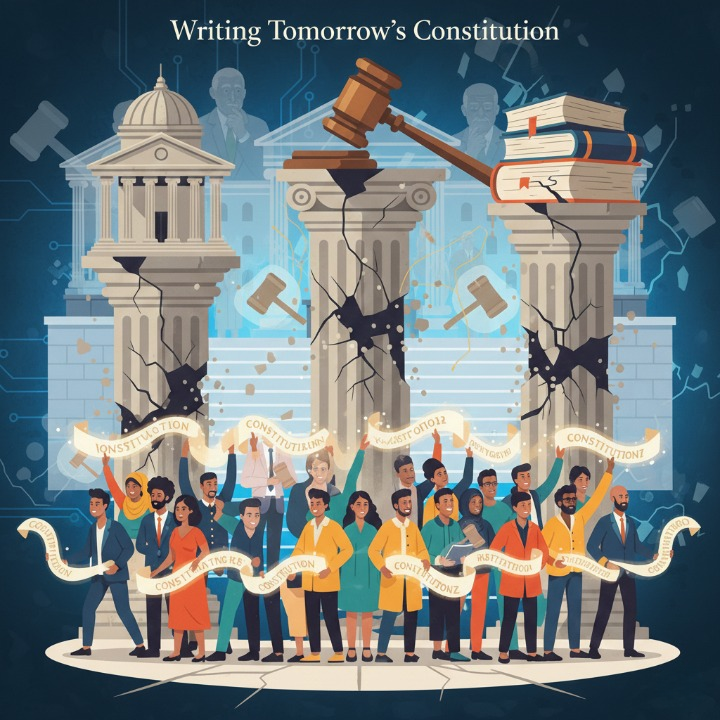
This is how republics evolve: not through dramatic rupture, but through gradual institutional transformation that eventually produces qualitatively different governance. The constitutional succession is already underway, proceeding through the routine mechanisms of legal education, professional advancement, and generational replacement. Those who recognize the transformation early position themselves advantageously. Those who resist find themselves increasingly marginalized within the very institutions they seek to control.
The question facing American institutions is not whether this demographic and epistemic transition will occur, but how quickly they will adapt to accommodate it. The answer will determine not only who interprets the Constitution in coming decades, but what constitutional interpretation itself becomes in an America that looks fundamentally different from the one that produced our current interpretive frameworks. The great constitutional succession represents both profound continuity with American institutional development and radical departure from the demographic assumptions that have guided that development for two and a half centuries.
A Note from the Author
This inquiry was sparked by a defining contrast in contemporary American politics: individuals from increasingly varied backgrounds are now finding their way into the nation’s constitutional elite.
It is that question which led to the investigation culminating in this essay.
Images Are Generated by AI

Gunjon Dasgupta writes about power, technology, and the cost of justice. His work includes The Ananya–Rudra Series, a political thriller, and essays bridging Ambedkar's moral philosophy with contemporary political economy. He lives in Kolkata.