Arthur Conan Doyle
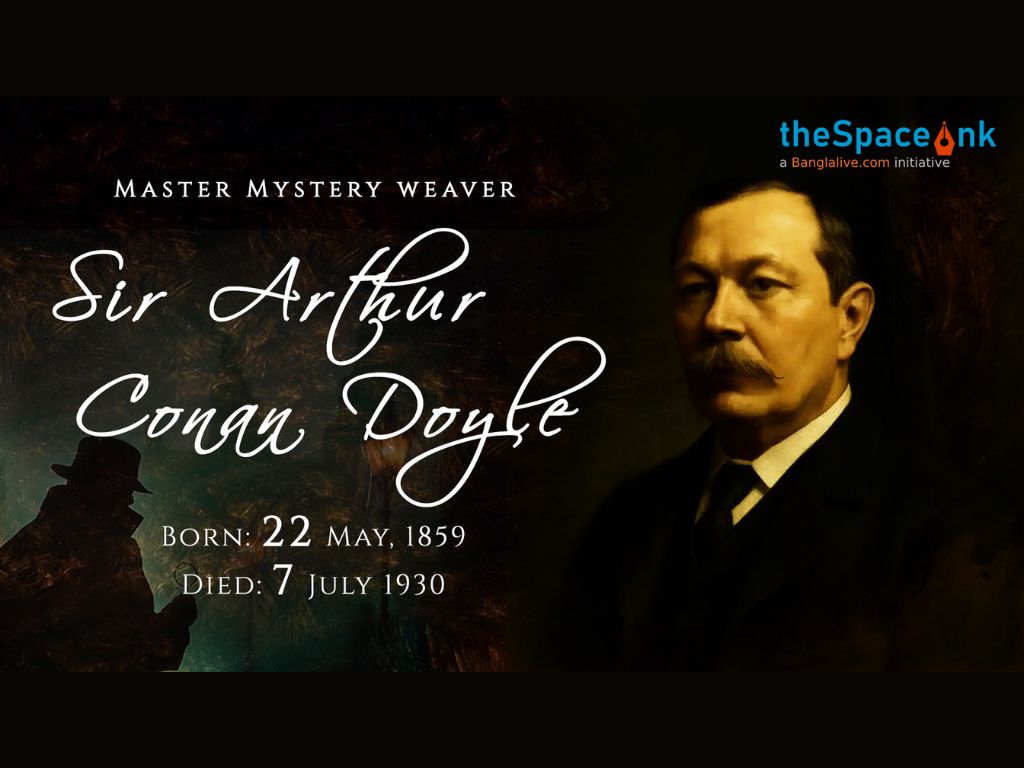
Arthur Conan Doyle tried to kill Sherlock Holmes. No kidding – in 1893, he threw the world’s most famous detective off a Swiss waterfall, convinced that Holmes was stealing all the attention from his “serious” historical novels. Fans went berserk. Men wore black armbands in the street. A London newspaper even ran a headline that read “DEAR MR. HOLMES – WE SHALL NOT SEE YOU AGAIN” as if the Queen had died. Doyle, meanwhile, just shrugged and said, “I’ve had enough of him.”
He was born in Edinburgh, Scotland in 1859. His family was well-connected but always broke. His dad, Charles, was a talented artist who also happened to be a violent alcoholic, eventually ending up in an asylum. That left young Arthur as the man of the house from a ridiculously early age. He later joked that his childhood taught him two things: how to fight, and how to tell a story to make people forget their troubles.
His family life wasn’t exactly easy. Rich relatives paid for his schooling, but they also reminded him constantly that he was the “poor relation.” At boarding school, he got bullied, so he started telling ghost stories to the other kids – for a fee. That’s right, nine-year-old Arthur charged his classmates a penny each to hear a scary tale. Even then, he understood the value of a good yarn.
Medicine became his first career. He studied at the University of Edinburgh, where one of his professors, Dr. Joseph Bell, could look at a patient and instantly guess their job, hometown, and recent travels. Sound familiar? Bell became the real-life model for Sherlock Holmes. Doyle graduated as a doctor, but he wasn’t exactly rolling in patients – his first medical practice made just £154 in three years.
Video: Tales from the Quill of the Dark Genius: The Life of Edgar Allan Poe
Writing started as a side hustle. While waiting for patients who never showed up, Doyle scribbled stories. His first published work appeared when he was just 20, but nobody paid him. It took years of rejection before a magazine finally accepted A Study in Scarlet – the first Holmes novel. They paid him £25 and kept the rights. Doyle never saw another penny from that story.
Sherlock Holmes first appeared in 1887. The detective was a hit, but not an immediate sensation. People liked him, sure – but Doyle still had to beg editors to take more stories. The real explosion came with The Adventures of Sherlock Holmes in The Strand magazine starting in 1891. Readers queued outside the publisher’s office to get the next issue. Suddenly, everyone wanted to know what the weirdo with the violin and the cocaine habit would do next.
Here’s where it gets dramatic. Doyle grew to hate his creation. He wrote to his mother, “Holmes is taking my mind from better things.” So he killed him at Reichenbach Falls. But the public outrage was so intense, and the money offers so huge, that he resurrected Holmes ten years later. His excuse? He claimed he’d only pushed Holmes off the waterfall in a “spirit of adventure.” Fans didn’t care – they just wanted more.
But Conan Doyle wasn’t just Holmes. He wrote historical novels about knights and Romans, plus horror stories, plays, and even a book about the Boer War that got him knighted. He also ran for Parliament twice. Lost both times. He played cricket for the famous Marylebone Cricket Club alongside the author J.M. Barrie (the Peter Pan guy). And he was a passionate rugby fan – he once reportedly helped found a club in Portsmouth.
Video: Victor Hugo – Ocean Man of Words
Then things got really strange.After his son Kingsley died in World War I, Doyle plunged headfirst into spiritualism – the belief that you can talk to the dead. He became the world’s most famous supporter of séances, table-tapping, and ghost photography. He even wrote a book defending the Cottingley Fairies – you know, those fake photos of two girls with paper fairies? Doyle believed they were real. So did Sir Arthur. It wrecked his scientific reputation.
He also loved sports and real-life detective work. Doyle was a keen boxer, skier, and golfer – he helped popularize skiing in Switzerland. And twice he personally solved wrongful convictions. The first was a shy, half-blind lawyer named George Edalji, who was accused of mutilating horses. Doyle investigated the case himself, wrote a series of newspaper articles, and got the man freed. He did the same for a German Jew named Oscar Slater. Just like Holmes, he couldn’t let injustice stand.
By the end of his life, Conan Doyle was a conflicted figure. He’d created the ultimate symbol of cold logic, yet spent his final years chasing séances. He died in 1930, at age 71, reportedly surrounded by family and a Ouija board. His last words were to his wife: “You are wonderful.” Then he added, to no one visible, “I am ready.” The man who gave us Sherlock Holmes apparently believed he was about to shake hands with his dead son.
So what’s his real legacy? More than 130 years after Holmes first lit that pipe, the detective remains the most filmed fictional character in history – over 250 movies and thousands of radio episodes, TV shows, and games. Doyle wanted to be remembered for his serious literature, but the world chose Holmes. Funny how that works. He tried to kill his own creation, but every new adaptation brings the great detective back to life. And somewhere, Arthur Conan Doyle is probably rolling his eyes.