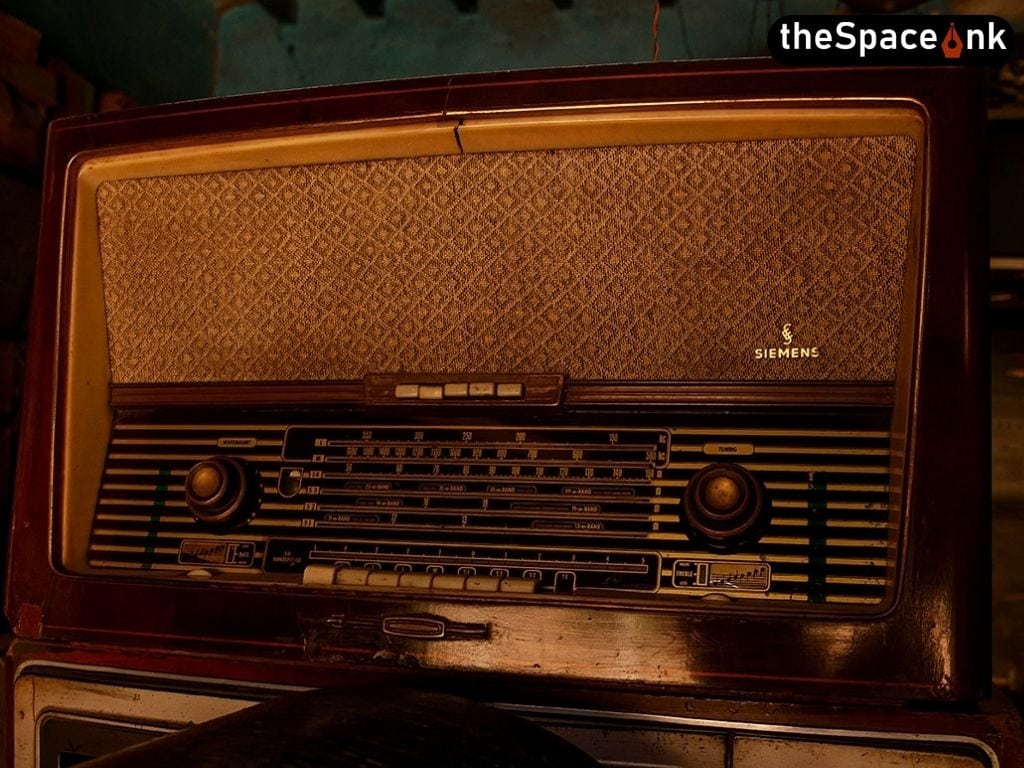
The Radio That Refuses to Fall Silent(Snow)
In a few days, it will be Mahalaya. Before dawn, across Bengal, homes will stir to a voice that has become almost sacred to generations of Bengalis—the deep baritone of Birendra Krishna Bhadra. Old radios will be dusted, polished and coaxed back to life. For one morning every year, perhaps, the radio becomes important again.
But where does one go when an old radio refuses to speak?
Radio repair shops have almost disappeared. A few can still be found in Kolkata, but travelling across India, I found them increasingly difficult to locate.


Then, in the old quarters of Hyderabad, I found one.
In Dar-ul-Shifa, north of Charminar, the aroma of paya and kebabs fills the air around Nayapul. Just before that, a road branches away—Chhatabazar Road. Walk along it for a while and an old archway appears: Chhatabazar Kaman.
Just beyond it, on the left, is a tiny shop – Mehboob Radio.
Inside, radios are everywhere. Murphy, Santosh and other forgotten names sit alongside old, horn-shaped sets that look as though they have travelled straight out of another century. In one corner, an elderly man sits quietly at his workbench.
His name is Moinuddin. His hands still know how to make a silent radio speak.
“This shop is almost a hundred years old,” he tells me. “My grandfather started it more than 100 years ago. My father’s name was Mohammed Mehboob, so that is where the name came from. The shop was originally in Devipura. We moved here in 1933.”


The story of the shop is almost a history of the radio itself.
Moinuddin took over the business in 1997. He remembers his father travelling across the country repairing radios. There was a time when the shop attracted well-known actors, singers and artists from Hyderabad.
Those days are gone.
“People are not interested in new radios anymore,” he says. A few still buy vintage sets to decorate their homes. On Sunday mornings, an old-things market near Charminar attracts collectors who sometimes come looking for radios.
Photostory: Kumortuli in Kolkata
Yet the radio has not completely disappeared.
There are still people who listen to FM. When their sets stop working, they come here.
Some travel from Karnataka and Maharashtra. Others come from different parts of India. Even customers from Kolkata have sent radios here for repair.
And then there is cinema.
Old radios, no longer useful in everyday life, have found another life on screen. Film productions sometimes buy or rent them as props, bringing these forgotten objects back into carefully recreated versions of the past.
I ask Moinuddin whether the next generation will continue the business.


His answer is immediate.
“No. There is no money in it. It is difficult to make a living from this work. People don’t understand the value of radios. Let the children do something else and live well.”
Before I can decide whether there is regret in his words, he puts a magnifying glass to his eye, soldering wire rests in his hand. He bends over a radio.
For a moment, the little shop feels less like a repair store and more like the last workshop of a vanishing civilisation.
A civilisation when sound arrived through a wooden box. When news was something you waited for. When music had a time and a place. When Mahalaya meant gathering around a radio before sunrise and listening to Birendra Krishna Bhadra summon autumn into the darkness. Technology has moved on. The radio has become a relic.


Yet here, in a narrow lane in Hyderabad, an old man still repairs its wounded circuits and perhaps that is why this tiny shop matters. Because sometimes, preserving an old object is not really about the object. It is about keeping a voice alive.
And somewhere, perhaps on another Mahalaya morning, an old radio will crackle once again—and from the static, the past will begin to speak.

By day, Amlan Chakraborty a technical architect in IT; by passion, he's an explorer, travel writer and photographer. During his travels, he savors the journey on foot or via public transport, immersing himself in the local culture at street food joints and book corners. Through his lens, he captures and shares the essence of nature, humanity, and cultural and socio-political moments.