Jackals and Arabs was written by Franz Kafka around 1917 and first published in 1917. Set in a desert oasis, the story uses a meeting between a European traveler, Arabs, and jackals to explore themes of cultural conflict, prejudice, colonial perspectives, and the futility of inherited hatred.
Jackals and Arabs
Translation by Ian Johnston
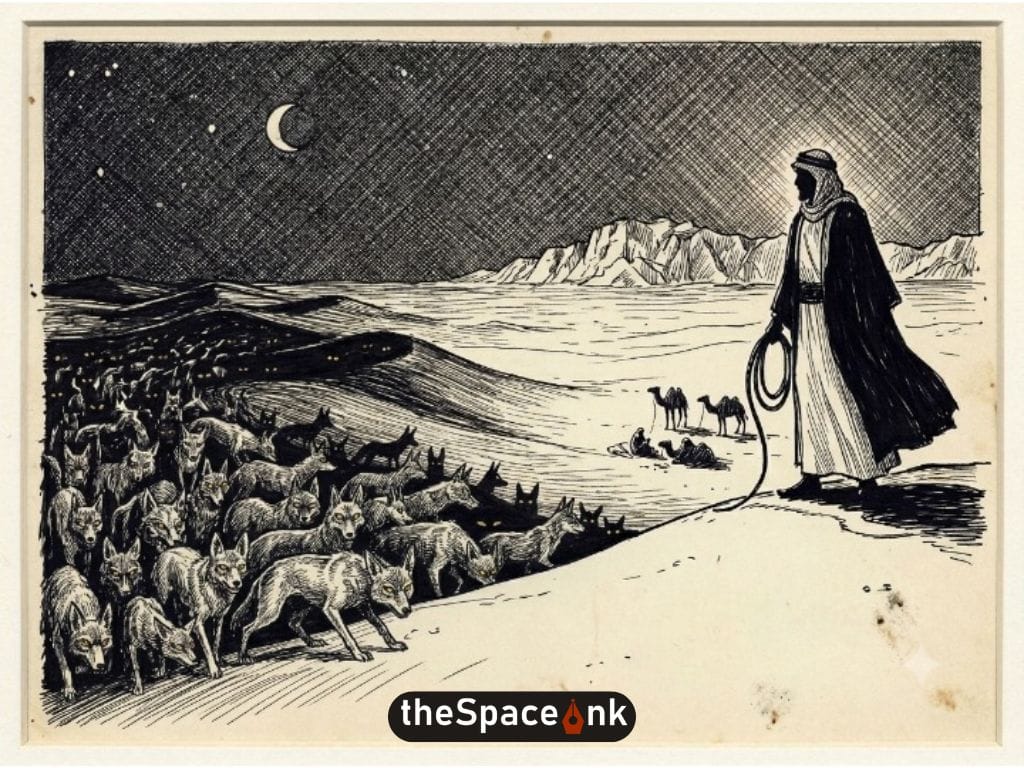
We were camping in the oasis. My companions were asleep. An Arab, tall and dressed in white, went past me. He had been tending to his camels and was going to his sleeping place.
I threw myself on my back into the grass. I wanted to sleep. I couldn’t. The howling of a jackal in the distance—I sat up straight again. And what had been so far away was suddenly close by. A swarming pack of jackals around me, their eyes flashing dull gold and going out, slender bodies moving in a quick, coordinated manner, as if responding to a whip.

One of them came from behind, pushed himself under my arm, right against me, as if it needed my warmth, then stepped in front of me and spoke, almost eye to eye with me.
“I’m the oldest jackal for miles around. I’m happy I’m still able to welcome you here. I had already almost given up hope, for we’ve been waiting for you an infinitely long time. My mother waited, and her mother, and all her mothers, right back to the mother of all jackals. Believe me!”
“That surprises me,” I said, forgetting to light the pile of wood which lay ready to keep the jackals away with its smoke, “I’m very surprised to hear that. I’ve come from the high north merely by chance and am in the middle of a short trip. What do you jackals want then?”
As if encouraged by this conversation, which was perhaps too friendly, they drew their circle more closely around me, all panting and snarling.
“We know,” the oldest began, “that you come from the north. Our hope rests on that very point. In the north there is a way of understanding things which one cannot find here among the Arabs. You know, from their cool arrogance one cannot strike a spark of common sense. They kill animals to eat them, and they disregard rotting carcasses.”
“Don’t speak so loud,” I said. “There are Arabs sleeping close by.”
“You really are a stranger,” said the jackal. “Otherwise you would know that throughout the history of the world a jackal has never yet feared an Arab. Should we fear them? Is it not misfortune enough that we have been cast out among such people?”
Like a small angry pump which—with a determination matched only by its hopelessness—seeks to put out an overpowering fire, every muscle of its body pulled and twitched in its place. Then right away all them were lying there on the corpse working in the same way, piled up like a mountain.
“Maybe—that could be,” I said. “I’m not up to judging things which are so far removed from me. It seems to be a very old conflict—it’s probably in the blood and so perhaps will only end with blood.”
“You are very clever” said the old jackal, and they all panted even more quickly, their lungs breathing rapidly, although they were standing still. A bitter smell streamed out of their open jaws—at times I could tolerate it only by clenching my teeth. “You are very clever. What you said corresponds to our ancient doctrine. So we take their blood, and the quarrel is over.”
“Oh,” I said, more sharply than I intended, “they’ll defend themselves. They’ll shoot you down in droves with their guns.
“You do not understand us,” he said, “a characteristic of human beings which has not disappeared, not even in the high north. We are not going to kill them. The Nile would not have enough water to wash us clean. The very sight of their living bodies makes us run away immediately into cleaner air, into the desert, which, for that very reason, is our home.”

All the jackals surrounding us—and in the meantime many more had come up from a distance—lowered their heads between the front legs and cleaned them with their paws. It was as if they wanted to conceal an aversion which was so terrible, that I would have much preferred to take a big jump and escape beyond their circle.
“So what do you intend to do,” I asked. I wanted to stand up, but I couldn’t. Two young animals were holding me firmly from behind with their jaws biting my jacket and shirt. I had to remain sitting.
Also read: The Ghost in the Mill
“They are holding your train,” said the old jackal seriously, by way of explanation, “a mark of respect.” “They should let me go,” I cried out, turning back and forth between the old one and the young ones. “Of course, they will,” said the old one, “if that’s what you want. But it will take a little while, for, as is our habit, they have dug their teeth in deep and must first let their jaws open gradually. Meanwhile, listen to our request.” “Your conduct has not made me particularly receptive to it,” I said.
“Don’t make us pay for our clumsiness,” he said, and now for the first time he brought the plaintive tone of his natural voice to his assistance. “We are poor animals—all we have is our teeth. For everything we want to do—good and bad—the only thing available to us is our teeth.” “So what do you want?” I asked, only slightly reassured.

“Sir,” he cried out, and all the jackals howled. To me it sounded very remotely like a melody. “Sir, you should end the quarrel which divides the world in two. Our ancestors described a man like you as the one who will do it. We must be free of the Arabs—with air we can breathe, a view of the horizon around us clear of Arabs, no cries of pain from a sheep which an Arab has knifed, and every animal should die peacefully and be left undisturbed for us to drain it empty and clean it right down to the bones. Cleanliness—that’s what we want— nothing but cleanliness.”
Every European is offered them for the great work; every European is exactly the one they think qualified to do it. These animals have an absurd hope. They’re idiots, real idiots. That’s why we’re fond of them. They are our dogs, finer than the ones you have. Now, watch this. In the night a camel died. I have had it brought here.”
Now they were all crying and sobbing. “How can you bear it in this world, you noble heart and sweet entrails? Dirt is their white; dirt is their black; their beards are horrible; looking at the corner of their eyes makes one spit; and if they lift their arms, hell opens up in their arm pits. And that’s why, sir, that’s why, my dear sir, with the help of your all-capable hands you must use these scissors to slit right through their throats”.
He jerked his head, and in response a jackal came up carrying on its canine tooth a small pair of sewing scissors covered with old rust.
“So finally the scissors—it’s time to stop!” cried the Arab leader of our caravan, who had crept up on us from downwind. Now he swung his gigantic whip.

The jackals all fled quickly, but still remained at some distance huddled closely together, many animals so close and stiff that it looked as if they were in a narrow pen with jack o’ lanterns flying around them.
“So, you too, sir, have seen and heard this spectacle,” said the Arab, laughing as cheerfully as the reticence of his race permitted. “So you know what the animals want,” I asked. “Of course, sir,” he said. “That’s common knowledge—as long as there are Arabs, these scissors will wander with us through the deserts until the end of days.
Every European is offered them for the great work; every European is exactly the one they think qualified to do it. These animals have an absurd hope. They’re idiots, real idiots. That’s why we’re fond of them. They are our dogs, finer than the ones you have. Now, watch this. In the night a camel died. I have had it brought here.”
Four bearers came and threw the heavy carcass right in front of us. No sooner was it lying there than the jackals raised their voices.

Every one of them crept forward, its body scraping the ground, as if drawn by an irresistible rope. They had forgotten the Arabs, forgotten their hatred. The presence of a powerfully stinking dead body wiped out everything and enchanted them. One of them was already hanging at the camel’s throat and with its first bite had found the artery.
Like a small angry pump which—with a determination matched only by its hopelessness—seeks to put out an overpowering fire, every muscle of its body pulled and twitched in its place. Then right away all them were lying there on the corpse working in the same way, piled up like a mountain.

Then the leader cracked his sharp whip powerfully all around above them. They raised their heads, half fainting in their intoxicated state, looked at the Arab standing in front of them, started to feel the whip now hitting their muzzles, jumped away, and ran back a distance. But the camel’s blood was already lying there in pools, stinking to heaven, and the body was torn wide open in several places. They could not resist. They were there again. The leader once more raised his whip. I grabbed his arm. “Sir, you are right,” he said. “We’ll leave them to their calling. Besides, it’s time to break camp. You’ve seen them. Wonderful creatures, aren’t they? And how they hate us!”
This story is now in the public domain. The text was reproduced from Franz Kafka online
Images courtesy: AI

Franz Kafka was a Prague-born German-language writer whose works explore alienation, bureaucracy, guilt, and existential anxiety. Though little recognized during his lifetime, he became one of the most influential literary figures of the 20th century. His notable works include The Trial, The Castle, and Metamorphosis.