

Where Clouds Wait: Notes from Dawaipani
Choosing Dawaipani during the early monsoons may well have been the finest decision of the entire trip, and one I would make again without a moment’s hesitation.
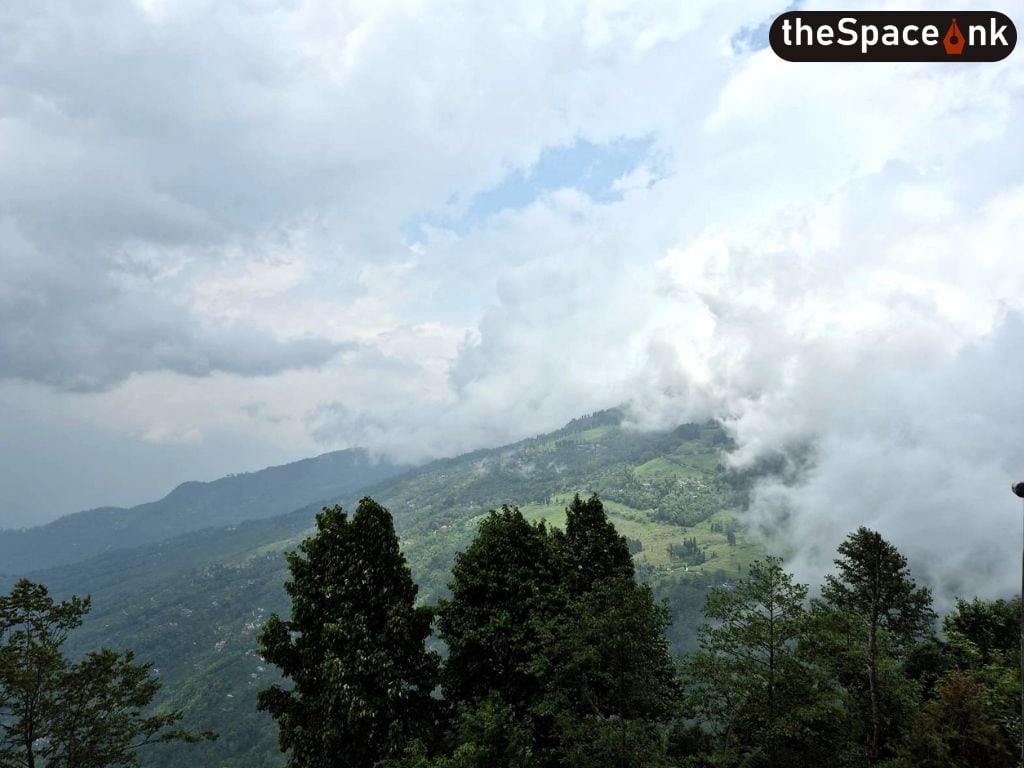
There is something almost otherworldly about waking among clouds. Mornings arrive wrapped in silence and silver fog, the kind that softens every edge and obliterates the boundary between earth and sky. The quiet art of waiting thus begins. Watching the mist slowly drift and thin, the sun’s rays timidly piercing through the lifting veil, until that breathtaking fleeting moment when the curtains finally reveal brooding silhouettes of the surrounding mountains, emerging from clouds like a secret the morning had been keeping all along—only to be shrouded all over again.

As we left the bustling streets of the Queen of Hills behind, something shifted almost immediately. The winding hilly roads made the world feel a little less urgent, a little less loud—the network bars on our phones began to disappear, one by one, and strangely, with each bar lost, the world outside the window started to feel a little more real. The journey from one mountain to the next was a study in gentle transformation. Darjeeling‘s busy buildings and crowded thoroughfares slowly gave way to sparser, smaller homes perched along the hillside and still smaller shops—modest, unhurried—demanding nothing of you.

But it wasn’t just the landscape that was changing. There was a subtler shift in the air too, in the rhythm of life itself. The pace of work, the texture of daily routine, the quiet way people moved through their mornings—all of it spoke of a culture less tethered to the clock, more rooted in the land beneath their feet and their immediate, subtle needs and necessities.
We arrived at our homestay, tucked quietly between the folds of the hilly forests, and the name Dawaipani suddenly made perfect sense. There is a local tale whispered among the villagers of a nearby spring whose waters are believed to carry therapeutic and medicinal properties, a natural remedy that has healed ailments for generations.
Also Read: The Sustainability of “Sustainable fashion”
We never did come across that fabled water source during our stay, but perhaps that was because Dawaipani’s truest medicine was never confined to a single spring, rather in its geographical as well as cultural landscape. The village welcomed us with rain and gusts of cool mountain wind, with the unfamiliar calls of birds hidden somewhere deep among the misty forests, and with strings of prayer flags swaying gently in the breeze, each flutter—a quiet harbinger of peace.

As I looked at the small wooden house beside our homestay, a quiet scene unfolded—an old woman sat cooking by her hearth, while roaming chickens pecked at the earth, mountain dogs lay sprawled, and wild roses bloomed in untamed bursts along the fence. It was as if the tapestry of their lives had always been woven with unhurried threads—each day unfolding gently into the next, unrushed by ambition, unbothered by the noise of the world beyond the mountains.
The next morning, it was time to leave Dawaipani. After two days, immersed in its unhurried rhythm, we slowly descended through the hills, bidding farewell to the mountains and winding roads. Then, somewhere midway down, a notification lit up my phone, the signal returning, and in that, the city had already found its way back in.
In a world increasingly enmeshed in hustle culture and productivity-driven narratives, this small village quietly offers a different philosophy—one that works gently against the arms of the clock. Unrushed life here is shaped by minimal needs and the simple rhythm of day-to-day living. There is rarely any sense of urgent want, because contentment here is not something chased—it is simply lived. What struck me most, though, was not the pace but the people.

The social fabric of Dawaipani is woven tight with warmth, a closely knit community where everyone leans on each other to give meaning to everyday life. Even from a distance, as a stranger who didn’t speak their language, the liveliness of their interactions was impossible to miss. Faces brimming with smiles, laughter spilling easily between greetings—there was a generosity to their joy that needed no translation. It felt like one large, sprawling family where each member quietly upholds the other, lending meaning and warmth to each other’s existence in a way that the anonymous, hurried city rarely allows.

In cities, time feels measured. In Dawaipani, it felt inhabited. This is a place gently ordained by nature rather than human convenience. The weather here doesn’t just set the mood—it sets the agenda. Heavy rains would have us nestled indoors, while a lifting mist was its own kind of invitation to step outside, breathe it all in, and simply look around. In this small, unhurried corner of the world, we were reminded, quite tenderly, that we are still subjects of nature, still answerable to the mist, the rains and the mood of the mountains, rather than the arms of the clock or the weight of calculative agendas.

Dawaipani, at night, is a mesmerizing sight to behold. On the clearer evenings, the surrounding cities and hamlets scattered across the adjacent mountains glimmered in the darkness like fallen stars, dotting the night in quiet, distant constellations. It’s like a temporary moment of happiness before the fog draws its curtains back on the night sky.
The next morning, it was time to leave Dawaipani. After two days, immersed in its unhurried rhythm, we slowly descended through the hills, bidding farewell to the mountains and winding roads. Then, somewhere midway down, a notification lit up my phone, the signal returning, and in that, the city had already found its way back in.
Also Read: Social Media- Banes and Boons
For all its beauty, slow living carries hardships that city dwellers like us tend to romanticise past: the isolation, the labour, the quiet difficulty of sustaining everyday life on a mountainside. Dawaipani was, for us, a retreat—a temporary space to breathe. For its residents, it was not an escape from life, but simply life itself. Perhaps that gap in understanding is exactly why slow living, however deeply attractive, is far easier to romanticise than to actually inhabit.
What stayed with me was not the landscape alone, but the unfamiliar feeling of having nowhere urgent to be; somewhere between the mist and the unhurried afternoons of Dawaipani, I realised how rarely we allow ourselves to simply exist, without constantly rushing towards the next urgent thing.
Image Courtesy: Author

Atreyi Biswas is a student of Sociology from Kolkata, India. She has a keen interest in the prevailing social institutions and changing social relationships. Atreyi loves watching movies, documentaries, listening to podcasts, reading articles, short stories and exploring new things.





One Response
Well expressed!!