Se7en: A Sermon in Blood and Rain
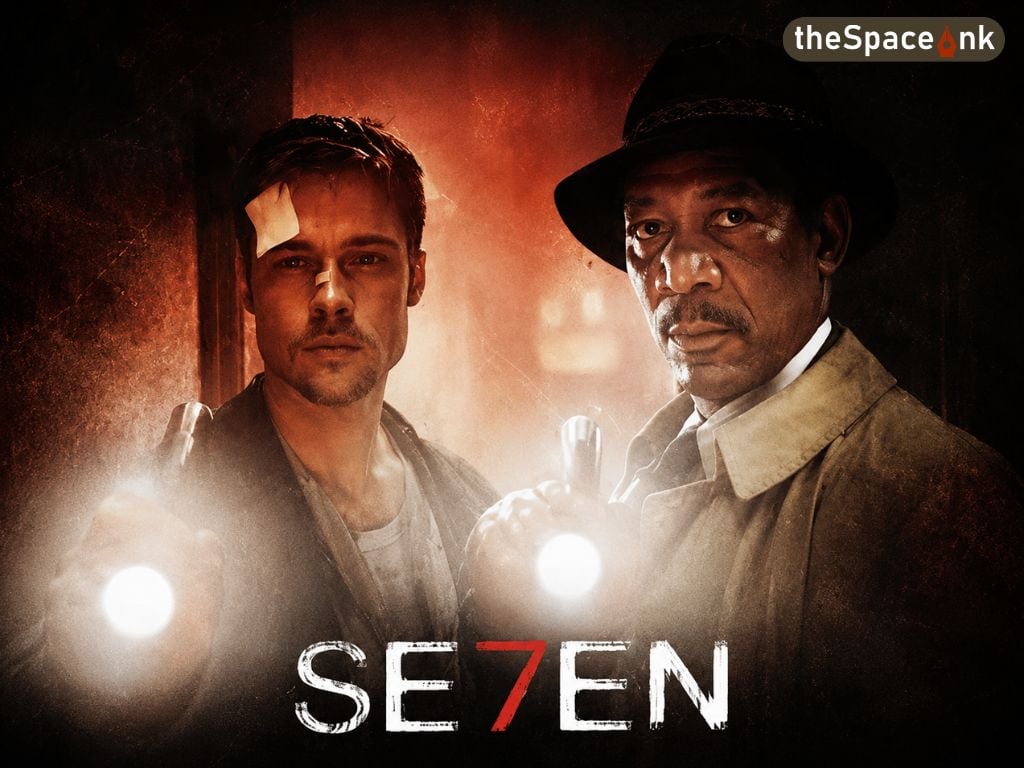
An unnamed metropolis that is not so much a city as a festering wound covered with the flimsiest of bandages: one scratch, and the gaping, putrescent flesh is laid bare; one poke, and the maggots come crawling out of the necrotic mass. Such is the setting for David Fincher’s neo-noir psychological thriller Se7en (1995)—an urban hellscape that partly resembles New York and partly Gotham of DC lore.

Steeped in apathy, riddled with crime, it is not a place where one can feel safe at any time, let alone think of starting a family. Slate-grey skies and incessant rainfall add to the city’s bleak demeanour, while a sense of permanent hopelessness permeates every pore of its hapless denizens.

Detective Somerset (played by Morgan Freeman), a police officer bone-weary from decades of waddling through the dregs of humanity, sees the city as beyond saving. Conversely, newcomer Detective Mills (played by Brad Pitt), fuelled by the naiveté and arrogance of youth, approaches it as a puzzle that can be solved with enough grit and determination.

Together, they hunt a terrifying serial killer John Doe (portrayed by Kevin Spacey) who exploits the city’s inherent decadence as a pulpit for his twisted preaching. Using the seven deadly sins—gluttony, greed, sloth, lust, pride, envy, and wrath—as his roadmap, the demented murderer turns the victims’ own vices against them, leaving behind grisly tableaus designed to shock a numb society into ‘paying attention’.

Pairing the wise but bitter veteran cop with the impulsive yet brave-hearted rookie is a movie trope as old as time itself. But in this instance the cliché works perfectly, as the partnership transcends the formulaic ‘buddy-cop’ routine to become an engaging battle of ideologies: Somerset’s pragmatic cynicism versus Mills’ reckless optimism. And while the duo eventually sort out their differences and start acting as a cohesive unit in their quest to apprehend the elusive killer, the audience waits with bated breath to find out whose worldview is validated, or for that matter shattered, at the end of the investigation.
Also Read: The Truth in the Shadows: Revisiting The X-Files
John Doe is a far cry from the run-of-the-mill ‘Slasher’ villains who dominated Hollywood horror in the 1970s and ‘80s. Instead of a mask-wearing, knife-wielding psychopath lurking around summer camps, Doe appears as a balding middle-aged male of average height and build, a quintessential ‘everyman’ who walks the streets of the city unseen and unheard. Doe’s lethality lies in this very banality; he is as outwardly unremarkable as the sins he seeks to punish. Driven by religious fanaticism and a profound ‘Messiah Complex’, he views his atrocities as the Lord’s work, and is willing to go to any extreme to ensure that his sermon is heard.
Dante, in his critically acclaimed text Inferno, introduced readers to the notion of ‘contrapasso’—punishment in hell fitting the exact nature of the sin committed. In Se7en, John Doe adopts this medieval idea of poetic justice to pen his manifesto of violence. By forcing the gluttonous to eat to the point of bursting, or the greedy to pay for his infractions with a literal ‘pound of flesh’, Doe (in his mind) becomes the architect of divine retribution. He aspires to show mankind a dark mirror, and the grisly fate of his victims serves as a stark warning: indifference and neglect are not without consequences.
Somerset, quoting Ernest Hemingway, reflects that “the world is a fine place and worth fighting for,” and quietly adds that he agrees with the second part. It is a statement that resonates with the viewers precisely because it feels so hard-won, so precariously held in the face of overwhelming evidence to the contrary.
As the movie progresses, Mills finds himself an unwilling visitor in Doe’s version of hell. Completely out of his depth, he struggles to make sense of his patient, meticulous adversary’s cryptic clues, taunts, and mindgames. To ease his predicament, Somerset (unwillingly at first) dons the garb of Virgil the guide. But his attempts at helping the younger man find a way out of the treacherous labyrinths of the City of Dis do not bear fruit. The cunning killer manages to stay one step ahead of the pair at all times, orchestrating a devious cat-and-mouse game that baits the detectives only to lead them into one dead end after another.
Also Read: Twin Peaks: Return to the Dream That Never Wakes
The last act of Se7en—often cited as one of the most shocking in modern-day cinema—successfully encapsulates the film’s viscerality. In a baffling turn of events, John Doe gives himself up to the detectives, and volunteers to take them to his final crime scene. However, the climactic confrontation between Mills and Doe in the middle of nowhere turns the tables on the former by stripping away every shred of his control over the captive killer.
The mind-numbing plot-twist forces Mills into an impossible position, one that collapses the distinction between a law enforcer and transgressor. In that moment, Doe’s design reaches its horrifying conclusion, delivering the viewers a denouement that carries deep psychological and moral ramifications.
Just before the end credits roll, we get to see perhaps the most memorable scene of the movie. Somerset, quoting Ernest Hemingway, reflects that “the world is a fine place and worth fighting for,” and quietly adds that he agrees with the second part. It is a statement that resonates with the viewers precisely because it feels so hard-won, so precariously held in the face of overwhelming evidence to the contrary.
Se7en’s ending does not offer comfort, nor does it boast of answering every question it poses. Instead, it leaves us suspended in a state of awe and ambiguity, compelled to reckon with the possibility that the line between right and wrong is far thinner than we would like to believe.
Photo Courtesy: Facebook, Facebook, Azzaezza,Deviantart

Souvik Chakraborty, by profession a mid-level manager at Steel Authority of India Ltd., has, since his early days, been a voracious reader of both literary and popular fiction. Till date he has edited eight acclaimed anthologies in English, and a handful in Bengali as well. When not busy collating stories, Souvik likes to try his hand at penning poems and speculative yarns, and over the past few years, has contributed a number of short pieces to various renowned periodicals. He loves playing the guitar, and his hobbies include listening to rock music and watching thriller movies.