Shipra—The Book Is a Collectors’ Item!
The cover entices you to explore the pages within. Simply titled Shipra, the book is extensively illustrated with the works of Shipra Bhattacharya encompassing over four decades of her artistic expressions. Excellent printing quality has brought alive her works. The book, of about 200 pages, was published by Alokalo Films in association with the Bikaner House on the occasion of her solo show— In Bloom: A Journey through the Five Decades of Shipra Bhattacharya— held recently at the Centre for Contemporary Art, Bikaner House, New Delhi.

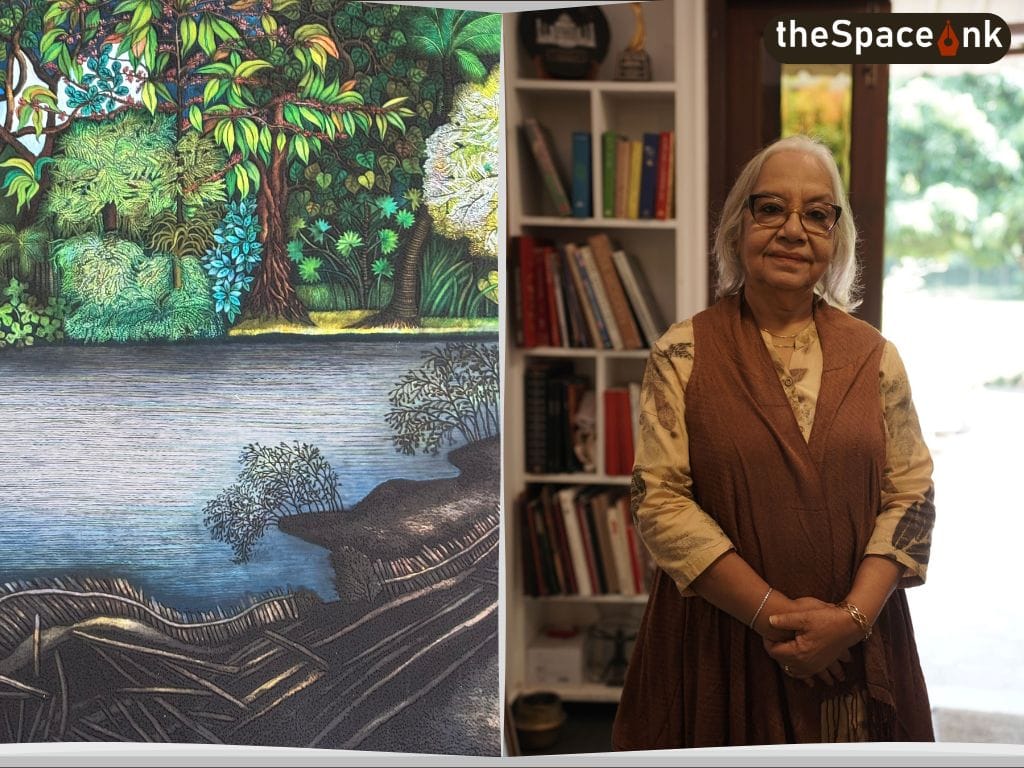
With contributions from Siddharth Sivakumar, Ina Puri, Goutam Ghosh and Sushobhan Adhikary, the book enlightens the reader about Shipra Bhattacharya’s body of work, her techniques, subjects and her vision. The articles in the book traces the evolution of her style starting from her early works that captured urban women in their milieu to her later pieces that traces Bhattacharya’s extensive figurative compositions. She has cultivated a distinctive artistic language shaped by empathy, autonomy, and a profound engagement with cultural memory. Her subjects are drawn from the domestic, urban and natural settings, often combining with elements of primitive art, nature and mythology.
Also Read: Window With a Train Attached by C P Surendran: A Review
Describing Shipra Bhattacharya’s works, Siddharth Sivakumar, in his essay The Dreaming Body and the City of Women, writes, “The subject of these mural-like drawings is mostly women, though sometimes a well-built man takes the stage. We also see them as couples; the faces of women and men float within circular or oval shapes. These are pure drawings. In these flat, two-dimensional images, the black-and-white texture is woven almost like a decorative carpet. In most, a single figure dominates, set against a background of geometric patterns of rivers, trees, and houses. The entire figure is ornamented, sometimes like a tattoo, sometimes filled with lush patterns like rural alpanas, sometimes blooming with primitive patterns, and elsewhere decorated with folk designs.”


From drawings to paintings, and then to sculptures and collages Shipra Bhattacharya has experimented with different genres drawing heavily from indigenous folk and primitive arts which have brought a new flavour to her creative vocabulary. It is, “as if, she was strengthening the ancient, enduring bridge between art and craft. Her distinct perspective as a sensitive, perceptive artist, together with her stylistic variety, has intrigued viewers and made them curious—it strikes a chord and pulls you closer to the pictures…” writes Sushobhan Adhikary.

Use of motifs from alpanas, Madhubani and Warli paintings and also those from Inka, Aztec, Mayan, African and Peruvian arts, have lent her work a certain uniqueness, a stylistic variety and an endearing quality. The tattoo-like art on human bodies have lent an individual flavour to her works. The book Shipra, offers a comprehensive look into the world of Shipra Bhattacharya’s artistic explorations, but what it lacks is her life sketch offering a peep into her personal world and a few more images capturing her at work.

An exclusive interview with Shipra Bhattacharya brought about quite a few unknown facets of her personality. When asked what were her inspirations, she replied, “Inspiration comes from within me. I feel uncomfortable if someone praises my work. I enjoy the process of creation and that inspires me onto the next one.” Here’s what she said…
Q. When did your interest in art begin?
Shipra Bhattacharya: I studied science up to graduation, and after completing it, I wanted to learn painting academically. Even as a child I used to draw by myself. I never learned from anyone. While in school and college, drawing and painting wasn’t just a casual hobby. It was the only thing I truly enjoyed, and also making things with clay. I did it all on my own because I enjoyed my creative outpourings. I was an introverted being ever since I was a child, and I still continue to be so. I didn’t want to mix with people. Even if guests visited our home, I would go into my room as I didn’t want to meet them.

I heard from my mother that, (I don’t remember much though), in school too I did not communicate much. Maybe that was the reason why I loved immersing myself in my own work. Being in a joint family set up, there were many people at home, but I remained aloof. During Puja as well, when Kolkatans were visiting pandals, I remained at home. When amidst people, I prefer to remain within my own world. Maybe that’s the reason why my love for drawing is the strongest compared to anything else, as it allows me to be with myself.
Q. Has Kolkata been your home always?
Shipra Bhattacharya: Yes! I was born and raised in Kolkata. The environment at home was aesthetically beautiful and peaceful. My grandmother and mother were all very artistic, in fact, both of them were skilled seamstress and needleworkers. My grandmother, even when she was very sick and confined to her bed, made beautiful kanthas, while my aunt used to draw beautiful alpanas on the rooftop during Poush Parbon. I used to stand and watch her draw it.

That’s the environment I grew up in. But none of them were professional artists. It was a culturally rich family where education and art co-existed. My father was a school teacher in Nabadwip, but then he left his job and started a business.
Q. Who encouraged you?
Shipra Bhattacharya: Encouragement came from within me. I dropped out of the science stream after graduation, even though my results were good. But my family didn’t object and allowed me to pursue art as I desired; they didn’t push me to study further. My motivation came from inside. I enjoy the process of creating, and that inspires me to create the next. Praise makes me uncomfortable, if someone praises a lot, I feel uneasy.

Q. When did you join the Government College of Art and Craft?
Shipra Bhattacharya: Initially I started learning from Shuvaprasanna before graduation. Later I joined the Government College of Art and Craft, Kolkata, and also enrolled for evening classes at the College of Visual Arts founded by Shuvaprasanna. At the evening college I got the opportunity to study and work alongside very talented students. The atmosphere was great…energetic and conducive for learning.

Q. What are your working hours?
Shipra Bhattacharya: I am mostly in the studio greater part of the day. After marriage I had to manage household work, as well as find time to pursue my art. I managed both. I stayed up working through the night and never stopped. Even when my daughter was born my work continued. Painting progressed with each exhibition. Bagan or garden is another studio space amidst nature at the Arts Acre Foundation in New Town, Kolkata.

Q. Please could you share the names of your favourite women artists?
Shipra Bhattacharya: I admire Meera Mukherjee and Amrita Shergill.
Her humility comes through as the conversation progressed. She is a renowned female artist from Kolkata, and her work has been exhibited in India and abroad. Most of her works have been sold with only 108 remains besides the new ones, many of which have been included in the book.
Also Read: Revisiting the Kargil War in ‘Despatches from Kargil’ by Srinjoy Chowdhury
She laments the fact, that “Once your works start selling, the demand to adhere to the same style creates pressure. I wanted to break out from the market demand but it can be hard. I moved to collages which started spontaneously in my studio, while I was leafing through the magazines. Once the process begins ideas flow naturally like writing. I have merged drawings with the collages. But my preferred medium is oil.” Her collages too have featured in the book, Shipra.
Image: AI, Wikimedia Commons

Arundhati Gupta is a Kolkata-based writer, editor and communications strategist. She has contributed reviews, essays, and features in leading national, regional and online publications. In addition to her writing, she serves on the executive committee of a non-profit organisation. Outside of work, she enjoys playing scrabble and cooking.