A Truth of Japan’s Foster Care (2): As If It Simply Didn’t Exist
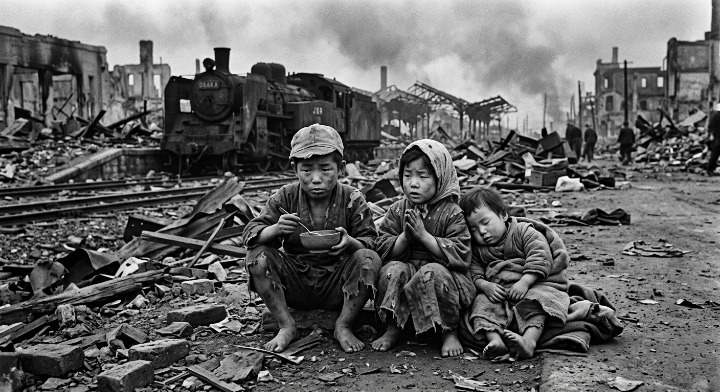
Japan’s foster care system originated in the 19th century as a desperate safety net for children orphaned by famine and disease. Following the devastation of World War II, the system became a final refuge for air-raid orphans forced to survive on the streets and in train stations.
As Japan transitioned into an era of rapid economic growth during the mid-20th century, the social landscape shifted toward urbanisation, resulting in the isolation of the nuclear family. Along with the disintegration of traditional community ties, many families became dysfunctional—often with mothers left to raise children alone while fathers worked long hours.
Today, the number of children with foreign roots in the foster care system is notably higher than their proportion in the general population. Many of these children possess “multicultural” backgrounds, often born to Japanese fathers and foreign mothers, and bear even more complex layers of hardship within their personal histories.
Today, the essence of foster care has fundamentally changed. It is no longer simply a place for children without parents; it is a sanctuary for minors for whom home is no longer a safe place. The mission of the system has evolved from simple poverty relief to providing psychological support for children scarred by abuse and neglect.
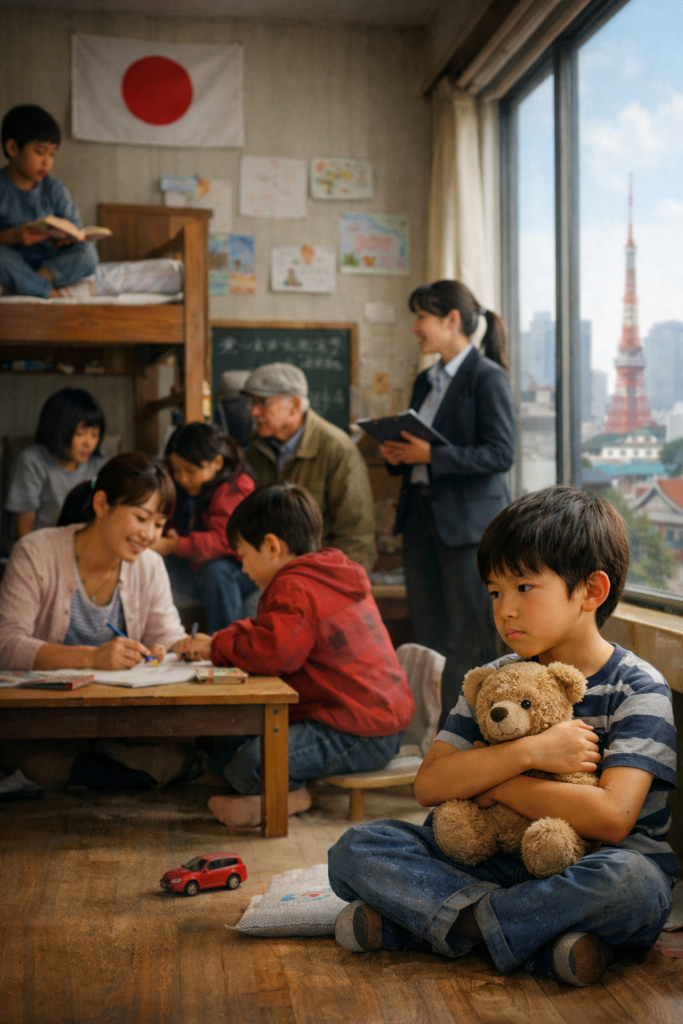
Arshleen, a true animal lover, used to have a dog when she lived at home. She often enjoys looking at photos of my two cats—the one still with me and the other who has passed away. When I showed her a photo of a flower-filled large wooden planter on my balcony, where I had buried my late, beloved cat, her eyes widened in surprise.
“When my dog died,” she said, “Mom threw him out with the trash. She said the body was dirty.”
Read More: A Truth of Japan’s Foster Care (1): The Girl in the Home
As soon as the words left her mouth, she seemed to sense something intuitively. A frozen, mask-like smile spread across her face, as if she were trying to shield herself from a sudden wave of terror. Her gaze didn’t meet mine; instead, she stared fixedly at the space in front of her. It wasn’t until much later, when I held her frail frame in my arms, that she finally whispered in my ear, “My mom has been suffering from a mental illness.”
Arshleen and the piano
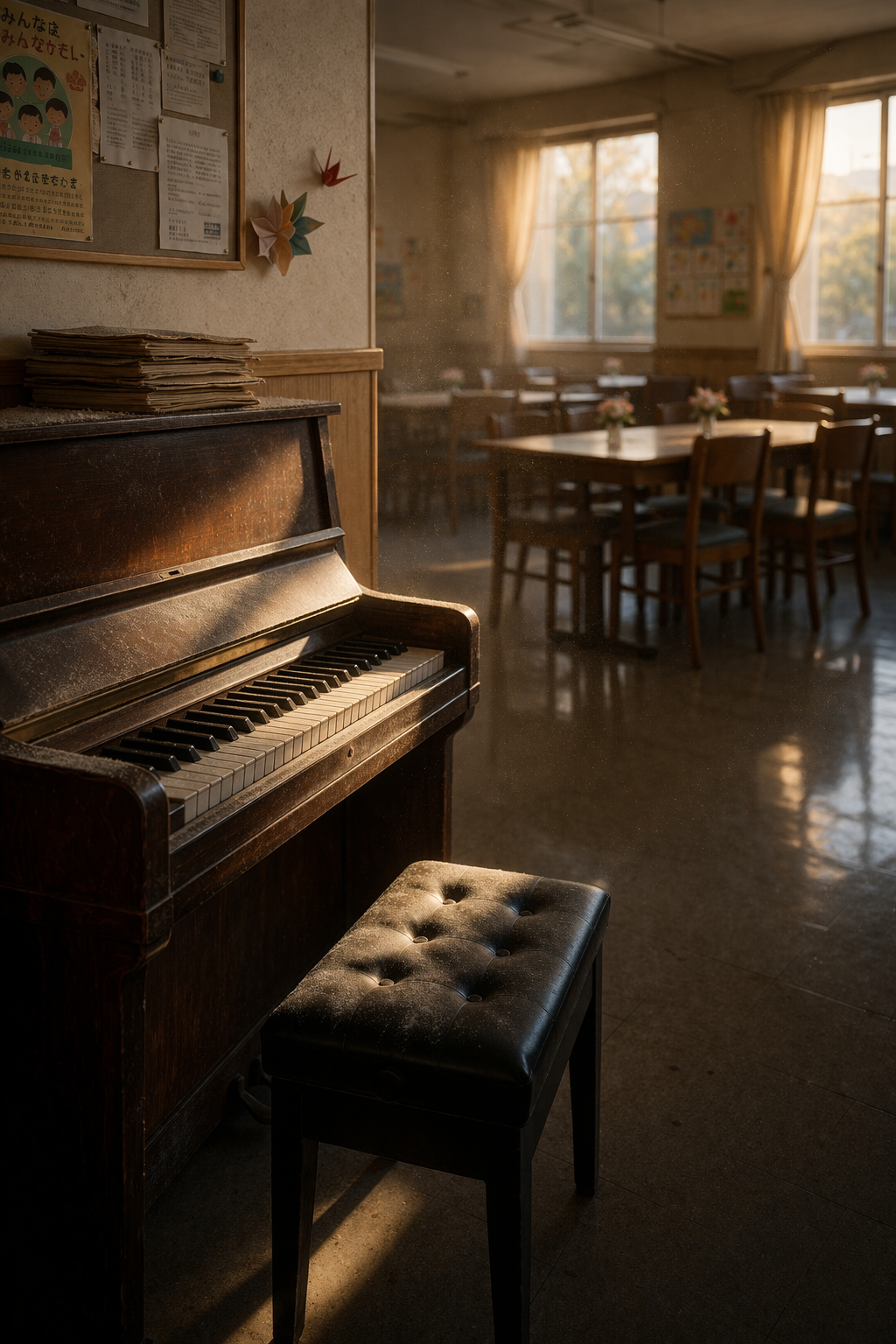
Arshleen sat alone at the piano
—an antique upright tucked away
in a corner of the Home’s dining hall.
It was a donation—a “gift”—most likely.
A stack of yellowed method books lay piled
carelessly on top,
gathering dust as if they had been abandoned
for want of a teacher.
Ever since I arrived,
I have been reflecting on
what the children in this facility truly need.
There is a piano, but no one to play it.
There is a piano, but no teacher visits.
There is a piano, but no child ever leaves these walls
to seek a lesson.
There is a piano. That’s all.
She was picking out a melody with one hand, tapping only the black keys. I recognised the tune immediately, but when I tried to show it to her, she brushed me off, insisting on finding the notes herself. So, I watched in silence. Yet the melody eluded her. She played only the black keys as if the white ones simply didn’t exist. It was such a simple fix, but having missed the moment to speak up, I stayed quiet by her side.
Also Read: Hideo: From Japanese Appropriation to Appreciation
I once asked the director if I might arrive shortly before the children returned from school to play the piano for a while. I wanted to create an environment where they would be naturally greeted by the sound of music as they entered the Home—though, in truth, it is not their own home. The director, however, informed me that the piano was for children’s use only, implying it was out of the question for any adult to touch it. Faced with her expression, which suggested my offer was utterly preposterous, I found myself unable to explain further.
The presence of non-Japanese children in foster care was first observed in the late 1970s, when Japan started resettling refugees from Indochina. In the wake of the surge of foreign labourers during the 1990s, an increasing number of children were taken into care. They came from families broken by isolation, language barriers, and unstable living conditions, which often spiraled into domestic violence or neglect.
I eventually went home, leaving Arshleen desperately hunting for the notes she couldn’t find. Had she grown up seeing the instrument in use, she would not have been confined to the black keys. Her curiosity was met with a void of guidance, and my desire to assist her was stifled by a rigid misunderstanding of what a “gift” should be. To the director, the piano was a mere object for the children rather than a medium for connection.
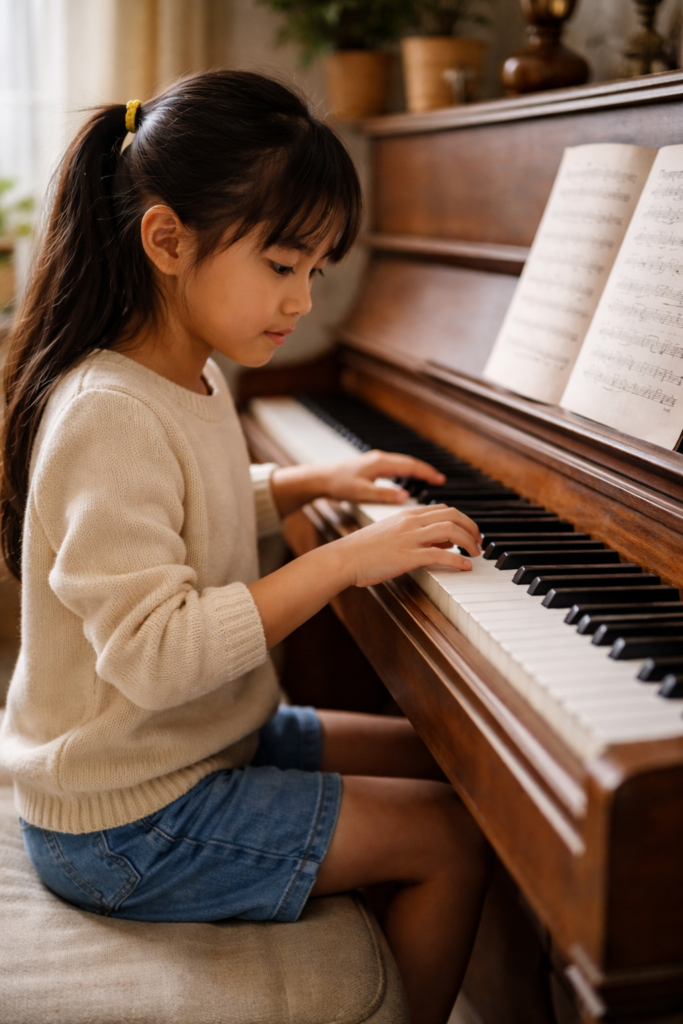
I cannot help but feel that the director’s attitude had trickled down to the children as well. To the very end, Arshleen never once reached out to me. Was she mirroring the director’s rigid influence, or was it simply the fierce pride of a child determined to do it by herself? I couldn’t be sure.
Be that as it may, without a living example, the spark has gone out. If she had regularly seen me at the keys—perhaps even witnessing me struggle through my own practice or stumble over a mistake—her psychological resistance to my guidance might have softened. Perhaps then, she would have felt it was okay to let someone in.
Once back home, I made a photocopy of a paper keyboard from the back of a method book I owned and penciled in the notes. The song she had been struggling with could actually be played almost entirely on the white keys, save for a single black one. When I saw her again, I handed it to her without saying anything. She looked at it and said with a perfectly straight face—as if nothing had happened—”Oh, is that all? You should have told me sooner.”
Since that day, I haven’t seen her sit at the piano even once. The instrument remains as it was before, gathering dust in the corner of the dining hall. It stands there, quiet and discarded, as if it simply didn’t exist.
The presence of non-Japanese children in foster care was first observed in the late 1970s, when Japan started resettling refugees from Indochina. In the wake of the surge of foreign labourers during the 1990s, an increasing number of children were taken into care. They came from families broken by isolation, language barriers, and unstable living conditions, which often spiraled into domestic violence or neglect.
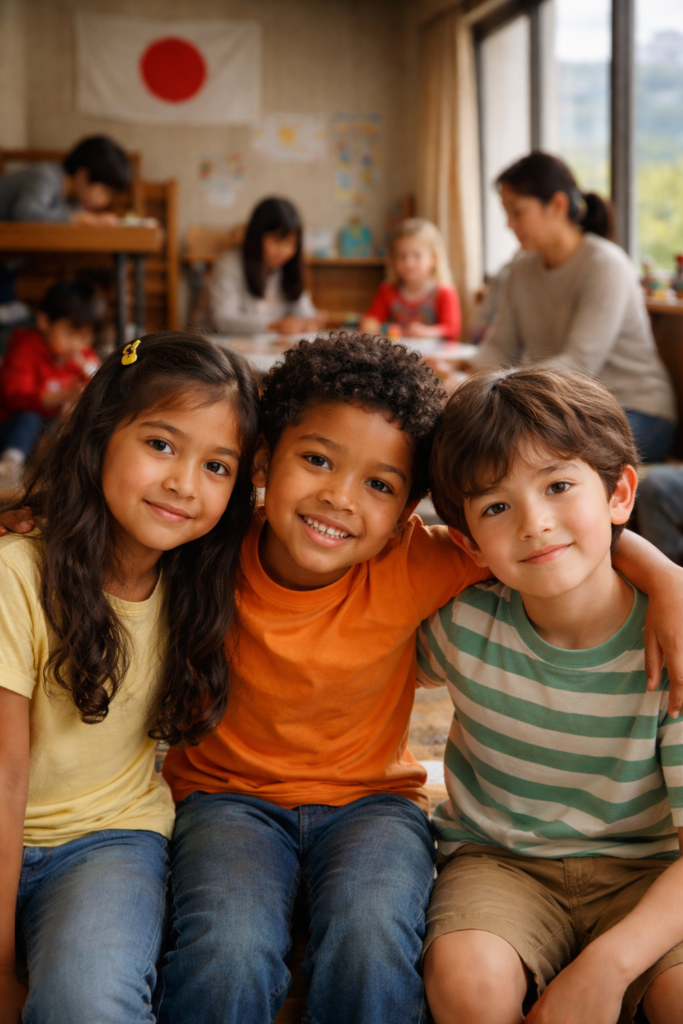
Today, the number of children with foreign roots in the foster care system is notably higher than their proportion in the general population. Many of these children possess “multicultural” backgrounds, often born to Japanese fathers and foreign mothers, and bear even more complex layers of hardship within their personal histories.
Final Part: 7 April, 2026
All Rights Reserved
Image Courtesy: AI

Mayumi Yamamoto is a writer and academic based in Kyoto, Japan. Her poems have appeared in Literary Yard, and some opinions in Indian Periodical. She authored several published books in the Japanese language.