
The Doordarshan Era
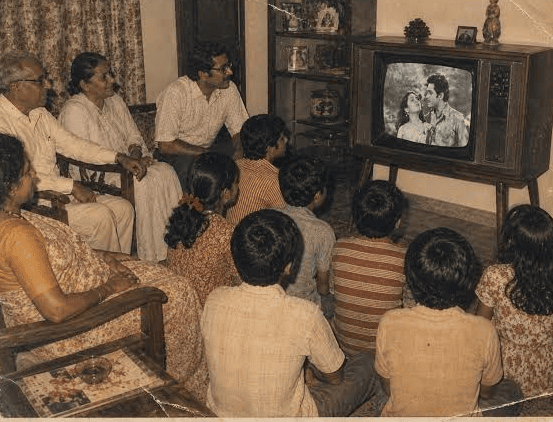
The early and eerily mid-seventies. We are sitting around a black and white television, stiff and straight-backed, the lights are dimmed. We are watching a film from the late fifties, which resembles reels of black and white footage from pre-World War 2 days.
Also Read: The Fine Arts of Criminology
Suddenly, there is a power cut. A collective groan goes up and we rise from the sofa to go home; home is the flat across the passage. The TV set does not belong to us. It is the prized possession of one of our better-off neighbours.
More than the programmes and the characters that were created, we, perhaps, miss the kinship and the family bonding that accompanied this home entertainment.
This was pretty much the scenario in the mid to late seventies in Calcutta. We carefully picked the programmes or films we wanted to watch, because neighbours could not be disturbed at all times. Initially, the programmes were not beamed 24×7 anyway. Public service television came to Delhi, India on an experimental basis in 1959 and it was not until 1965 that regular services were introduced. It was only for an hour and only news was telecast; bit by bit, more cities came under the purview of Doordarshan as it came to be known, the sister concern of All India Radio.
In Kolkata, television arrived in 1975, with a make-up code for female anchors, a flower tucked into their hair-do. They always tilted their heads to one side while speaking. From a single channel, soon we had DD 1 and DD 2, with more local content in the latter.
In the mid-seventies, growing up next to a South Indian eatery, Anand, which rose to fame later, the queues in front of it told us whether it was a Saturday or Sunday. If it was Saturday, a Bengali film would be shown, thus a bigger crowd next door, as the clientele comprised mostly Gujaratis. Sunday they stayed indoors to enjoy the Hindi film. This was occasionally interchanged and whoever bothered about the TV listings that became a regular feature in the daily newspapers later?
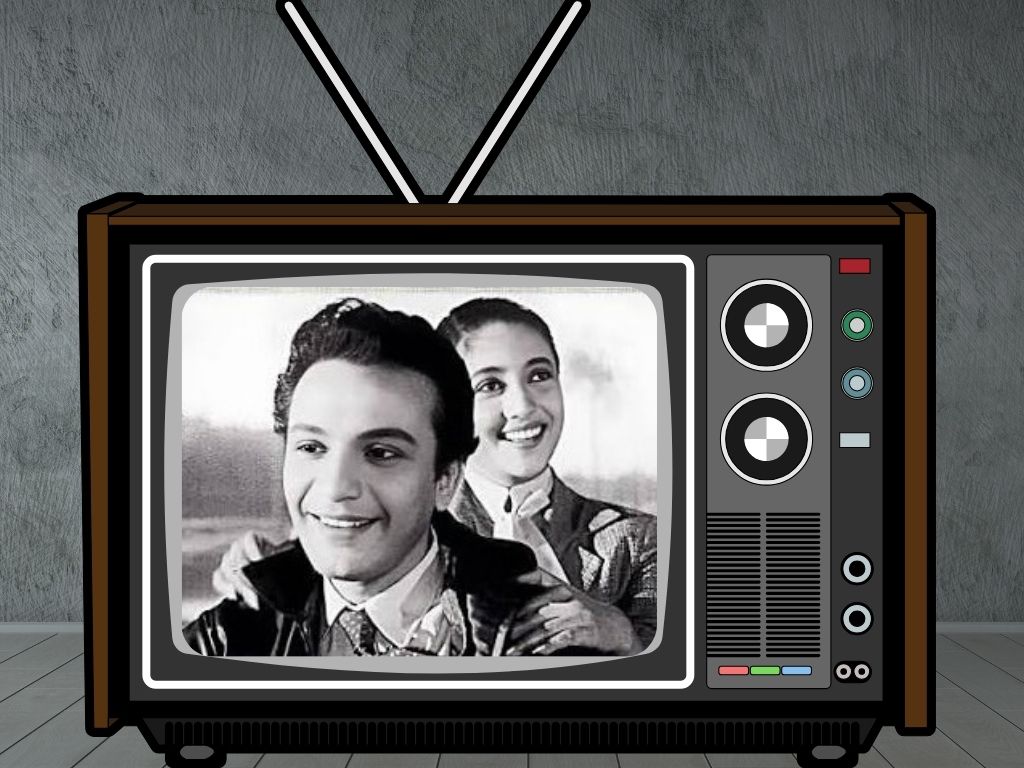
In the other parts of the city, Bengali women looked forward to the Uttam-Suchitra classics on a Saturday or Sunday, depending on the case.
The very first television set came into my life in the early eighties. Boxed inside a wooden cabinet, we had to slide the door in front and lo and behold, the single screen revealed black and white images, which our domestic help insisted were real men and women hiding at the back! In fact, once when the TV set conked out due to the antenna on the terrace malfunctioning, one of the helps wryly commented it was because the dancers had jumped around too much!
Those were days you just had to whack the TV if it failed to start.
There are several funny stories but the programming is what needs to be remembered. These have now become classics.
Hum Log and Buniyaad were the top most daily serials, later known as soaps, a US-import presumably because sponsorships came in via advertisement of household products. The Bold and the Beautiful, Dallas, The Young and the Restless and many more, travelled to our shores, first as video tapes, and then on specific channels. The morning serials The Ramayan (1987) and Mahabharat (1988) emptied the streets out on Sunday mornings all over India. Irrespective of faith, people watched the feats of Lord Hanuman and serious family politics!
We also had our homespun serials catering to the middle classes, followed by soaps. Humlog, a west Delhi family saga inspired by a Mexican serial, adapted in Hindi by noted writer Shyam Manohar Joshi and directed by P. Kumar Vasudev, became an instant hit. A veteran actor Ashok Kumar summarized what was then our middle-class struggles and aspirations. The characters like Badki, Chutki etc became household names.
This was followed by Buniyaad, which was about the laying down of two foundations: a family, which is forced to leave their ancestral home in Lahore, and set up afresh in post-independence, new India. It was again written by Joshi and produced by Ramesh Sippy. It ran for a year – from 1986 onward.
In a bid to improve “content”, constant brainstorming resulted in weekly serials such as Malgudi Days, based on R.K. Narayan’s stories, and Fauji, in which we were first introduced to Shah Rukh Khan, a theatre actor from Delhi.
Viewership began to grow, the middle classes began to enjoy more and more white goods as women got liberated somewhat from the kitchen drudgery due to their jobs and gadgets. It was a two-way thing. Bit by bit, with more money, the programming became slicker and production values went up. We learned new television vocabulary – Primetime, TRP, as sponsors vied with each other to pour in money to grab our eyeballs.
Similar to Bob Dylan going electric at the Newport Folk Festival, in 1962, which changed the musical scenario in the USA, in 1982, colour broadcasts started with the Asian Games. Things were never the same; just as the transition from analog to digital began from 2012.
Major expansion occurred from the 1990’s, considered the beginning of the liberalization period, when markets opened up and privatization entered the public domains in a big way. Satellite TV to Channels to Cables to Dish to Set-top boxes, we have seen it all.
The evolution of television on India is today the text of media colleges. Detective serials (Karamchand, for example), travel programmes (Surabhi), etc. soon gave way to opinions and discussions on primetime news channels. Just as the electronic media edged out print, the Internet made Breaking News on TV passé.
The magic of programmes such as Nukkad, Yeh Jo Hai Zindagi, etc. made by trained filmmakers from FTII touched us for a brief while, opening up job avenues for trained technicians, actors and directors as they waited to hit big time on the silver screen.
The images on the screen now looked like real images and not apparitions in the dark. The saas-bahu sagas addressed audiences who were breaking away from joint families to become nuclear ones.
Television started to target the lowest common denominator among the masses.
In the Barry Levinson-directed film Avalon, we catch a glimpse of the late 1940s and early part of the 1950s through an immigrant Polish family, which first arrived in America in 1914. We witnessed television emerging in a big way, reflecting a newer, modern society, whereby the joint family starts to break up (daughters-in-law are no longer obedient – does it ring a bell?) due to various reasons.
TV viewing was no longer a family activity.
Not very much different from what television has now become in India. Doordarshan has little recall among the young, and though we cannot always claim a golden period in TV programming, we can fondly recall some of the earlier ones.
Also Read: Good Evening, the Headlines
Today our huge television screens almost resemble a home theatre; lonely couples bickering over the many remotes. The 100-odd channels, also comprising OTT platforms, telecast over hundreds of old and new films, serials and documentaries. And just like in the developed countries, we have over a hundred channels but little to watch really!
The Doordarshan Era was when less was more. Too much of anything creates confusion. And if I can speak for myself, I now watch television ‘more or less’ while preferring to read more. More than the programmes and the characters that were created, we, perhaps, miss the kinship and the family bonding that accompanied this home entertainment.
Photo Courtesy: Facebook, Wikimedia Commons

For a living, Manjira Majumdar has traversed the world of reporting, feature writing and editing. Today an independent journalist, she likes writing essays, fiction and translating from Bengali to English.