

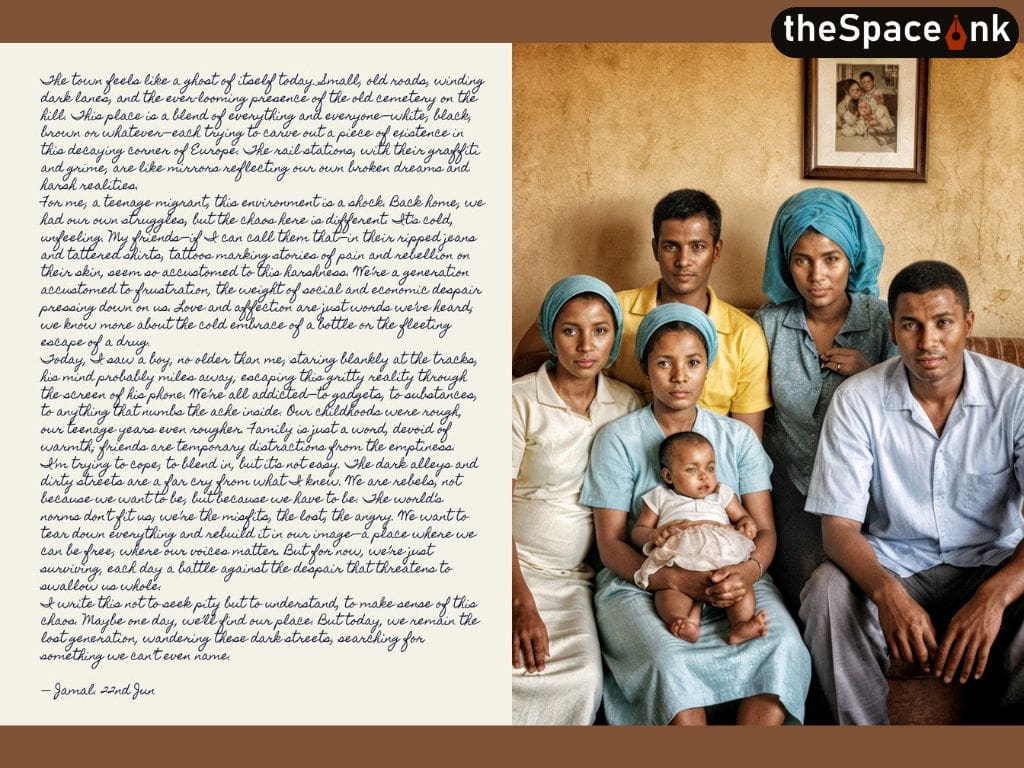
Photostory: Ripped Jeans, Silent Screams
The town feels like a ghost of itself today. Small, old roads, winding dark lanes, and the ever-looming presence of the old cemetery on the hill. This place is a blend of everything and everyone—white, black, brown or whatever—each trying to carve out a piece of existence in this decaying corner of Europe. The rail stations, with their graffiti and grime, are like mirrors reflecting our own broken dreams and harsh realities.
For me, a teenage migrant, this environment is a shock. Back home, we had our own struggles, but the chaos here is different. It’s cold, unfeeling. My friends—if I can call them that—in their ripped jeans and tattered shirts, tattoos marking stories of pain and rebellion on their skin, seem so accustomed to this harshness. We’re a generation accustomed to frustration, the weight of social and economic despair pressing down on us. Love and affection are just words we’ve heard; we know more about the cold embrace of a bottle or the fleeting escape of a drug.
Photostory: Faces of Innocence: A Photographer’s Children’s Day Story
Today, I saw a boy, no older than me, staring blankly at the tracks, his mind probably miles away, escaping this gritty reality through the screen of his phone. We’re all addicted—to gadgets, to substances, to anything that numbs the ache inside. Our childhoods were rough, our teenage years even rougher. Family is just a word, devoid of warmth; friends are temporary distractions from the emptiness.
I’m trying to cope, to blend in, but it’s not easy. The dark alleys and dirty streets are a far cry from what I knew. We are rebels, not because we want to be, but because we have to be. The world’s norms don’t fit us; we’re the misfits, the lost, the angry. We want to tear down everything and rebuild it in our image—a place where we can be free, where our voices matter. But for now, we’re just surviving, each day a battle against the despair that threatens to swallow us whole.
I write this not to seek pity but to understand, to make sense of this chaos. Maybe one day, we’ll find our place. But today, we remain the lost generation, wandering these dark streets, searching for something we can’t even name.
— Jamal. 22nd Jun.


Artist Statement:
The entire journey—from the spark of ideation to the weaving of stories, the creation and enhancement of images, the meticulous post-processing and editing, the final presentation of visuals, the crafting of narratives and titles, and even the conceptualization of the installation—is guided by GenAI, harnessing the power of OpenAI’s GPT-4, DALL-E, and PhotoRealistic GPT.
This collection transcends traditional photography, presenting instead a “Promptographic” oeuvre. It is likely the first of its kind in Kolkata, showcasing a GenAI-driven visual storytelling experience conceived, narrated, and meticulously crafted by neural networks. This endeavour strives to make an infinitesimal contribution to the futuristic and generative universe of visual art.

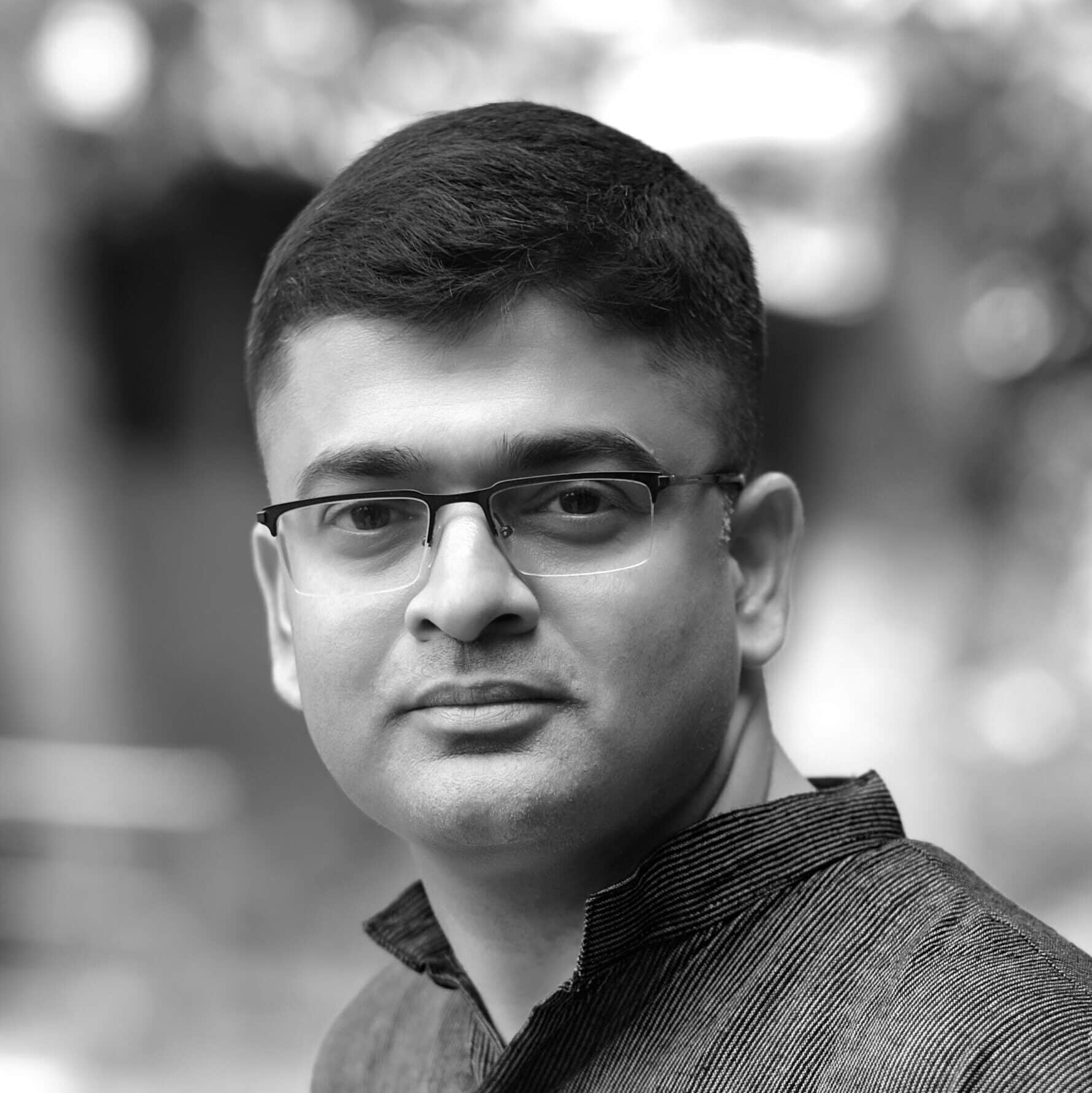
Debiprasad Mukherjee is an independent documentary photographer based in Kolkata, India, whose work explores the socio-political realities and environmental transformations shaping contemporary humanity. Believing photography to be a powerful instrument of social memory and global consciousness, his visual narratives span over 50 countries across cultures and crises.
He is the author of The Stars Are His Bones and Sound of Silence, former Convener of the Kolkata International Photography Festival 2019, and served as Global Carbon Ambassador at the World Climate Summit COP25 in Spain. His works have been published in 30+ international magazines, exhibited across 35+ exhibitions, and recognised with awards from over 40 countries.
He has also served as jury member for 15+ international photography symposiums and competitions. Debiprasad studied The Art of Photography at RMIT University Melbourne and The Language of Design at California Institute of the Arts.
One Response
Went through your documentary photo story. So beautifully expressed. You have an eye for creating something meaningful and impactful.