(Fellini)
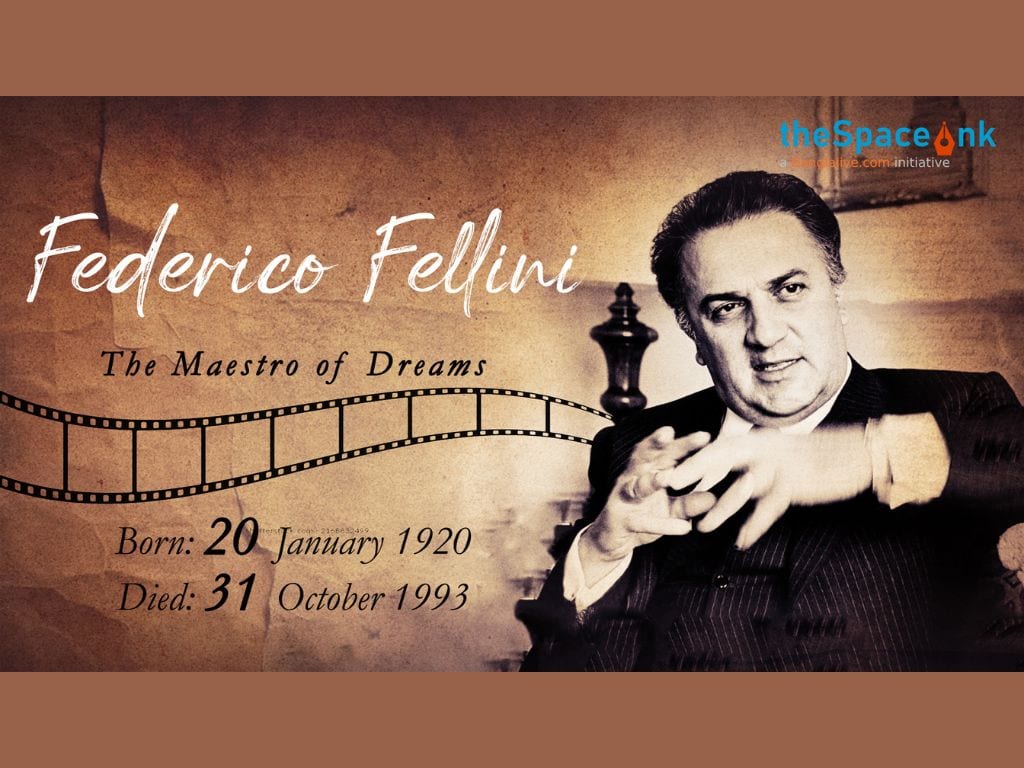
Federico Fellini’s life was as surreal as his films. His hometown airport is named after him, he skipped school 67 times in one year, and he once failed a military exam because he preferred drawing cartoons. He also helped introduce the word “paparazzi” to the world through his film La Dolce Vita.
He was born in 1920 in the coastal town of Rimini. His father was a traveling salesman, and his mother came from a bourgeois Roman family. This small-town childhood, with its circus visits and Catholic schooling, became the raw material for many of his future films.
Fellini moved to Rome in 1939. To please his parents, he enrolled in law school, but there’s no record he ever attended a class. Instead, he survived by selling caricatures and writing gags for a popular humor magazine called Marc’Aurelio.
His break into cinema came through screenwriting. During World War II, he wrote for radio serials and met actress Giulietta Masina, who would become his wife. He then joined the team writing Roberto Rossellini’s neorealist landmark, Rome, Open City, earning his first Oscar nomination.
Video: Emily Brontë: A Soul of the Moors
This apprenticeship in Italian Neorealism was crucial. He worked closely with pioneers like Rossellini, absorbing their focus on social reality. However, Fellini’s own imagination was already straining against pure realism, leaning towards the poetic and the fantastic.
He co-directed his first feature, Variety Lights, in 1950. His first solo film, The White Sheik, was a satire on photo-comics that was booed at its Venice premiere. But his next film, I Vitelloni, a portrait of provincial youth, was a hit and won the Silver Lion in Venice.
International fame arrived with La Strada in 1954. Starring his wife, Giulietta Masina, as an innocent waif, the film won the Oscar for Best Foreign Language Film. It established Fellini’s signature blend of heartbreaking realism and poetic, almost fable-like, storytelling.
The 1960s solidified his legend. La Dolce Vita (1960) was a sensational, scandalous portrait of Rome’s decadent high society. Then came 8 ½ (1963), a dazzling, self-referential masterpiece about a director with a creative block, winning him another Oscar.
Video: The Child Behind the Genius: Understanding Steven Spielberg’s Cinematic Vision
His later films grew more lavish and personal. He revisited his childhood in the Oscar-winning Amarcord (1973) and explored ancient Rome in the psychedelic Fellini Satyricon (1969). His style—a unique “Felliniesque” mix of circus, dream, memory, and spectacle—was now fully formed.
His personal life was centered on his long marriage to Giulietta Masina. They married in 1943 and remained together for 50 years, despite personal tragedies and challenges. She was his most iconic muse, starring in several of his greatest films.
Fellini died in Rome on October 31, 1993, at the age of 73. He left behind a staggering legacy: four competitive Oscars for Best Foreign Language Film and an honorary award for lifetime achievement.
His influence is everywhere. Filmmakers from Martin Scorsese to David Lynch and Pedro Almodóvar have cited him as a major inspiration. He expanded the language of cinema, proving that the most profound truths could be told through dreams, memories, and unparalleled imagination.