Writers, Pubs and Book Shops
On a recent trip to England and Scotland, connecting British writers to places and pubs offering excellent food and drinks, and picking up their works in old and modern book shops were the memorable highlights.
Also Read: The Fine Arts of Criminology
Travelling to foreign locales is not just about viewing the Swiss Alps, Big Ben or Eiffel Tower. These may be on your bucket list and it is perfectly fine, but once you have done the sights through a bus ride or otherwise, there is so much to discover in a world that has given us timeless writers, artists, film makers and performers.
For which, you have to walk the streets.
Whether it is Hemingway’s Daquiri at Gordon Ramsay’s or a Sunday Roast at Fletchers Inn, it is not only about food but its connection to a literary world that fortifies your body and enriches your mind.
You may do a curated literary walk or go on a specific writer’s trail, knowing how nomadic most writers can be, or do it yourself. I had never wanted to go to Great Britain because Shakespeare and Dickens were done to death in a country like India where our elite education system came from the English and ended with them. Dublin in Ireland was an option because of Yeats, Beckett, Joyce, Synge and more, except that the two of the greatest Irish writers lived in Paris.
Therefore, Shakespeare & Company was a great pilgrimage spot for me and some books bought from there (The pocket book size of The Artist As An Young Man by Joyce for example) with the logo of the shop stamped on it, is one of my prized collectibles.

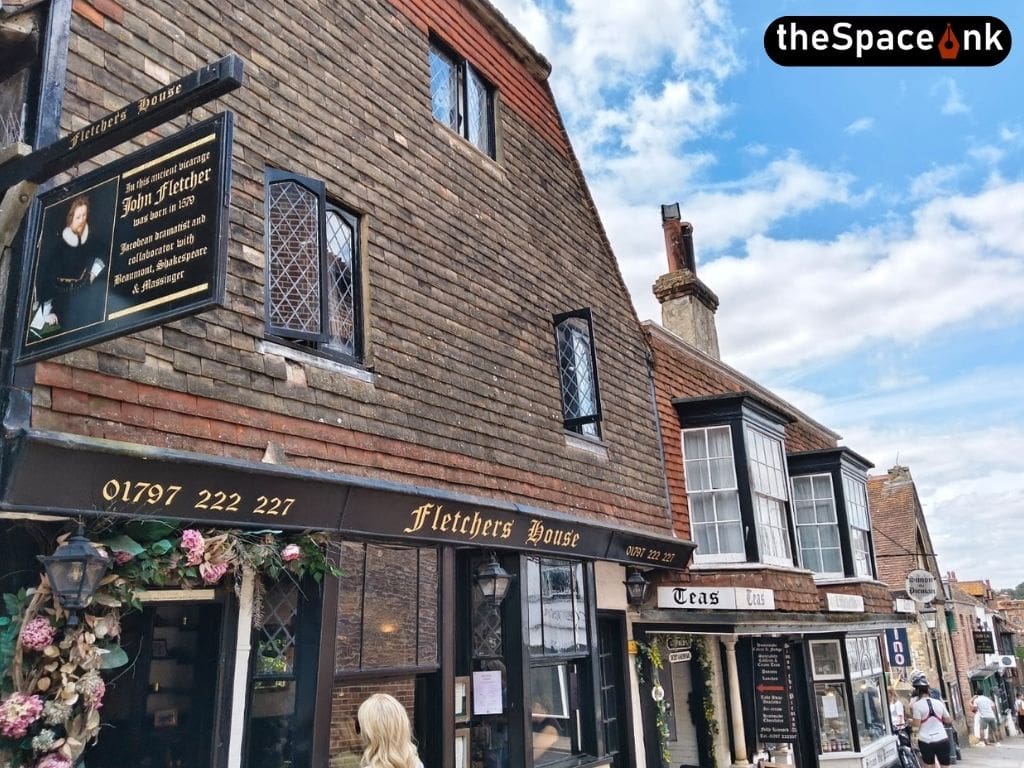
But when an opportunity to visit England did come, I immediately started to prepare a list with names of writers like Bronte, Austen, Hardy and their cottages, and soon struck them off the list with equal ease. I struck off the romantic poets too because in their places, I let serendipitous discoveries fill my heart and soul (see how poetic literature makes you feel even if you are a hard core lover of prose) with joy. I cannot simply describe the feeling one had in suddenly discovering, say Becket Fletchers House (now a restaurant), in a picturesque town Rye, in Sussex, once the residence of John Fletcher.

Not widely known as Shakespeare, John Fletcher, in the 16th century, was a house playwright of the King’s Men during the Stuart Restoration, and after the golden Elizabethan period. A little ahead or after, depending on the turn of the road, was Henry James’s garden house; author of The Portrait of a Lady and the famous gothic horror The Turn of the Screw.

Back to London, as you walk through Queen Street, Central London, you find yourself staring at a stately home in which lived the great American novelist Herman Melville. He is said to have lived here in the 1920’s and it was in London that he saw Turner’s whaling picture that led to his writing of the novel Moby Dick.
You connect but connect the references in your head and the cultural world reveals to you in unique ways. While killing time before going to a play at the West End theatre district, you discover a book shop to browse in. There is a book shop at every district to pull you in.

The smaller towns also had their share of books shops. Rye had its own shop, so did Canterbury in Kent known more for Chaucer’s Tales than this very old Cathedral, which features in the historical play Murder in The Cathedral by T.S.Eliot.
It does send a shiver down your spine at the shrine where Thomas Becket was killed by Henry the Second’s men and makes you re-read Eliot.
“O Thomas….You come with applause, you come with rejoicing, but you come bringing death into Canterbury.”

Outside it, in this sunny town, there is a proliferation of notices put up about performances of this play as also readings from Chaucer. A quaint second hand book shop called Catching Lives Bookshop housed in a 17th century crooked house is run by volunteers. The sale proceeds go to help people without homes.
Since old English is tough for me, I wanted a retelling of the stories of the pilgrims travelling to the Canterbury Cathedral. Instead I had to contend with the quote of Charles Dickens over the shop. Why Dickens? Because he too spend some time in this town, being born in the next county left of it -Hampshire, also the birthplace of Jane Austen.

The old Sun Hotel in still preserved is where Dickens lived for some time in Canterbury, just as the pub – The Grapes – he mentions in one of his novels, still stands in the Limehouse district near about Canary Wharf. This pub is mentioned in his novel Our Mutual Friend and he disguises the name as The Six Jolly Fellowship Porters. The Grapes –still a great watering hole – is now co-owned by actor Sir Ian McKellen and offers a riverside view of River Thames that was so central to Dickens’s works.

Look for such nuggets of treasures and you will find them! The Parrot another ancient pub in Canterbury squeezed between two narrow lanes serves awesome food and booze once you settle down avoiding the low wooden beams. Would you believe it if I told you it has been around since 1370, known by another name? The preservation of this pub is in the memory of Geoffrey Chaucer who writes about the imitative powers of the parrots in his poems.

The pubs are known to have funny, quirky and poetic names besides the usual Red Lion for the greatest British symbol.
Canterbury is also where Christopher Marlowe was born. Suddenly you hit your nose against the stone church in which he was baptized in the town square.

This takes me to the famous café in Edinburgh, the Elephant House – in which J.K Rowling wrote her initial Potter stories, sad and broke. The most famous one in a series of colourful shops – the Magic Street – draws visitors by the hordes.

But London is where the book stores are humming with activities. In Waterstones, one of the biggest chains. Mother Mary Comes to Me by Arundhati Roy was very prominently displayed followed by Emily Wilson’s translation of Homer’s The Odyssey. The Waterstones Debut Fiction Prize 2026 was announced end July and May We Feed the King by Rebecca Perry won it while the Indian writer Tara Menon’s Under Water was shortlisted.

It was heartening to see the crowds in the book shops and it is perhaps in an environment of books that one forgets the colour of one’s skin, in a camaraderie where you are united by a common passion of reading and collecting books. Many young mothers with two to three children in tow reminded me of my childhood when my mother took us to New Market to buy our summer reading. While she bought spices, we browsed and occasionally bought books near the stalls selling stationary for kids, Park Street too had its share.
Also Read: The Fine Arts of Criminology
And upon returning, when a friend back asked me but did you go to Baker Street? I simply had to use the cliché – but that’s elementary, my dear!
Think out of the box!
Think convergence as media schools teach you and you will have a nice visit to any foreign country beneath the sightseeing layers of everyday life connecting books, plays, cinema, theatre, art, with local cuisine.
Whether it is Hemingway’s Daquiri at Gordon Ramsay’s or a Sunday Roast at Fletchers Inn, it is not only about food but its connection to a literary world that fortifies your body and enriches your mind.
It connects our past memories with the present ones, which we create to become tomorrow’s past.
Photo Courtesy: Author

For a living, Manjira Majumdar has traversed the world of reporting, feature writing and editing. Today an independent journalist, she likes writing essays, fiction and translating from Bengali to English.