You Can Run but You Can’t Hide: Perils of Social Media
Today thanks to social media, ‘Hum sab hamam me nange hai.’
We are all naked in the bath. The saddest part is that in our most vulnerable moment, our knives and clubs are out. So we can bludgeon and batter anyone whom we like (The English language is such a contradiction. It is actually whom we don’t like or rather disagree with).
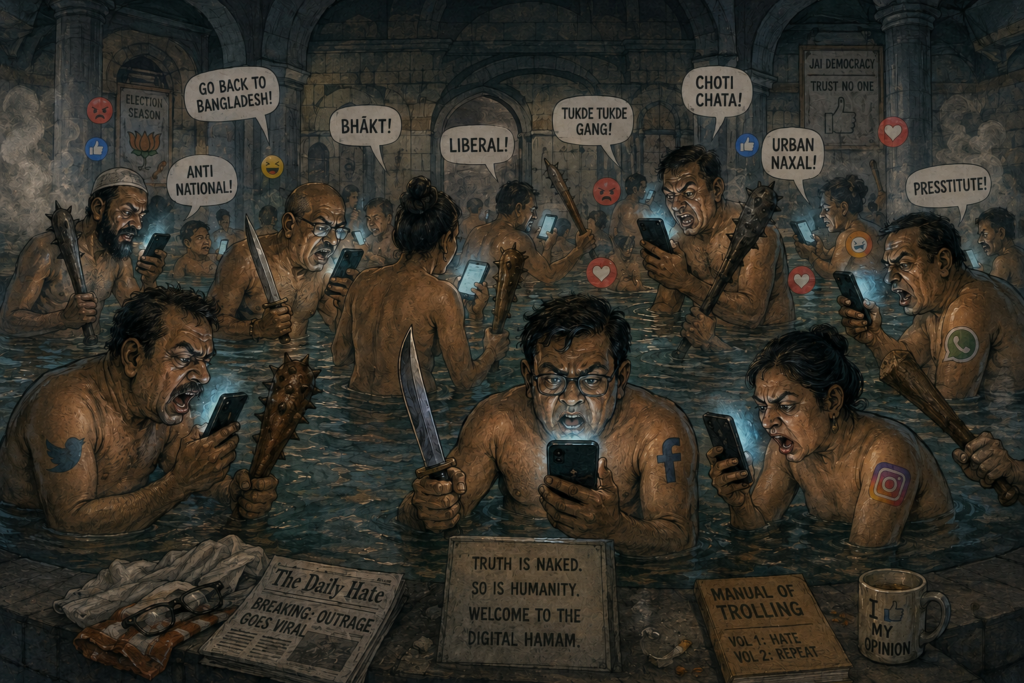
These sharp objects were being sharpened before the recent West Bengal elections, both sides confident that it will win. It was not like this during the earlier generations. My father like many bhadralok refugee was an unwavering leftist. My mother’s side from this side of the border did Congress as we say, and she took part in the freedom struggle, spinning khadi. While alive she recounted that voting was fun after independence because the para dadas told the young ‘bar bar vote dite parish’ – you can vote as many times as you wish. Congress was The Party.
Also Read: The Fine Arts of Criminology
My father had the greatest regard for Nehru, and now wait, he never ever bad-mouthed Shyama Prasad Mookerji, whose father, Sir Ashutosh Mookerji’s grand statue on that little green patch, opposite Statesman House, was where I played with my Christian, Muslim and Chinese friends. While growing up, however, I did not know who Savarkar was.
When I came into political and business reporting, I began to understand the politics of the country and especially of Bengal. My father continued to mock the Aya Rams and Gaya Rams of Cow Belt politics. I found this a bit offensive because growing up in a cosmopolitan neighbourhood, our sweeper Gulab, with his toothy smile, would greet all of us, with Ram Ram. And those who did adaab had no objection whatsoever.
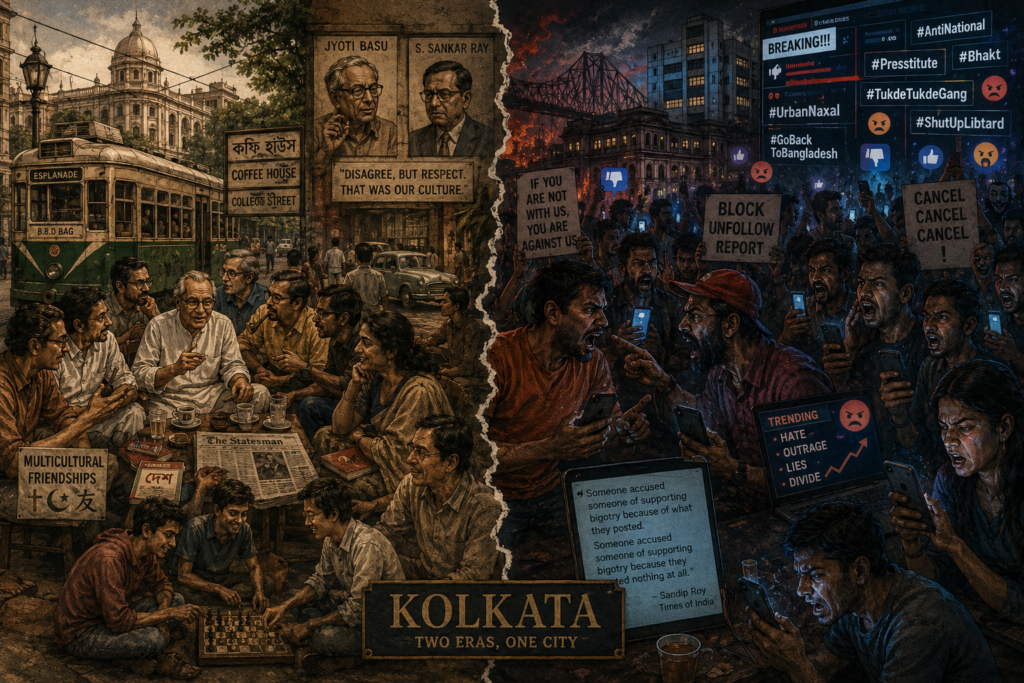
We all know how after office politics hours Jyoti Basu and Siddhartha Shankar Ray shared drinks. And the great clubs of Calcutta after the sun goes down are where our leaders are to be found irrespective of their political colour.
In college it was Amar Naam Tomar Naam Vietnam. In campuses (the Christian colleges had zero tolerance for political activities) the politics swung between The Left and Ultra Left. Vietnam is now a place most frequented by American tourists.
Also Read: The Fine Arts of Criminology
Then when did things start to change? When Social Media opened up the democratization of the media happened and no longer was print the only place to get our news and well-manicured opinions. And while news on say, a platform like Facebook, can be dangerous because it is not verified, opinions can be as outrageous as they are nasty, vile and toxic.
Who posts what on which site is less about the comment and more about being visible and remaining relevant and while for academicians, writers and the intellectuals this is necessary because of the written word, the problem lies with any alternate perspective being rudely decimated.
We have information. It is the most powerful fall-out of the digital age. So many stories both good and bad have resurfaced. The narratives have and should change. It is how we manipulate it – on both sides – is the issue. And since the Internet is virtually global, a new militant woke group know exactly how to run this country, because some of them are afraid to open their mouths now in a country which was once considered The Land of the Free. They have to vent.
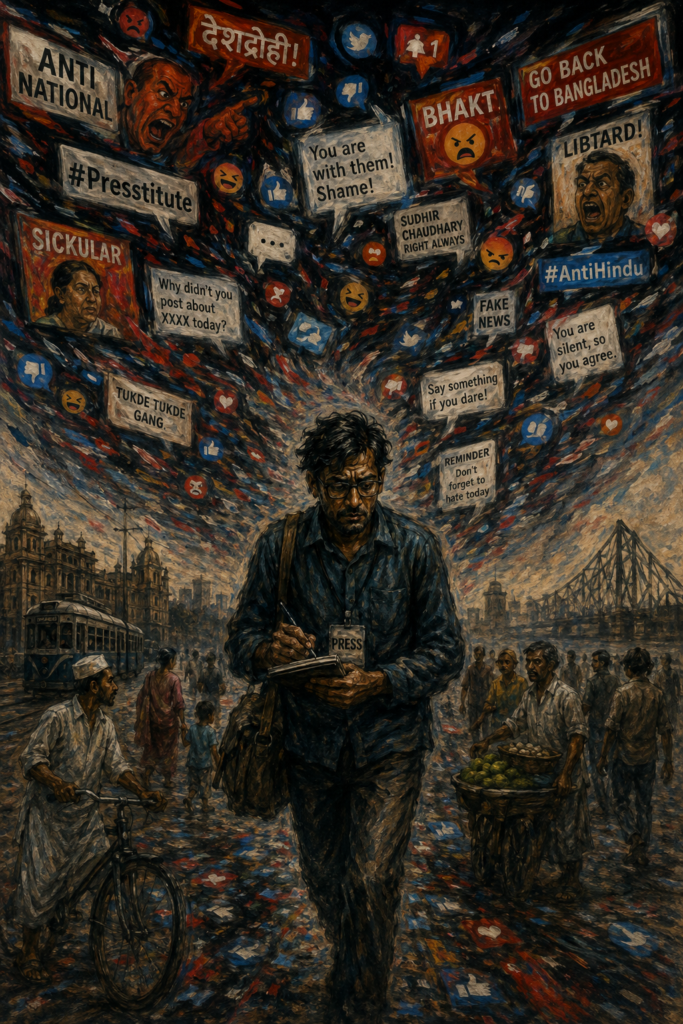
I only wish instead of issuing diktats they could really be on our side physically. This trend that I kill two bhakts today, in between my work in AC comfort, while you kill two ‘enlightened’ souls, has been the growing trend and our latest election proved just that. The old political Bengali belief that if you are not with us, you are against us surfaced.
Writes Sandip Roy in Times of India about this political trolling, “Someone accused someone of supporting bigotry because of what they posted. Someone accused someone of supporting bigotry because they posted nothing at all.”
Or maybe not directed but directly linked with it!
If I protest against the horrible memes mocking Mamata Banerjee I am choti chata. I have worked as a gender activist, a journalist and I am a common person who loves to engage with the world around me; simple folks with no agency.
Our “memory” gets “better” or “dimmer” with age so if one loosely observes the profile, the selectiveness of the comments are remarkable.
Who posts what on which site is less about the comment and more about being visible and remaining relevant and while for academicians, writers and the intellectuals this is necessary because of the written word, the problem lies with any alternate perspective being rudely decimated.
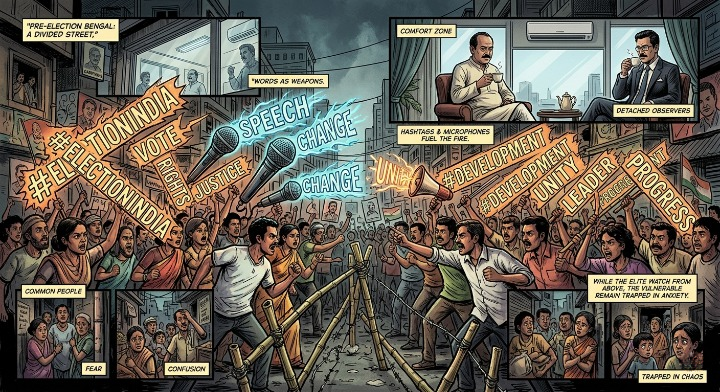
Who is bothered with analysis? Of course some comments are offensive. For every little thing you post (as harmless as jhalmuri or even a beef roll) someone writes – go back to Bangladesh – that’s wrong. Don’t deal with them. But if you post a clip of Abhishek Banerjee and it is not fake – of his 36-car cavalcade – passing through a village because what one actually missed in that story was the poor Muslim peasant waiting with his cycle for it to pass so he could cross the road. You will at once be detected as someone who supports the Centre.
Can we not retain some propriety? Some balance? What badhrota are we taking about? For ultimately the not-so-innocent privileged light the match and watch the innocent die, in glee.
If I protest against the horrible memes mocking Mamata Banerjee I am choti chata. I have worked as a gender activist, a journalist and I am a common person who loves to engage with the world around me; simple folks with no agency. I know when to leave politics, economic policies, defence to people who know better than me. I will leave businesses to the businessmen. I will leave activism to the activists but if I see activism keeps some people or arguments outside the public discourse continuously, thanks, and no thanks – I do not wish to be one.
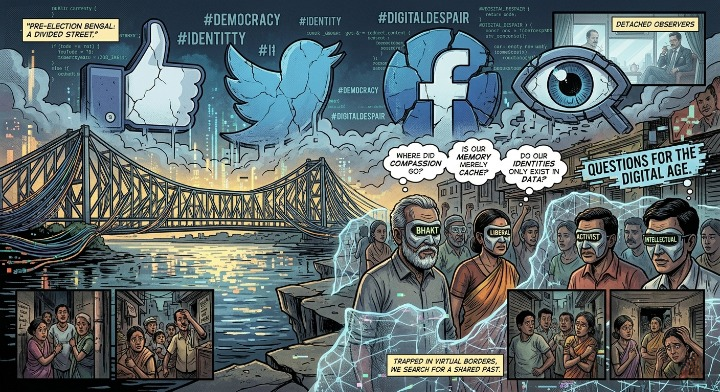
So like cancel culture we have The Blockade. Here too it was hilarious between the two camps before and after the elections. One art historian wrote on his post to people wanting to block him after the BJP win: “Who do you think you are? Pablo Picasso? Block me quietly if you wish, you don’t have to announce it to the whole wide world, you know.”
Is there something quantitative to measure compassion? Can AI teach us human compassion or do it for us? Can we not have compassion for people who have no compassion in their blood? We cannot suddenly become Europe or China or even USA (ahem). We are South Asians first. Not even South-East Asians.
Can we not retain some propriety? Some balance? What badhrota are we taking about? For ultimately the not-so-innocent privileged light the match and watch the innocent die, in glee. They harm most those whom they most wish to save.
Photo Courtesy: AI
For a living, Manjira Majumdar has traversed the world of reporting, feature writing and editing. Today an independent journalist, she likes writing essays, fiction and translating from Bengali to English.