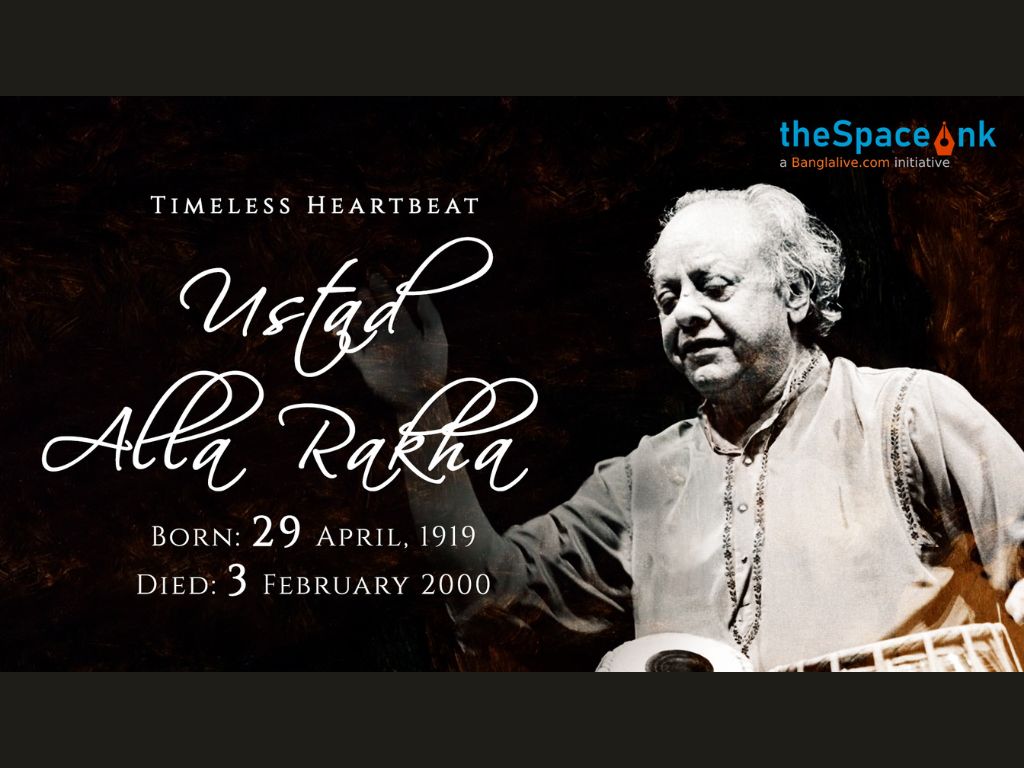
Timeless Heartbeat – Ustad Alla Rakha
Ustad Alla Rakha once said his tabla had a thousand tongues. He wasn’t joking – he could make the drums laugh, cry, argue, and even flirt. This village boy from Jammu performed at Woodstock, shared a stage with The Beatles, and turned a simple percussion instrument into a global superstar. Yet he started as a singer, not a drummer. And one of his most famous performances happened without any prior rehearsal.
He was born as Alla Rakha Qureshi in 1919. The village was Phagwal, in what is now Jammu and Kashmir. His family had little money but plenty of music. Young Alla Rakha would sneak into local gatherings just to hear the rhythmic patterns of folk songs.
As a child, he wanted to be a singer. He trained in vocal music under his uncle, a respected classical musician. For years, his dream was to become a great khayal vocalist. But fate had a noisy, percussive surprise in store.
A throat infection changed everything. In his teens, Alla Rakha lost his singing voice for months. Frustrated but restless, he turned to the tabla – the twin hand-drums that accompany most North Indian music. He never looked back.
Video: Dadasaheb Phalke: Birthday Tribute
He mastered the Punjab gharana style of tabla. This school is known for its powerful, open sounds and lightning-fast compositions. Under the legendary Mian Qadir Baksh, Alla Rakha turned technique into pure emotion. His fingers seemed to dance, not just drum.
His partnership with sitar maestro Ravi Shankar was legendary. For nearly three decades, the two toured the world as the dream team of Indian classical music. Their album “The Sounds of India” introduced Western ears to the magic of the tabla. Alla Rakha’s solos often stole the show.
In 1969, he played at the Woodstock festival. Half a million people had gathered for peace, love, and rock music. Then Ravi Shankar and Alla Rakha took the stage at midnight. The rain was pouring, but the crowd sat in stunned silence – listening to ancient rhythms in the middle of a countercultural revolution.
Alla Rakha called his tabla his “first wife.” He said this with a laugh, usually in front of his actual wife. His humor was legendary. Once, after a fan asked for an autograph, he scribbled a rhythm pattern and said, “Learn this first. Then we’ll talk.”
Video: Remembering Virginia Woolf’s A Room of One’s Own
He trained his sons, including the famous Zakir Hussain. Zakir was only three years old when his father began drilling him in rhythm. Alla Rakha was strict but loving. He once told Zakir, “The tabla is not an instrument – it is a way of listening to God.”
His playing could mimic human speech. He often demonstrated how the bols (spoken syllables of tabla) could form sentences. One famous phrase he loved to “say” on his drums was, “Why are you running away?” Audiences would laugh, then gasp. It sounded exactly like a real question.
The Indian government honoured him with the Padma Shri in 1977. By then, he had performed at the United Nations, the Royal Albert Hall, and even for the Shah of Iran. Yet he remained famously humble. When a journalist called him a genius, he replied, “The genius is the tabla. I just open the door.”
He died in 2000, but his rhythm never stopped. His son Zakir Hussain became a global icon, carrying his father’s legacy forward. Today, every time a tabla player makes the drums speak, laugh, or cry, they are echoing Ustad Alla Rakha – the man who gave a thousand tongues to two pieces of wood and skin.