

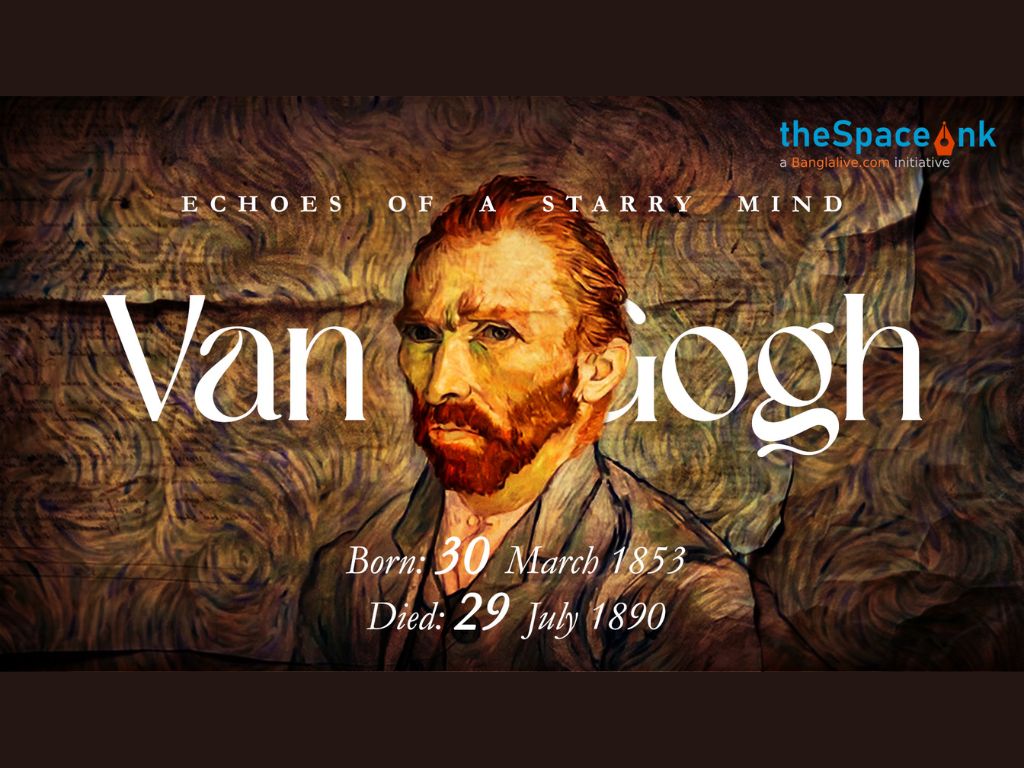
Echoes of a Starry Mind – Vincent van Gogh
The story of Vincent van Gogh is one of fire and fragility. We know him as the quintessential tortured artist, the guy who cut off his ear, the genius who painted The Starry Night. But behind the myth was a man of incredible sensitivity, fierce intelligence, and a work ethic so intense it quite literally consumed him. In just over a decade, he produced roughly 2,100 artworks. Let that sink in for a second: that’s nearly a new painting every other day for years. The man didn’t just paint; he erupted onto canvas.
Born on 30 March,1853,he didn’t pick up a paintbrush seriously until he was 27. Think about that. Most artists are grinding away in their teens. Vincent? He was floundering. He’d been an art dealer, a teacher, a bookseller, even a preacher in a poor mining district in Belgium. He got fired from that last job for being too passionate, for giving away his own clothes and living in a hut, which the church bigwigs found a little too radical. He was, from the very beginning, a man who felt things too deeply for this world.
Before he was an artist, Vincent was a man desperately searching for his purpose. He just wanted to serve humanity, you know? To mean something. That deep hunger for connection would eventually fuel every brushstroke. His early work is… well, it’s not pretty. It’s dark, gritty, muddy. He painted peasants, weavers, potato eaters. His first major piece, The Potato Eaters, is this unflinching, unglamorous portrait of a family huddled around their dinner table. It’s not about beauty; it’s about truth. It was his mission statement: to show life as it really was, in all its raw, imperfect glory.
Then, everything changed. He finally moved to Paris in 1886 to live with his little brother, Theo. And thank God for Theo, right? He supported Vincent financially and emotionally for his entire career. In Paris, Vincent’s world exploded with light. Suddenly, he’s introduced to the Impressionists—Monet, Pissarro—and his jaw just drops. His palette transforms overnight. The murky browns and greys of Holland vanish, replaced by screaming blues, electric yellows, and vibrant greens. It’s like someone turned the lights on in a dark room.
Video: Blue House Artist – Frida Kahlo
In February 1888, Vincent left the chaos of Paris for the bright, harsh light of Arles in the south of France. He had this dream, this beautiful, crazy dream: to start an artist’s colony. A “Studio of the South,” a creative utopia where he and his painter buddies could live and work together. He rented a little yellow house and started filling it with sunshine, painting sunflowers to decorate the walls for his hero, Paul Gauguin, who he hoped would come and lead this new brotherhood.
The intensity of his vision was matched by the intensity of his method. I mean, this guy painted like his hair was on fire. He’d chase the light, slapping on paint in thick, swirling mounds—impasto, they call it—so thick the paintings have texture, they have weight. He didn’t just paint a sunflower; he painted its whole life story: the vibrant bloom, the drooping head, the decaying petals. He believed color itself was a language. That specific, blazing yellow could actually mean something—the warmth of a friend, the joy of the southern sun.
It was during this fever dream of creativity that the most infamous incident of his life went down. Gauguin finally showed up, and spoiler alert: the “Studio of the South” was a disaster. These two titans, these incredibly stubborn artists, clashed violently. Their arguments were explosive. Then, on Christmas Eve, after a particularly nasty fight, Vincent snapped.
He followed Gauguin into the street with a razor. He didn’t attack him, but later, in a state of absolute psychic torment, he used that same razor to slice off part of his own left ear. And then—this is the part that gets me—he wrapped it up, took it to a woman at a local brothel, and just… handed it to her. A cry of pain wrapped in a piece of cloth.
In May 1889, Vincent voluntarily committed himself to the Saint-Paul-de-Mausole asylum in Saint-Rémy-de-Provence. He was suffering from what we now think was a mix of epilepsy, bipolar disorder—things they just didn’t understand back then. But here’s the incredible part: even locked up, even in the depths of his despair, they let him paint.
And from behind those barred windows, staring out at the night sky, he created some of the most transcendent art the world has ever known. It was there he painted The Starry Night—not just a picture of a village at night, but a vision of a living, breathing, swirling cosmos. It’s the sky as a feeling, not a fact.
Video: Brushstrokes of Brilliance – The Artistry of Jamini Roy
He spent the last two months of his life in a little village called Auvers-sur-Oise, north of Paris. And he worked like a man possessed. Over seventy paintings in as many days. His work from this period feels frantic, desperate, and massive. Paintings like Wheatfield with Crows show these vast, churning fields under stormy, emotional skies. The beauty is still there, absolutely, but it’s fragile. It feels like it could shatter at any second.
Vincent van Gogh died on July 29, 1890, from a gunshot wound. The official story is he shot himself in a field, though some now wonder if it was an accident. His last words, whispered to his beloved brother Theo, were, “The sadness will last forever.” And Theo, completely wrecked by Vincent’s death, died himself just six months later. Now they lie side-by-side in the same cemetery in Auvers, covered in ivy from Theo’s wife’s garden.
But in death, Vincent finally got what he craved most in life: connection. He sold maybe one or two paintings while he was alive. Today? His works go for nine, ten figures. They’re the treasures of the greatest museums on earth. He didn’t live to see it, but his letters show he knew what he was doing. He once wrote to Theo, “I am risking my life for my work, and my sanity has half foundered in it.” He knew the cost.
His life was a testament to the idea that you can find beauty anywhere, even in the depths of your own personal hell. Vincent van Gogh taught us to see the world not just as it is, but as it feels. He painted the very soul of things—the swirling life in a starry night, the defiant hope in a sunflower. He may have died believing he was a failure, but he left behind a legacy of pure, undiluted, blazing light.



One Response
Wonderfully crafted !!!