(Window)
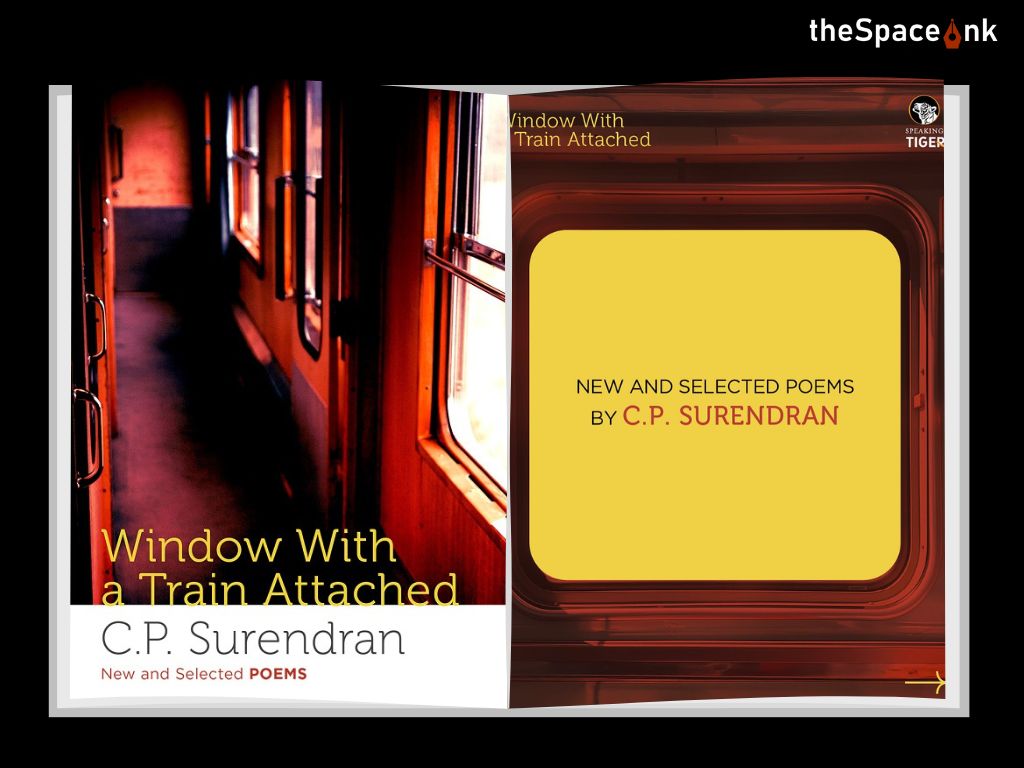
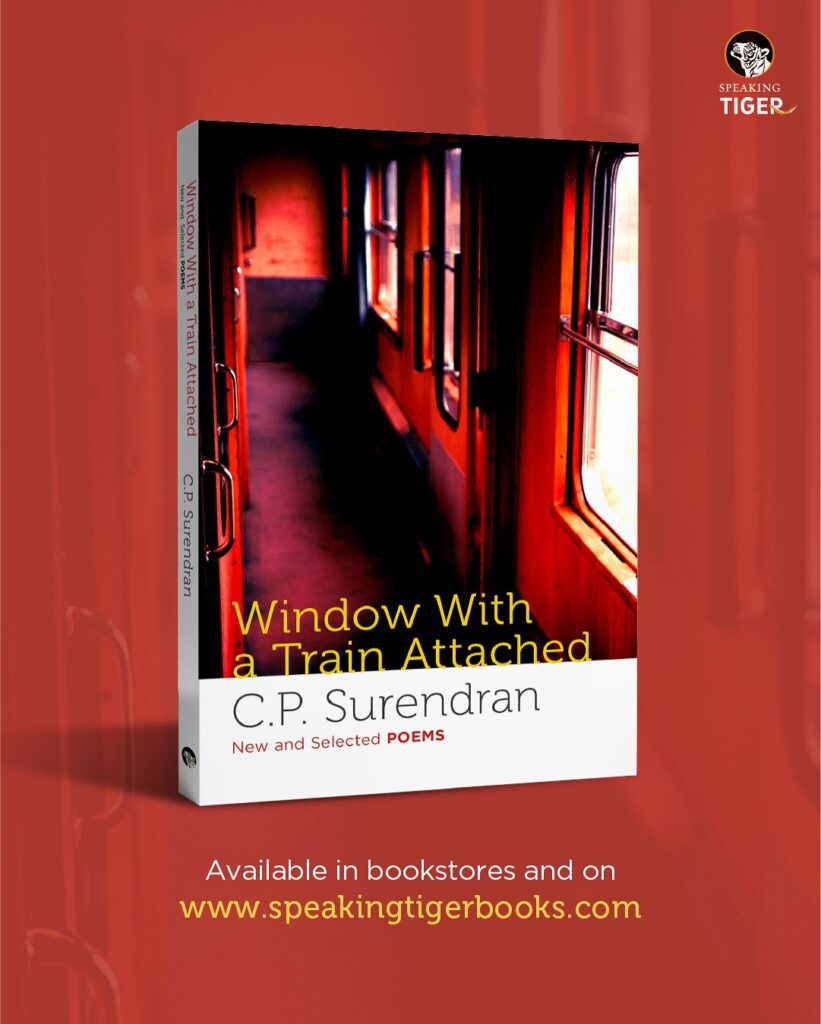
Title: Window With a Train
Author: C P Surendran
Language: English
Publisher: Speaking Tiger
No. of Pages: 152
Format: Paperback
Price: Rs 499
This remarkable collection by C P Surendran is an aesthetic, emotional and intellectual treat to a serious reader. Many poems in the collection appear as thunderbolts conveying themes of awe, destruction, and self-realization; poems depicting intense moments across many different domains of human existence and interaction with the inner and the outer world. The poems talk of memory, of loss, of trauma, of incompatible marriages, of the pointlessness of being, and much more, often generating a sort of chaos in the process of liberating various elements of the poetic experience. (Window)
The first part of the collection begins with a haiku titled Line reproduced below:
A line in my head swims, hooked through chin and eye,
Round and round and against the tide, gasping for a word
To explain why, shore to shore, the sea is freezing ink.
The three-line haiku serves as an anchor to the powerfully evocative and poignant collection. Many of the poems carry weighty thematic elements – some of these expressed in an apparently incongruous order (e.g., Conversation Over Abel) while others come in a more conventional style. The themes are varied and variegated in nature – bashful, bleak, and bold, depicting a constant tension between presence and absence, creation and destruction, beginning and end. (Window)
The subjects and themes are as unusual or unfamiliar as George the lonesome snail in Endling, or as commonplace as the destiny of a rock in its various shapes and forms between a weather-borne grain of sand and a timeless fossil in Rock. Themes as grim and grotesque as the scenes from the times of the pandemic in A Trip in the Time of the Virus; or as sensitive as the obituary of an activist who died in oblivion “on no one’s watch” in a “narrow room without a number” in The Death of an Activist. (Window)
Several poems relate to Biblical topics bringing to life ancient and largely forgotten cultural tropes and contexts. In them we find references to Kition — an ancient port city in Cyprus in Lazarus where the Biblical figure made his way to a second life, and to Lucina, the ancient Roman goddess of childbirth in The Day After. Or historical poems such as the quatrain Pari Mahal recalling (the severed head of) Dara Shikoh staring at his father in chains. (Window)
One of the most poignant and effective poems depicting childhood and nostalgia on the one hand and the painful memories associated with it on the other is Farewell to the Boy Who Was You as illustrated in these lines:
Now do you see? See in sleep the long corridor
Connecting the kitchen to the family folklore? (Window)
The poem depicts the poet’s farewell to the boy “who was afraid of school,” as expressed in the fear of the school bell still haunting him in his memory. (Window)
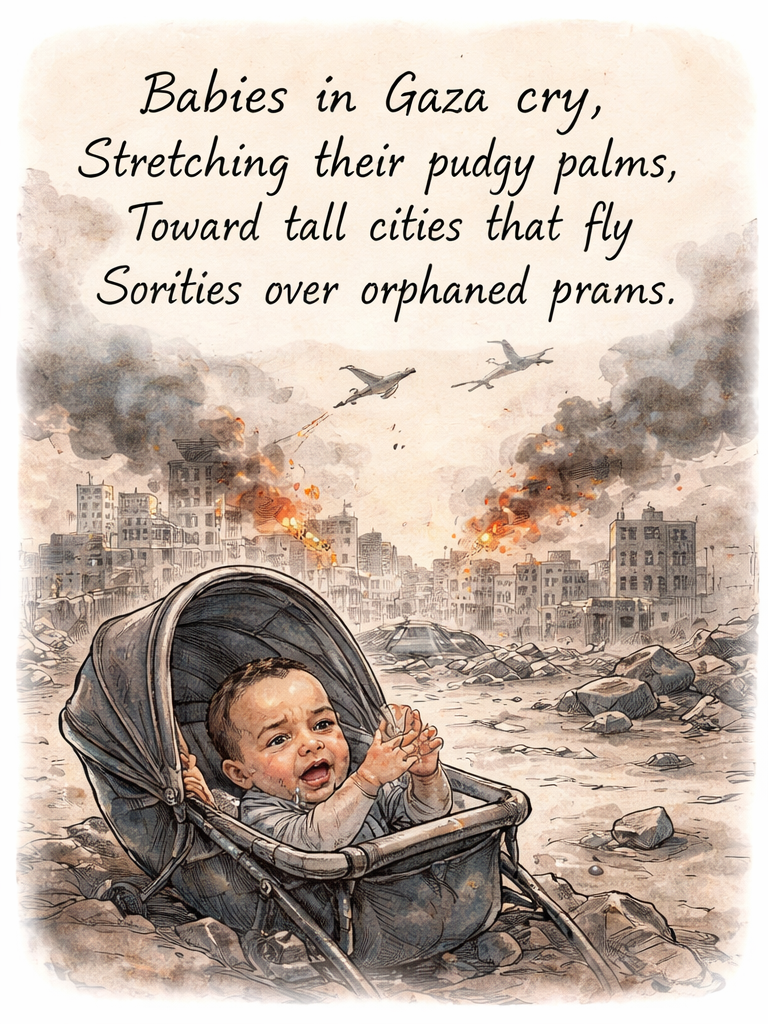
The poet is also aware of the present happenings around the world as illustrated by poems like Tabernacle documenting an ongoing humanitarian crisis while also placing it in a historical and cultural context:
“Babies in Gaza cry,
Stretching their pudgy palms,
Toward tall cities that fly
Sorties over orphaned prams.”
……
“Christ, at home among the nails,
Considers his apostles in the desert
In battalions armed and bent,
Collapses on the cross like a tent”
(from Tabernacle)
And then there is Deception, a poem in which the poet laments human apathy against a cat described thus:
Bebo, whose human eyes
Sensed something like love
In me. (Window)
One Love and The Many Lives of Osip B: Review by Sadaf Munshi
A similar sentiment is expressed in the quatrain Birds’ Paradise (Open 9 a.m. to 9 p.m.):
The shutters go up, and again the birds can see the sky.
At the price of one, you can buy two, the cage comes free.
They spread their wings, the span of their heart’s unease
At the one thing they are born to do, but cannot try. (Window)
In Duel, the poet expresses his fascination and playful interaction with a growing bougainvillea plant as illustrated by these lines:
There the bougainvillea mixes
The sun with flowers and leaves
Like the sherbet
That shadows drink. (Window)
And then there are satirical poems like Charlie’s People protesting caste and class inequalities and abuse, drudgery of the poor and working class, cruelty of patriarchy, and apathy of the political elite. (Window)
One of the most powerful devices that the poet employs with an extraordinary ease is visual symbolism. The poems illustrate a concatenation of deep and dazzling imagery and dense conceptual content, which is not only remarkable, but surprisingly unusual, embellished by beautiful poetic devices,
From a structural point of view, the collection offers a broad array of short and long poems in a variety of genres. Many of the poems are in loose, free-verse style, without employing a fixed meter, and yet they are true to their rhythm and musicality. Rhyme scheme in these poems, when employed, is subtle as is characteristic of the modern English verse form, with use of both internal and external rhyme as observed in the following excerpts:
The plant is a gun
Firing flowers
Into the sun.
(from Paradox of Intent)
The needle threads through your eyes.
I have sewn all that you have seen
Into a blindfold
From what the crows gave.
You wave it out of sight
From the other side of the grave. (Window)
(from Bridge)
The poem Roots in free verse deserves a special mention here. This poem is sculpted like a building with different compartments, tied together in a single unit with phrases that repeat themselves at different levels, creating a powerful impact. The poem depicts many levels of parallel patterning – both in its imagery as well as in structure and musicality. Below, I quote the opening lines around which the entire poem is woven; laid out like a table of contents or chapters of a book, each phrase in these lines is expanded as a subject of its own:
Dead night. Dead sea.
Dead friends. Dead I.
In comparison to the poems in free verse are the quatrains employing a meter and a consistent rhyme scheme (predominantly ABBA), besides their use of beautiful imagery and other poetic devices. I reproduce the following two quatrains here:
Reckoning
Oh, I know, as the hour-hands cross,
We will meet again down the same old lane,
Strangers, bound to wheelchair or cane,
Smiling at each other, nodding at a loss.
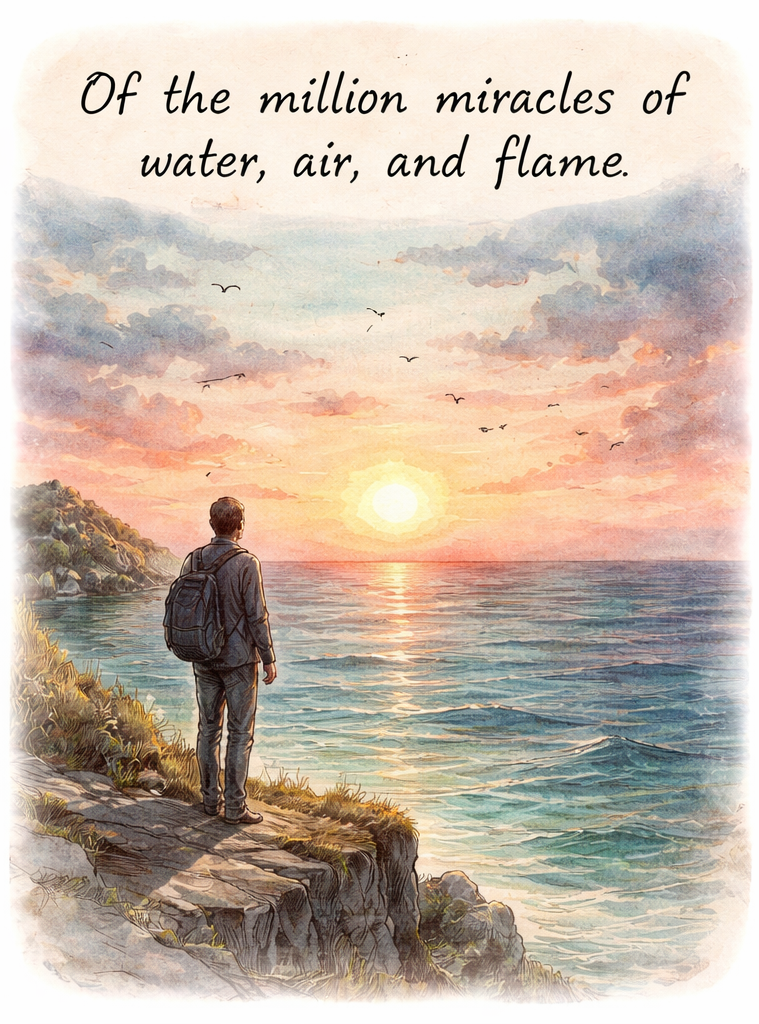
Memorabilia
Of the million miracles of water, air, and flame
As I step off the round earth’s one dark edge
Into the silence, I carry the unredeemed pledge,
The still echoing sound of your name. (Window)
The collection also includes prose poems, such as Return, narrative in tone, told like stories. Return, although prosaic, is packed with poetic metaphors, rhythm, imagery and parallel patterning characteristic of poetry. The prose poem is laden with beautiful expressions, witty metaphors and powerful imagery as illustrated in the following lines:
“This narrow road picks its way through puddles. The rain drops the sky at your feet.”
“At sunrise, she looks forward to her first flush of beauty. The sun sets in her unseeing eye.”
“The moss soft like silk to the sole. The river wrinkling the skin of the stone steps. The distant lamps across the river flitting like butterflies on the water.” (Window)
The 18th century Romantic poet of the English language, Coleridge argued in the Biographia Literaria that the imagination of the poet “dissolves, diffuses, dissipates, in order to recreate.” His contemporaries, such as Wordsworth, regarded the enterprise of poetry as the “work of defamiliarizing the familiar by freshening the visions.” The work of the poet, in Coleridge’s terms, was to release “wonder” from the “familiar.”
The poet adopts a remarkably powerful use of poetic devices such as alliteration as illustrated in the following line from the quatrain titled Garden:
“Voices in the garden fading in the same one-way wind”
Or these lines from the poem Lazarus:
The dead return dazed, heavy, dull as funeral bells.
There is life after death. We live it forgetful of our former selves. (Window)
A clever use of parallel patterning at multiple levels – sound, meaning and syntax, is seen in expressions such as “sacrifice and slaughter” in the quatrain titled April. (Window)
One of the most powerful devices that the poet employs with an extraordinary ease is visual symbolism. The poems illustrate a concatenation of deep and dazzling imagery and dense conceptual content, which is not only remarkable, but surprisingly unusual, embellished by beautiful poetic devices, as illustrated by the following lines from This Moth, This Lamp: (Window)
The scales on your wings are fallen from the eyes of a god, poorer
For his vision. What else explains the lamp, lit like a pyre? (Window)
Expressions such as “The skin stretched over words” or “In dimming eyes, golden pavilions rise | And fall in a cherry-red mist ||” (from Confessions of a Mask) and “The old male mango tree flowers, | Like a mistake, in the slow sun ||” (from Assembling Pointers to a Purpose) are exceptionally poetic. And then there are these beautiful lines from (separate sections of the poem) Self-Portrait with Bandaged Ear depicting powerful use of poetic imagery as well as poetic devices such as repetition and alliteration adding to the musicality of these verses:
“Marveling at your violet nights in South of France”
“Man and crow crowning infinite space, looking finally like themselves,
And not; wasted, but free, free like ringed fire.”
“The beauty of breath, clear and steaming, like pug marks in the snow.”
“the rasp, the rasp of a poor man’s wear”
“….like a jar collecting
And emptying yellow, yellow clouds”
“a battered ship passing from wreck to wreck”
“Iridescent crystals lighting up, like bulbs, the blue, blue deep.”
“Flecked out from the fissures of the burlap’s blank, blank face”
(from Self-Portrait with Bandaged Ear)
Notice the softness of tone in the following lines:
“What flowers were those? In their fragrance
Our hearts lifted.”
(from Sidewalk Art Plaza, Kalagoda)
“The ragged noon held in place
By the stitch-work of rain.”
(from Kit-Kat Prosthetics)
This softness of tone is in contrast with the levity and what could be deemed “distasteful” vocabulary in poems such as Charlie’s People that challenge the conventional concept of “poetic” as opposed to “nonpoetic” language. But then that is the point. The poem is a satire on certain distasteful realities of out time. Here is an excerpt:
In winter, they grill well-fed lambs painlessly in a garden fire,
Turning the kebabs round and round, wondering what to do when they retire
And furtively returning to the one truly enjoyable act of wrong
Of hanging Charlie upside down and striking a match to his fucking shlong.
A masterful use of metaphors is illustrated in the following excerpts:
“The back of the ears, the hutch of rumors;
Now a brushing of her wrist with withered lips,
Dry as a palimpsest’s kiss.”
“Once, when the house was haunted by those alive”
“Their liver soft as spotted bread.”
(from The Day After) (Window)
A very interesting poem in the collection that especially caught my attention is Taiga. Apparently inspired by T.S. Eliot’s (1920) poem Gerontion in which Jesus Christ is symbolically associated with the image of the tiger – a divergent image as opposed to the previously popular image of the lamb (See also William Blake’s famous (1825) poem The Tyger). Taiga is vivid in its descriptions of the animal which has lived and evolved over a million years. The tempo of this poem moves such that it creates a strong momentum, rising and then falling towards the end, with “eyes” as the focal point — both in terms of symbolism and strength. My favorite lines from this comparatively longer poem are the following:
“With eyes fixed on you, he hones
His claws a million years against the stone of time.”
“Taiga’s pug marks may be mistaken
For handprints of fate.”
“And through charred and broken rings that his body wears
Taiga has begun his long leap,
To put out his fire,
To set you alight with his kerosene eyes.”
The 18th century Romantic poet of the English language, Coleridge argued in the Biographia Literaria that the imagination of the poet “dissolves, diffuses, dissipates, in order to recreate.” His contemporaries, such as Wordsworth, regarded the enterprise of poetry as the “work of defamiliarizing the familiar by freshening the visions.” The work of the poet, in Coleridge’s terms, was to release “wonder” from the “familiar.” It is this “wonder” that we experience throughout Surendran’s powerful poetic and literary discourse. In this sense, he carries the legacy of many famous poets of the English language quite elegantly, often to a degree of awe and surprise. I conclude this piece with the title poem. (Window)
Window with a Train Attached
Lemon yellow speeds the world.
A fractured sun,
Restored late, sets
Along the edge
Of a knife sleeping
On the tray table.
Sit back.
Consider again the crack at the centre,
That draws blood from a sleep-walking thumb,
The jagged signature that light left when it tried, and failed to enter. (Window)
Image Courtesy: Facebook, AI

Dr. Sadaf Munshi is a US-based academic, writer and artist of Kashmiri-Indian origin, born and raised in Srinagar, where she completed her early education. She began her professional journey as a playwright for the state television Doordarshan in 1990’s while pursuing a Bachelor’s degree in Science. A deteriorating political situation in Kashmir forced her to leave her hometown. After completing an MA and an M.Phil. in Linguistics at the University of Delhi, she went to the United States to conduct doctoral research at the University of Texas at Austin. A person of multi-dimensional interests, Munshi has travelled extensively in India and Pakistan, besides other countries, studying language, music and culture. Munshi has published numerous social and political critiques and personal accounts on a wide range of topics related to language, society, culture, politics and gender. A polyglot and a poet, she writes in English, Urdu and Kashmiri. Some of her incisive pieces of satire were broadcast on the state television in Jammu & Kashmir. A self-taught visual artist and art critic, she has produced numerous pieces of art in oil, watercolor, and multimedia.