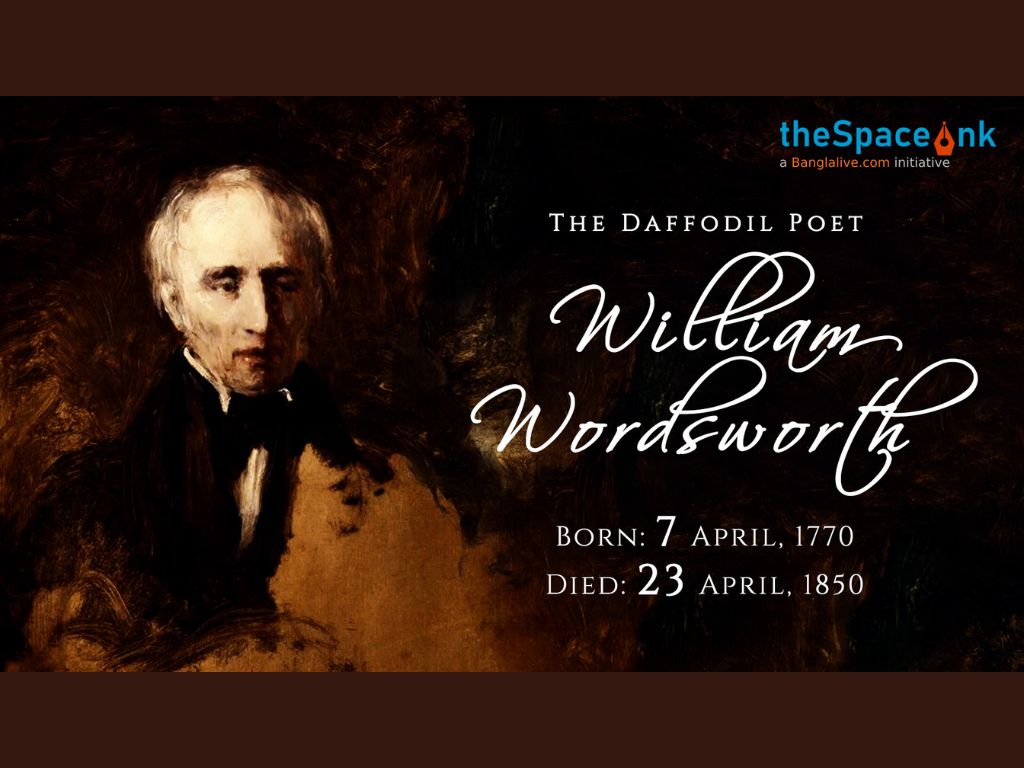
The Daffodil Poet: William Wordsworth
He was the man who looked at a field of daffodils… and quietly started a revolution.
William Wordsworth didn’t just write poetry. He changed how we see the world.
The original moody artist. A restless wanderer who strolled through revolutionary France like a casual backpacking trip. He lived with his sister Dorothy in a modest cottage by the lakes—the kind of closeness that made neighbours whisper. He hated the noise of cities and believed the only place worth writing was where you could hear the wind move through the grass.
In the end, he became Britain’s Poet Laureate—a conservative, almost grumpy figure—but the fire never left him. He spent his life proving nature wasn’t just scenery. It was soul medicine. He remains the undisputed patron saint of the countryside stroll.
Let’s go back to the beginning. 1770, The Lake District—those impossibly green fells and glassy waters that feel almost too beautiful to be real. That’s where William Wordsworth was born.
His childhood was shaped by loss. His mother died when he was seven. His father when he was thirteen. He and his beloved sister Dorothy were separated and passed between relatives. Yet the lakes and mountains never released him. The landscape became the true heart of nearly every poem he would write.
Video: Emily Brontë: A Soul of the Moors
His youth was wilder than most imagine.
In his twenties, he was a radical, swept up by the French Revolution. He crossed the Channel, fell deeply in love with Annette Vallon, and had a daughter with her. When war broke out between England and France, he was forced to leave them behind. Nearly ten years passed before he saw his daughter again. That kind of heartbreak rarely appears in the textbooks.
Broke and disillusioned, he returned to England. And that’s when everything changed.
He moved into a simple house with Dorothy. She kept luminous journals of daily life. “We saw a few daffodils,” she once wrote. William read her words, felt them deeply, and transformed them into poetry. That immortal line—“I wandered lonely as a cloud”—was born from Dorothy’s eyes and shaped by his voice.
Then came the spark that ignited English literature.
He met Samuel Taylor Coleridge. In 1798, they published Lyrical Ballads. While most poetry of the time was stiff and formal—about kings and ancient myths—Wordsworth wrote about ordinary people: lepers, old soldiers, grieving mothers—using the real language they spoke.
He declared poetry should be “the spontaneous overflow of powerful feelings.” It was a quiet rebellion against the stuffy literary world.
Video: Remembering Virginia Woolf’s A Room of One’s Own
Eventually, the radical settled. He married his childhood friend Mary Hutchinson. His politics softened, but his devotion to nature only grew deeper. For decades he worked on a vast autobiographical poem about his inner life and his sacred bond with the natural world. Published after his death, it became The Prelude—the first great work of confessional poetry.
By the end of his life, Wordsworth was a celebrity and Poet Laureate. Tourists flocked to the Lake District hoping to glimpse the old man walking his dog. The former firebrand had become a cantankerous elder who despised the new railways carving through his beloved countryside.
Yet his core message never changed: nature matters more than machines. Beauty outweighs industry.So why does he still matter in our frantic, screen-filled age?
We’re drowning in notifications and digital noise. Wordsworth reminded us that nature isn’t just pretty—it’s essential. A single walk in the woods can nourish the soul. Memories of golden daffodils can sustain us through darkness. He taught us that stopping to stare at flowers isn’t laziness. It’s a spiritual act.
When he died in 1850 at eighty, he left a world that now valued emotion, ordinary beauty, and the healing power of nature.
He made it okay to feel deeply. He made it okay to simply stop… and look. Every time you step outside, feel the wind, and feel that quiet urge to just be—that’s a Wordsworthian moment. He gave that feeling a name. And a home.