(Anton Chekhov)
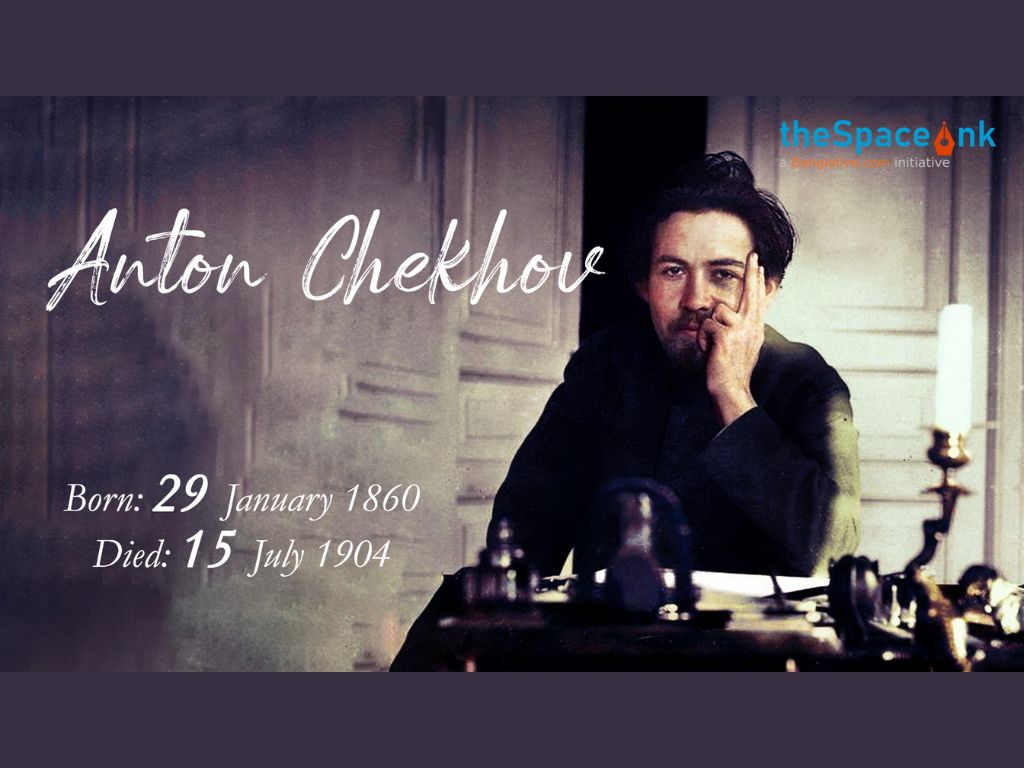
Anton Chekhov was a doctor who treated poor patients for free, a writer who called literature his mistress, and a philanthropist who built schools for children he would never meet. He famously quipped, “Medicine is my lawful wife, and literature is my mistress. When I get fed up with one, I spend the night with the other”. Despite dying of tuberculosis at just 44, he packed two brilliant careers into one short life, leaving behind some of the world’s most beloved plays and short stories.
He was born on January 29, 1860, in the port city of Taganrog, southern Russia. His grandfather had been a serf, and his father ran a small grocery store while directing the local church choir.
His childhood was marked by poverty and abuse. Chekhov later recalled his father’s tyranny, writing that he was thrashed with a birch rod and lived in daily fear of beatings. When his father went bankrupt in 1876, the family fled to Moscow, leaving the teenage Chekhov behind to sell their belongings and finish school.
Chekhov became a physician in 1884. He considered medicine his principal profession, but he made little money from it and often treated the poor without charge. To support himself and his family, he turned to the pen.
Video: Emily Brontë: A Soul of the Moors
He started writing to pay his tuition fees. While a medical student, he churned out daily humorous sketches and vignettes under silly pseudonyms like “Antosha Chekhonte”. This grind honed his eye for the absurdities of everyday Russian life.
His literary talent was soon recognized. In 1886, the esteemed writer Dmitry Grigorovich read one of his stories and wrote to Chekhov, praising his “real talent” and urging him to take his art more seriously. The letter struck Chekhov “like a thunderbolt” and spurred him to aim higher.
Chekhov’s play The Seagull initially flopped. Its 1896 premiere in St. Petersburg was a disaster, with the audience heckling the actors. However, two years later, Konstantin Stanislavski’s Moscow Art Theatre revived it to great acclaim, cementing Chekhov’s reputation as a revolutionary playwright.
He also devoted himself to philanthropy. At his country estate, Melikhovo, he built schools and hospitals for the poor. In his hometown, he supplied books for public libraries and funded educational institutions, all while keeping his charity private.
Video: Remembering Virginia Woolf’s A Room of One’s Own
In 1890, he journeyed to a remote penal colony. Chekhov traveled across Siberia to the Sakhalin Island prison camp, where he spent three months interviewing thousands of convicts and documenting the horrific conditions. The resulting book, The Island of Sakhalin, shocked Russian society and fueled prison‑reform efforts.
Chekhov married actress Olga Knipper in 1901. Olga had performed in his plays at the Moscow Art Theatre, and their marriage, though cut short by his illness, was a deep partnership.
He died of tuberculosis in 1904. By then, his health had long been failing; he had first coughed blood in 1884 but kept his condition secret for years. He died in a German spa town at the age of 44.
His works remain classics today. Plays like Uncle Vanya, Three Sisters, and The Cherry Orchard are staples of world theatre, and his short stories are masterpieces of the form. Chekhov’s influence—his “gun” principle, his subtle realism, his compassionate eye—shapes how we tell stories even now.